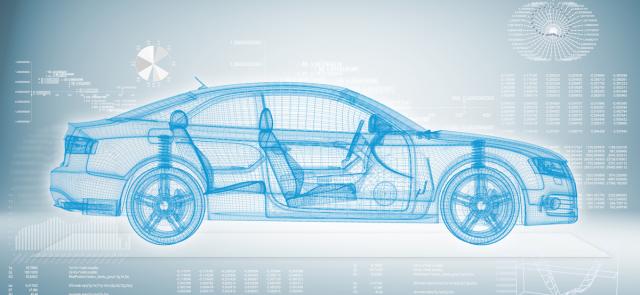
Vehicle Dynamics III: Vertical oscillations (iversity)

Vehicle Dynamics III: Vertical oscillations (iversity)

From Bugatti Veyron to Volkswagen Beetle, from racing to passenger car: Learn how they behave on a country road and on the autobahn! In this third part of Vehicle Dynamics, we will illuminate the vertical dynamic aspects of vehicles. In short, we will describe the elements involved when a car drives on a bumpy or rough street.

We will start with a survey of suspensions and springs and dampers. After this, we will explain the description of rough streets and give an introduction to Fourier integrals. Next, we will take a closer look at vertical models. In the last fundamental part of the course, we will describe the conflict between driving safety and comfort. The course will be finished with two applications from automotive mechatronics.
At the end of the course you will …

  • know different kinds of suspensions, springs and dampers.
  • know the description of rough and bumpy streets
  • understand the Fourier integral
  • understand the conflict between driving safety and comfort
  • be able to calculate simple properties of a car

Course structure

This course has a total of 11 chapters, and the topics for each chapter are the following:
Chapter 1: Overview
Chapter 2: Damped Oscillator
Chapter 3: Fourier integral
Chapter 4: Conflict: Comfort vs. Safety I
Chapter 5: Conflict: Comfort vs. Safety II
Chapter 6: Ideal active system and skyhook damper principle
Chapter 7: Vibration absorber in powertrains
Chapter 8: Models and nonlinearities
Chapter 9: Homework solutions of chapter 1, 2 and 3
Chapter 10: Homework solutions of chapter 4, 5 and 6
Chapter 11: Homework solutions of chapter 7 and 8
Go to Class
MOOC List is learner-supported. When you buy through links on our site, we may earn an affiliate commission.

Related Courses

Ethics in Engineering (Coursera) Coursera
University of Michigan

Ethics in Engineering (Coursera)

e.g. This is primarily aimed at first- and second-year undergraduates interested in engineering or science, along with high school Explore unique case studies in engineering ethics. On this four-week course, you’ll examine different historical case studies and understand how they led to classic engineering failures. Though each case is unique and has a distinct context, they all share common themes; a backstory, a disastrous event, a post-event with ramifications, and outcomes.

Sep 21st 2026
4 Weeks
Introduction to Engineering Mechanics (Coursera) Coursera
Georgia Institute of Technology

Introduction to Engineering Mechanics (Coursera)

This course is an introduction to learning and applying the principles required to solve engineering mechanics problems. Concepts will be applied in this course from previous courses you have taken in basic math and physics. The course addresses the modeling and analysis of static equilibrium problems with an emphasis on real world engineering applications and problem solving.

Sep 21st 2026
5-12 Weeks
Project Management of Engineering Projects: Preparing for Success (edX) EdX
Delft University of Technology,DelftX

Project Management of Engineering Projects: Preparing for Success (edX)

Create your own project plan and learn the importance of the early project phases in achieving project success. People are key! Are you a (project) engineer with a technical background but lack management knowledge? Are you eager to improve project performance and want to expand your knowledge? This business and management course will focus on the necessary project management skills to successfully manage projects.

Sep 24th 2026
5-12 Weeks
Modelling and Simulation using Simulink (iversity) Iversity
Hochschule RheinMain - Wiesbaden Rüsselsheim

Modelling and Simulation using Simulink (iversity)

Do you want to use Simulink® to simulate technical systems? Do you want to control real systems using an Arduino® microcontroller? Then this MOOC's for you. Enrol today! The main objective of this MOOC is to teach you how to use of Simulink® as a simulation tool suitable for a broad variety of application domains. We will specifically focus on topics of interaction of the simulation models with the real world using Arduino Microcontrollers and Simulink®'s corresponding Arduino Support Package.

No sessions available
5-12 Weeks
Diversity and inclusion in the workplace (Coursera) Coursera
ESSEC Business School

Diversity and inclusion in the workplace (Coursera)

Diversity is a fact. It is also paradoxical. We need to be capable of seeing and hearing differences in order to reap the benefits of diversity. But seeing and hearing differences hone our discriminating reflexes and can also lead to discrimination. If you take this MOOC, you will: 1. understand this paradox, 2. understand its dynamics, and 3. identify ways to manage it, so that you can better channel the diversity potential in the workplace for greater performance and innovation.

Sep 14th 2026
4 Weeks
Rigid Body Dynamics (Coursera) Coursera
Korea Advanced Institute of Science and Technology - KAIST

Rigid Body Dynamics (Coursera)

This course teaches dynamics, one of the basic mechanics subjects of Mechanical Engineering. Students would be able to organize their knowledge about force and motion, work-energy, impulse-momentum in view of Newton's 2nd law and its integration over time and displacement. The Engineering Dynamics consists of two parts: particle dynamics and rigid body dynamics. This is the second part of the dynamics: rigid body dynamics.

Sep 14th 2026
13-24 Weeks
Nanotechnology: A Maker’s Course (Coursera) Coursera
Duke University,University of North Carolina,North Carolina State University

Nanotechnology: A Maker’s Course (Coursera)

How can we create nano-structures that are 10,000 times smaller than the diameter of a human hair? How can we “see” at the nano-scale? Through instruction and lab demonstrations, in this course you will obtain a rich understanding of the capabilities of nanotechnology tools, and how to use this equipment for nano-scale fabrication and characterization.

Sep 7th 2026
5-12 Weeks
Oral Communication for Engineering Leaders (Coursera) Coursera
Rice University

Oral Communication for Engineering Leaders (Coursera)

Taught by Rice University communication faculty from the Rice Center for Engineering Leadership (RCEL). This course covers core topics in oral communication: Communication strategy, content, data visualization, and delivery. You’ll learn key principles in: Creating a communication strategy; Developing a clear message and organizing persuasive content; Creating strong visual support; Presenting data effectively; Presenting professionally and confidently; Handling formal presentations, giving pitches, speaking extemporaneously, managing online presentations, and lowering public speaking anxiety.

Sep 21st 2026
5-12 Weeks
Fundamentals of Engineering Exam Review (Coursera) Coursera
Georgia Institute of Technology

Fundamentals of Engineering Exam Review (Coursera)

The purpose of this course is to review the material covered in the Fundamentals of Engineering (FE) exam to enable the student to pass it. It will be presented in modules corresponding to the FE topics, particularly those in Civil and Mechanical Engineering. Each module will review main concepts, illustrate them with examples, and provide extensive practice problems.

Sep 7th 2026
5-12 Weeks
Interpersonal Communication for Engineering Leaders (Coursera) Coursera
Rice University

Interpersonal Communication for Engineering Leaders (Coursera)

This course covers communication skills that engineering leaders use every day to motivate, inspire, and support the people in their organizations. Speaking and writing are basic leadership communication skills. (We covered these topics in the Specialization course 1 and 3.) However, leaders also need to be skillful interpersonal communicators.

Sep 14th 2026
4 Weeks
Industrial Biotechnology (Coursera) Coursera
University of Manchester

Industrial Biotechnology (Coursera)

Fossil fuels have been the primary energy source for society since the Industrial Revolution. They provide the raw material for the manufacture of many everyday products that we take for granted, including pharmaceuticals, food and drink, materials, plastics and personal care. As the 21st century progresses we need solutions for the manufacture of chemicals that are smarter, more predictable and more sustainable.

Sep 7th 2026
5-12 Weeks