Toledo: Deciphering Secrets of Medieval Spain (Coursera)

Toledo: Deciphering Secrets of Medieval Spain (Coursera)

This course evaluates the medieval history of Toledo from the era of the Visigoth Kingdom (6th-8th centuries) through its Islamic period (8th to 11th centuries) and into its reintegration into Christian Spain (after 1085 c.e.) In particular, we take note of the cultural and religious transformations that characterized the city with a special effort to understand how many peoples and religions came to settle and live amongst one another.

Class Deals by MOOC List - Click here and see Coursera's Active Discounts, Deals, and Promo Codes.

We will virtually-tour the Islamic and Christian structures of the Museo de Santa Cruz, Iglesia de San Román, Sinagoga del Tránsito, Mezquita de Bab al-Mardum, Archivo Municipal de Toledo, and the Archivo Historico de la Nobleza.
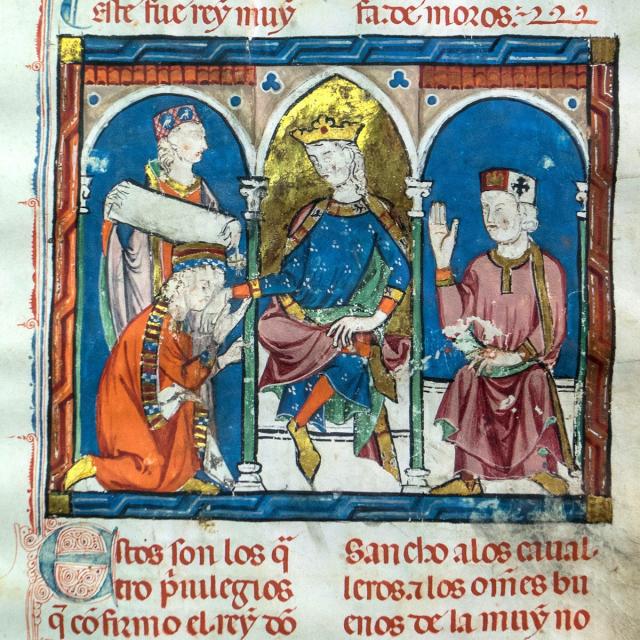
We examine the Visigoths transition from Christian Arianism to Catholicism and the harsh treatment of the Jewish population. We explore Islamic governance and development of the medieval city of three faiths, with a special interest in its cultural achievements. We will study King Alfonso “The Wise” (1252-1284)’s efforts to characterize himself as the “king of three religions” via his legal codices, the creation of the Cantigas de Santa María, and his intellectual endeavor known as the Toledo School of Translators. We evaluate the robust Jewish and converso noble families of the city and appreciate their intellectual, religious, and economic contributions to Castilian life. We will bear witness to the rise of anti-Jewish blood purity statutes, the creation of the Inquisition, and the expulsion of the Jews. We also briefly introduce and study Spanish manuscripts from the municipal and cathedral archives to make new scholarly breakthroughs relating to the Jewish, Christian, and Muslim interrelations.
No knowledge of Spanish is needed to participate in the course or in our transcription efforts.

Syllabus

Week 1
Course Introduction and an Abbreviated History
We start with a course introduction and an abbreviated history of ancient and medieval roots of the city of Toledo. This includes an introduction to medieval Europe, the Byzantine Empire, and the Islamic word.. We also explore the Visigothic Kingdom that called the city of Toledo its capital.

Week 2
Jews, Christians, and Muslims in Medieval Toledo Until 1212 CE
This week we study Jews, Christians, and Muslims in Medieval Toledo until 1212 CE. We will witness the Islamic conquest of Visigothic Spain, the formation of Islamic al-Andalus, the birth of the Christian Reconquest, and Toledo under the Umayyads and as an independent taifa ("party kingdom"). We will also explore Islamic architecture at the Museo de Santa Cruz as well as other local sites.

Week 3
Jews, Christians, and Muslims in Medieval Toledo After 1212 CE
This week we study Jews, Christians, and Muslims in Medieval Toledo and in the broader Iberian Peninsula. We will evaluate the rule of Castilian King X "The Wise" and his legal codes and the Cantigas de Santa Maria. We will also visit the Museo Sefardi and consider how "cleanliness of blood" statutes impact recent converts to Christianity (conversos).

Week 4
Introduction to Archives and Paleography
This week we begin with two visits to archives in Toledo -- the Archivo Municipal de Toledo and the Archivo Historico de la Nobleza (formerly the Archivo Historico Nacional-Seccion Nobleza). Subsequently, our manuscript studies begin with 13th through 19th century paleography (learning to read older forms of handwriting.)
Introduction to Archives and Paleography: Lesson Choices

Week 5
The SILReST Paleography Method for 15th Century Manuscripts
This week we advance our paleographic training by studying and practicing using the SILReST Paleography Method for deciphering the most challenging manuscripts.

Week 6
The Global Team at Work: Transcription & Interpretation Project
During this class, not only will you be mastering your paleography skills, but we will also begin our work as Global Citizen Scholars as we, first, work collectively and, second, independently to transcribe a collection of medieval manuscripts pertaining to Jewish, Christian, and Muslim life in Toledo.
The Global Team at Work: Transcription & Interpretation Project: Lesson Choices

Go to Class
MOOC List is learner-supported. When you buy through links on our site, we may earn an affiliate commission.

Related Courses

Structuring Values in Modern China (Coursera) Coursera
The Chinese University of Hong Kong

Structuring Values in Modern China (Coursera)

This sequence of four courses will propose a multi-disciplinary approach to the study of Chinese cultural history conceived of as a succession of modes of rationality (philosophical, bureaucratic, and economic). The focus will be on the moments of paradigm shift from one mode of rationality to another. For each of these moments, cultural facts and artifacts—thought, literature, ritual—will be examined in relationship to changing social, political, and economic systems.

Jun 22nd 2026
5-12 Weeks
Film, Images & Historical Interpretation in the 20th Century: The Camera Never Lies (Coursera) Coursera
University of London,Royal Holloway, University of London

Film, Images & Historical Interpretation in the 20th Century: The Camera Never Lies (Coursera)

This course is a short taster on the topic of the use of Images, Film, and their use in historical interpretation in the 20th century. It is primarily provided for those who have a general interest in history that draws on photojournalism as primary evidence, and films based on historical events.

Jun 15th 2026
5-12 Weeks
The Emergence of the Modern Middle East - Part II (Coursera) Coursera
Tel Aviv University

The Emergence of the Modern Middle East - Part II (Coursera)

This course will discuss the developments in the Middle East from the early 20th century to the present. It will discuss the rise and retreat of Arab nationalism, the problems of internal cohesion of the Arab states, issues of religion and state, and the evolution of Islamist politics. It will also focus on the evolution of the Arab-Israeli conflict and its impact on the region and will conclude with an in depth analysis of the “Arab Spring” by placing these contemporary revolutionary events in their historical context.

Jun 15th 2026
5-12 Weeks
Plagues, Witches, and War: The Worlds of Historical Fiction (Coursera) Coursera
University of Virginia

Plagues, Witches, and War: The Worlds of Historical Fiction (Coursera)

A unique and exciting introduction to the genre and craft of historical fiction, for curious students, aspiring authors--anyone with a passion for the past. Read classics of the genre, encounter bestselling writers of historical fiction, and discover your own historical archive while interacting with a global community of interested readers.

Jun 22nd 2026
5-12 Weeks
Magic in the Middle Ages (Coursera) Coursera
University of Barcelona

Magic in the Middle Ages (Coursera)

Magical thought has always attracted human imagination. In this course we will introduce you to the Middle Ages through a wide conception of magic. Students will have an approach to medieval culture, beliefs and practices from the perspective of History and History of Science. Popular magic, as well as learned magic (alchemy, geomancy and necromancy) will be addressed. Moreover, we will also deal with how eastern practices and texts influenced western culture. In July 2016, the course will contain a brand-new module devoted to astrology. Magic in the Middle Ages offers a captivating overview of medieval society and promotes reflection about certain stereotypes associated with this period.

Jun 22nd 2026
5-12 Weeks
Journey of the Universe: The Unfolding of Life (Coursera) Coursera
Yale University

Journey of the Universe: The Unfolding of Life (Coursera)

Journey of the Universe weaves together the discoveries of the evolutionary sciences together with humanities such as history, philosophy, art, and religion. The course draws on the Emmy-award winning film, Journey of the Universe, and the book from Yale University Press. Journey explores cosmic evolution as a creative process based on connection, interdependence, and emergence. It examines a range of dynamic interactions in the unfolding of galaxies, Earth, life, and human communities. It investigates ways in which we understand evolutionary processes and the implications for humans and our ecological future.

Jun 22nd 2026
5-12 Weeks
The Final Solution to the Jewish Question (Coursera) Coursera
Yad Vashem

The Final Solution to the Jewish Question (Coursera)

The "Final Solution to the Jewish Question" was the official code name used by Nazi German authorities for the planned annihilation of Jews during World War II. This course focuses on the origins, evolution, and implementation of this deadly operation which led to the murder of six million Jews by the Nazis and their collaborators.

Jun 22nd 2026
5-12 Weeks
The Changing Landscape of Ancient Rome. Archaeology and History of the Palatine Hill (Coursera) Coursera
Sapienza University of Rome

The Changing Landscape of Ancient Rome. Archaeology and History of the Palatine Hill (Coursera)

Studying ancient - as well as medieval or modern - cities basically means telling local urban stories based on the reconstruction of changing landscapes through the centuries. Given the fragmentary nature of archaeological evidence, it is necessary to create new images that would give back the physical aspect of the urban landscape and that would bring it to life again. We are not just content with analyzing the many elements still visible of the ancient city.

Jun 22nd 2026
5-12 Weeks
Søren Kierkegaard - Subjectivity, Irony and the Crisis of Modernity (Coursera) Coursera
University of Copenhagen

Søren Kierkegaard - Subjectivity, Irony and the Crisis of Modernity (Coursera)

In this course created by former associate professor at the Søren Kierkegaard Research Centre, Jon Stewart, we will explore how Kierkegaard deals with the problems associated with relativism, the lack of meaning and the undermining of religious faith that are typical of modern life. His penetrating analyses are still highly relevant today and have been seen as insightful for the leading figures of Existentialism, Post-Structuralism and Post-Modernism.

Jun 22nd 2026
5-12 Weeks