Supply Chain Management: A Learning Perspective (Coursera)

Supply Chain Management: A Learning Perspective (Coursera)

As a human being, we all consume products and/or services all the time. This morning you got up and ate your breakfast, e.g., eggs, milk, bread, fresh fruits, and the like. After the breakfast, you drove your car to work or school. At your office, you used your computer, perhaps equipped with 27” LCD monitor. During your break, you drank a cup of coffee and played with your iPhone. So on and so forth. You probably take it for granted that you can enjoy all of these products. But if you take a closer look at how each of these products can be made and eventually delivered to you, you will realize that each one of these is no short of miracle.

Class Deals by MOOC List - Click here and see Coursera's Active Discounts, Deals, and Promo Codes.

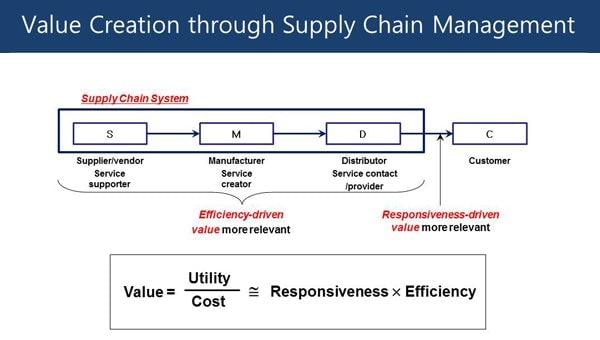
For example, which fruit do you like? Consider fresh strawberries. In order for the strawberries to be on your breakfast table, there must be numerous functions, activities, transactions, and people involved in planting, cultivating, delivering, and consuming strawberries. Moreover, all of these functions, activities, transactions, and people are connected as an integral chain, through which physical products like strawberries themselves and virtual elements such as information and communication flow back and forth constantly. By grouping related functions or activities, we have a supply chain, comprised of four primary functions such as supplier, manufacturer, distributor, and finally consumer. A supply chain is essentially a value chain.
For the society or economy as a whole, the goal is to maximize value, i.e., to create satisfactory value without spending too much. In order to create the maximum value for the strawberry supply chain, every participant in the chain must carry out its function efficiently. In addition, all of the members must coordinate with each other effectively in order to ensure value maximization. We have to face the same issues for almost all the products and services we take for granted in our everyday life, e.g., cars, hamburgers, haircuts, surgeries, movies, banks, restaurants, and you name it!
In this course, we want to understand fundamental principles of value creation for the consumers or the market. We try to answer questions like how the product or service is made, how the value-creating activities or functions are coordinated, who should play what leadership roles in realizing all these, and so on. As our course title hints, we approach all of these issues from a learning perspective, which is dynamic in nature and emphasizes long-term capability building rather than short-term symptomatic problem solving.

Syllabus

WEEK 1
Re-opening Introduction
In this chapter, Professor Bowon Kim briefly introduces students to this course. It is about philosophical and moral foundation of a supply chain management.

WEEK 2
Introduction to Value, Value Creation, and Supply Chain Management
In this chapter, we will learn what a supply chain is, what supply chain management is all about, and why it is important to grasp the fundamentals of supply chain management in creating real value for the customers.

WEEK 3
Management Capability
Effective SCM requires the firm to have strong operations capabilities. One can group various operations capabilities into three representative capabilities: Controllability, flexibility, and integrating capability. In order to be competitive in the market, the firm must retain high levels of these capabilities. In this chapter, we will discuss what the management capabilities are and the relationship among these capabilities.

WEEK 4
Learning Perspective
Learning is an essential part of any creative activity. In this chapter, we will learn what the learning capability is and its dynamics in supply chain management. We will also look into the learning propensity model and how the learning processes influence the performance of a supply chain system.

WEEK 5
Quality Management
Quality is one of the most important factors that determine the utility. That is, the higher the quality, the larger the utility experienced by the customer. But, quality is not a one-dimensional concept. In fact, it is a highly complex, multi-layered one. In this chapter, we will explore this complex concept, 'Quality'. We will learn dimensions of quality, total quality management (TQM), quality dynamics and statistical process control (SPC) in detail.

WEEK 6
New Product Innovation
New product innovation is the key to firm's success. In order to sustain successful business, the firm must design and manage its new product process effectively and efficiently. In this chapter, we will learn new product innovation and new product development process. Especially, we will look into and compare two approaches, traditional approach and cross-functional approach.

WEEK 7
Supply Chain Strategy I: Structural and Infrastructural Dimensions
In order to optimize the supply chain performance, the firm must design its supply chain effectively. In this chapter, we will talk about how to design the effective supply chain and look into the designing factors of supply chain management in detail.

WEEK 8
Supply Chain Strategy II: Coordination for Value Creation
Coordination is the key dimension of infrastructure in supply chain management. In this chapter, we will talk about what supply chain coordination is and why it is important. And we will learn vendor-managed inventory (VMI) and postponement in detail.

WEEK 9
Supply Chain Globalization and Sustainability
Why is the effective SCM important for the firm to gain competitive advantage in the global market? In this chapter, we will consider crucial issues related to the question and deal with global supply chain management and value chain sustainability.

WEEK 10
Final Exam

Go to Class
MOOC List is learner-supported. When you buy through links on our site, we may earn an affiliate commission.

Related Courses

Supply Chain Analytics Essentials (Coursera) Coursera
Rutgers University

Supply Chain Analytics Essentials (Coursera)

In this introductory course to Supply Chain Analytics, I will take you on a journey to this fascinating area where supply chain management meets data analytics. You will learn real life examples on how analytics can be applied to various domains of a supply chain, from selling, to logistics, production and sourcing, to generate a significant social / economic impact.

Oct 5th 2026
4 Weeks
A Business Approach to Sustainable Landscape Restoration (Coursera) Coursera
Erasmus University Rotterdam

A Business Approach to Sustainable Landscape Restoration (Coursera)

Integrated landscape management and large-scale landscape restoration should be in every company’s business strategy because in order to reach the Sustainable Development Goal on Land Degradation Neutrality (SDG Number 15.3) scaling up and acceleration of business-driven landscape restoration is urgently needed.

Oct 5th 2026
5-12 Weeks
Climate Change and Water in Mountains: A Global Concern (Coursera) Coursera
University of Geneva

Climate Change and Water in Mountains: A Global Concern (Coursera)

What is climate change? How are mountain regions affected by the evolution of water resources and their uses? What kind of risks need to be considered? Mountains are recognized as particularly sensitive physical environments where intense and rapid changes have in the past, and may increasingly in the future, place pressure on their resource base.

Oct 5th 2026
5-12 Weeks
Discover Best Practice Farming for a Sustainable 2050 (Coursera) Coursera
University of Western Australia

Discover Best Practice Farming for a Sustainable 2050 (Coursera)

The Discover Best Practice Farming for a Sustainable 2050 Course is based on a clear vision: imagine best practice farming for 2050, start to implement these strategies now, all the while making sure it will still be profitable. At UWA we're doing just that with the Future Farm 2050 Project, set on a mixed-enterprise farm in Western Australia and we want you to learn how it can be done in your part of the world.

Oct 5th 2026
5-12 Weeks
Introducción a la Gestión de Operaciones (Coursera) Coursera
Wharton School of the University of Pennsylvania

Introducción a la Gestión de Operaciones (Coursera)

Aprende a analizar y a mejorar los procesos empresariales en servicios o en la industria. Aprende cómo incrementar la productividad y a ofrecer niveles de calidad mayores. Después de que finalices con éxito este curso, podrás aplicar estas habilidades en un reto empresarial del mundo real como parte de la Programa Especializado de Fundamentos Empresariales de Wharton.

Oct 5th 2026
4 Weeks
Teaching Science at University (Coursera) Coursera
University of Zurich

Teaching Science at University (Coursera)

This course will prepare you for teaching science in higher education. In this MOOC you will learn to make your knowledge as an excellent researcher accessible to your students. We will show you how to communicate science to novices as well as advanced students in science.

Oct 12th 2026
5-12 Weeks
Negotiation Fundamentals (Coursera) Coursera
ESSEC Business School

Negotiation Fundamentals (Coursera)

This course gives you access to negotiation practical tools and best practices gathered by Professor Aurélien Colson & his team from assignments in more than seventy countries and in a wide set of sectors, be they services, industry, high tech, or public organizations. In an interactive manner, this course will help you, among other topics: get prepared for any negotiation; avoid traps; know how to prompt value-creating partnerships; structure an effective negotiation sequence; bargain in an efficient and respectful manner; overcome deadlocks; and much more!

Oct 5th 2026
4 Weeks
Ecosystem Services: a Method for Sustainable Development (Coursera) Coursera
University of Geneva

Ecosystem Services: a Method for Sustainable Development (Coursera)

Ecosystem services are a way of thinking about – and evaluating – the goods and services provided by nature that contribute to the well-being of humans. This MOOC will cover scientific (technical), economic, and socio-political dimensions of the concept through a mix of theory, case-studies, interviews with specialists and a serious-game.

Oct 5th 2026
5-12 Weeks
Engaging ELLs and Their Families in the School and Community (Coursera) Coursera
Arizona State University

Engaging ELLs and Their Families in the School and Community (Coursera)

In this course, you will learn how to better and more successfully engage your ELL(s) and their families in the school and community. You will learn how to engage your ELL student in the classroom setting as well as in various aspects of the school including extracurricular activities and the inner workings of the school and education system. You will also be introduced to strategies for engaging the families of your ELL students in the school community and the wider community of your city and state.

Oct 5th 2026
5-12 Weeks
Digital Product Management: Modern Fundamentals (Coursera) Coursera
University of Virginia

Digital Product Management: Modern Fundamentals (Coursera)

Not so long ago, the job of product manager was about assessing market data, creating requirements, and managing the hand-off to sales/marketing. Maybe you’d talk to a customer somewhere in there and they’d tell you what features they wanted. But companies that manage product that way are dying. Being a product person today is a new game, and product managers are at the center of it. Today, particularly if your product is mostly digital, you might update it several times a day. Massive troves of data are available for making decisions and, at the same time, deep insights into customer motivation and experience are more important than ever.

Oct 5th 2026
4 Weeks