Software Engineering: Implementation and Testing (Coursera)

Software Engineering: Implementation and Testing (Coursera)

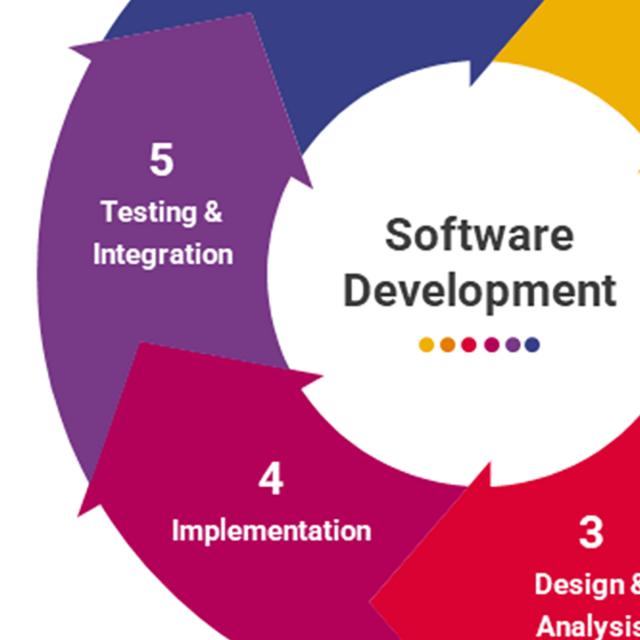
Software Development Life Cycle (SDLC) is the process of developing software through planning, requirement analysis, design, implementation, testing, and maintenance. This course focuses on the implementation and testing phases of SDLC, and you will examine different software development processes for large software systems development, and understand the strengths (pros) and weaknesses (cons) of different software development processes.

Class Deals by MOOC List - Click here and see Coursera's Active Discounts, Deals, and Promo Codes.

You will also encounter defensive programming techniques to prevent software bugs during implementation, and learn how to test your system thoroughly using different types of test cases.
Basic object-oriented programming (OOP) concepts are required for topics covered in defensive programming and object-oriented testing. Implementation is driven by the UML models derived from requirement analysis. It is recommended to take the course "Software Engineering: Modeling Software Systems using UML" before attempting this course, but it is not a hard requirement.
Course 2 of 3 in the Software Engineering Specialization.

Syllabus

WEEK 1
Introduction to Software Development
Welcome to the first module of this course! In this module, you will learn: (1) The tasks involved in software development. (2) The processes involved in Software Development Life Cycle (SDLC).

WEEK 2
Software Development Processes
In this module, you will learn: (1) Different software development processes, including Waterfall, Code-and-Fix, Prototyping, Spiral, Phased-Released, Agile, Extreme Programming, Continuous Integration, Scrum, and Unified Process.

WEEK 3
Implementation and Defensive Programming
In this module, you will learn: (1) The purpose and the major activities of implementation. (2) Defensive programming techniques to prevent software bugs during implementation.

WEEK 4
Debugging and Configuration Management
In this module, you will learn: (1) Different techniques for debugging. (2) Configuration management to manage, control and monitor changes to life cycle artifacts.

WEEK 5
White Box Testing
In this module, you will learn: (1) The purpose of testing. (2) Design tests that have the highest likelihood of finding defects with the minimum amount of time and effort. (3) What is White Box testing. (4) Revealing subdomains for Basis Path Testing.

WEEK 6
Black Box Testing
In this module, you will learn: (1) Revealing subdomains for Condition Testing, Loop Testing, and Data Flow Testing. (2) What is Black Box testing. (3) Revealing subdomains with equivalence partitioning. (4) Revealing subdomains for Boundary Testing.

WEEK 7
Acceptance Testing
In this module, you will learn: (1) How to perform tests. (2) How to evaluate tests. (3) Deriving test case for Acceptance Testing.


Go to Class
MOOC List is learner-supported. When you buy through links on our site, we may earn an affiliate commission.

Related Courses

Black-box and White-box Testing (Coursera) Coursera
University of Minnesota

Black-box and White-box Testing (Coursera)

After completing this course, learners will have an understanding of a variety of black-box and white-box testing techniques. The learner will have put this understanding into practice, creating effective sets of test cases (called a test suite) to properly exercise software for defect finding. The learner will have examined requirements for testability, created an oracle for automated testing, assessed fault-finding effectiveness of test suites, and generated inputs using a variety of techniques.

Jun 1st 2026
4 Weeks
Gerenciamento de Serviços de TI (Coursera) Coursera
FIA Business School

Gerenciamento de Serviços de TI (Coursera)

Nossas boas-vindas ao Curso Gerenciamento de Serviços de TI. Neste curso, você aprenderá sobre o gerenciamento de serviços de TI, com base na biblioteca ITIL4, considerando uma nova perspectiva de criação de um sistema de valor de serviços. Além disso, discutiremos a construção da cadeia de valor do serviço, entendendo seu valor para o negócio e envolvendo o usuário em toda as etapas de construção.

Jun 1st 2026
4 Weeks
Introduction to Automated Analysis (Coursera) Coursera
University of Minnesota

Introduction to Automated Analysis (Coursera)

This course introduces state-of-the-art techniques for automated analysis. Automated analysis encompasses both approaches to automatically generate a very large number of tests to check whether programs meet requirements, and also means by which it is possible to *prove* that software meets requirements and that it is free from certain commonly-occurring defects, such as divide-by-zero, overflow/underflow, deadlock, race-condition freedom, buffer/array overflow, uncaught exceptions, and several other commonly-occurring bugs that can lead to program failures or security problems.

Jun 1st 2026
4 Weeks
Securing Digital Democracy (Coursera) Coursera
University of Michigan

Securing Digital Democracy (Coursera)

In this course, you'll learn what every citizen should know about the security risks--and future potential — of electronic voting and Internet voting. We'll take a look at the past, present, and future of election technologies and explore the various spaces intersected by voting, including computer security, human factors, public policy, and more.

Jun 1st 2026
5-12 Weeks
Python Data Representations (Coursera) Coursera
Rice University

Python Data Representations (Coursera)

This course will continue the introduction to Python programming that started with Python Programming Essentials. We'll learn about different data representations, including strings, lists, and tuples, that form the core of all Python programs. We will also teach you how to access files, which will allow you to store and retrieve data within your programs. These concepts and skills will help you to manipulate data and write more complex Python programs.

Jun 1st 2026
4 Weeks
Continuous Integration (Coursera) Coursera
University of California, Davis

Continuous Integration (Coursera)

In today's world, software development is highly complex and often has large teams of developers working on small pieces of a larger software project. This course will go over the basic principles of using a continuous integration system effectively to constantly improve software. We're going to describe the different stations of continuous test, build, integration and deploy processes required for DevOps practices and apply best practices for quality software management, and tooling to accomplish iterative software build & test processes.

Jun 1st 2026
4 Weeks
Human-Centered Design for Inclusive Innovation (Coursera) Coursera
University of Toronto

Human-Centered Design for Inclusive Innovation (Coursera)

This course introduces the principles and practices of human-centered design (also sometimes called “design thinking”) which are essential for developing innovative and inclusive products, services, processes and policies. You will learn by doing, experiencing the design process through exercises and a mini-bootcamp. In this course, you will learn about and experience key human-centered design practices: empathize, reframe, ideate, prototype and test. You will learn why human-centered design is a central component of Gender Analytics. You will develop skills in problem finding (and not just problem solving) by understanding users', stakeholders’ and beneficiaries' lived experiences.

Jun 1st 2026
4 Weeks
Introduction to Agile Development and Scrum (Coursera) Coursera
IBM

Introduction to Agile Development and Scrum (Coursera)

After successfully completing this course, you will be able to embrace the Agile concepts of adaptive planning, iterative development, and continuous improvement - resulting in early deliveries and value to customers. This course will benefit anyone who wants to get started with working the Agile way. It is particularly suitable for IT practitioners such as software developers, development managers, project managers, product managers, and executives.

Jun 1st 2026
4 Weeks
Algorithmic Toolbox (Coursera) Coursera
University of California, San Diego,Higher School of Economics - HSE University

Algorithmic Toolbox (Coursera)

The course covers basic algorithmic techniques and ideas for computational problems arising frequently in practical applications: sorting and searching, divide and conquer, greedy algorithms, dynamic programming. We will learn a lot of theory: how to sort data and how it helps for searching; how to break a large problem into pieces and solve them recursively; when it makes sense to proceed greedily; how dynamic programming is used in genomic studies. You will practice solving computational problems, designing new algorithms, and implementing solutions efficiently (so that they run in less than a second).

Jun 1st 2026
5-12 Weeks
Visual Basic Programming: Inheritance and Polymorphism (Coursera) Coursera
LearnQuest

Visual Basic Programming: Inheritance and Polymorphism (Coursera)

This course is the third course in a series that aims to prepare you for a role working as a programmer. In this course, you will be introduced to the four main concepts in programming: Advanced String Operations and Dates, Modeling Classes, Development of Classes and Collections. Labs will allow the students to apply the material in the lectures in simple computer programs designed to re-enforce the material in the lesson.

Jun 1st 2026
4 Weeks
Prototyping and Design (Coursera) Coursera
University of Minnesota

Prototyping and Design (Coursera)

In this course you will learn how to design and prototype user interfaces to address the users and tasks identified in user research. Through a series of lectures and exercises, you will learn and practice paper- and other low-fidelity prototyping techniques; you will learn and apply principles from graphic design, including design patterns; you will learn to write a design rationale; and you will learn how to design for specific populations and situations, including principles and practices of accessible design.

Jun 1st 2026
4 Weeks