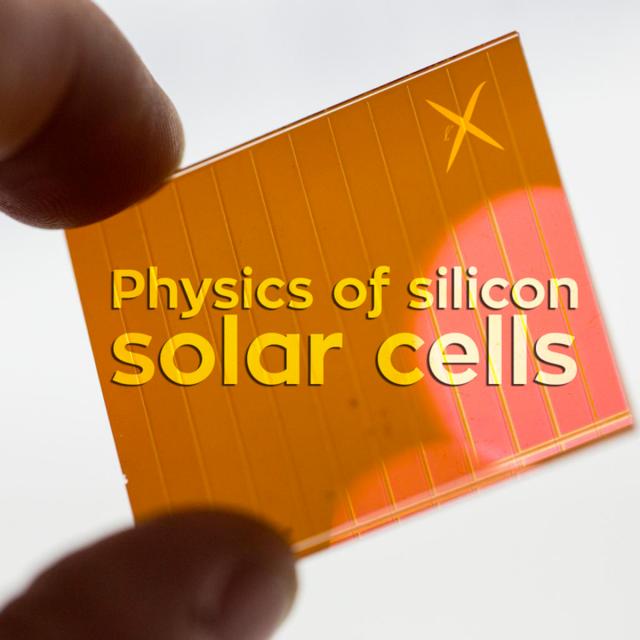
Physics of silicon solar cells (Coursera)

Offered by École Polytechnique,
Physics of silicon solar cells (Coursera)

The first MOOC “Photovoltaic solar energy” is a general presentation of the solar photovoltaics technologies in the global energetic context, without extensive details. In particular the description of the solar cell operation is restricted to the ideal case. In contrast this second MOOC allows a deep understanding of the properties of solar cells based on crystalline semiconductors.

Class Deals by MOOC List - Click here and see Coursera's Active Discounts, Deals, and Promo Codes.

It consists in a general presentation of the physics of the photovoltaics devices with a particular emphasize on the silicon technology that currently represents more than 90% share of the market. Photovoltaic applications of III-V semiconductors are also mentioned.
Indeed from a fundamental point of view, a solar cell can be considered as a semiconductor device (a diode) exposed to the sunlight. An introduction to the semiconductor physics is given, followed by the electron transport phenomena in a diode device. A detailed description of the solar cell operation is then provided, including the conversion efficiency limitations. A description of the solar spectrum and the optical properties of the cells are also presented. Finally the crystalline silicon technology is described from the bulk crystalline growth up to the preparation of heterojunctions combining crystalline and amorphous materials.

Syllabus

WEEK 1
Introduction to semiconductor physics
Introduction to semiconductor physics : band structure of crystalline semiconducors, optical absorption and doping.

WEEK 2
Transport phenomena: the p-n junction
Transport phenomena in semiconductors : carrier injection by light and recombination; the equilibrium and non-equilibrium p-n junction; the photovoltaic effect

WEEK 3
Asymmetrical devices
Metal-semiconductor contacts and semiconductor surface; Heterojunctions

WEEK 4
Solar cell operation
Solar Spectrum; solar cell Fundamentals; limitations of conversion efficiency; solar modules

WEEK 5
Crystalline semiconductor solar cells
Description of the crystalline silicon photovoltaic technology from bulk crystal growth. Extension to III-V compounds solar cells.

WEEK 6
Silicon heterojunctions
Go to Class
MOOC List is learner-supported. When you buy through links on our site, we may earn an affiliate commission.

Related Courses

Tesoros de la Física y sus Descubridores I (Coursera) Coursera
Universidad de los Andes

Tesoros de la Física y sus Descubridores I (Coursera)

¿Sabes cómo vuelan los aviones, tan pesados y no se caen mientras vuelan? ¿Sabes que viajamos por el espacio sobre el planeta Tierra que se traslada y gira muy rápido y no lo percibimos? ¿O acaso, notas efectos de su movimiento? ¿Cuál es nuestro lugar en el universo? ¿Podemos viajar en el tiempo? ¡Preguntas, muchas preguntas! Con espíritu de descubridores nuestra curiosidad nos motiva a buscar respuestas, a explorar nuestro entorno, a entrar a lo desconocido y hallar nuevo conocimiento.

Jun 8th 2026
5-12 Weeks
The Finite Element Method for Problems in Physics (Coursera) Coursera
University of Michigan

The Finite Element Method for Problems in Physics (Coursera)

This course is an introduction to the finite element method as applicable to a range of problems in physics and engineering sciences. The treatment is mathematical, but only for the purpose of clarifying the formulation. The emphasis is on coding up the formulations in a modern, open-source environment that can be expanded to other applications, subsequently.

Jun 15th 2026
13-24 Weeks
Kinetics: Studying Spacecraft Motion (Coursera) Coursera
University of Colorado Boulder

Kinetics: Studying Spacecraft Motion (Coursera)

As they tumble through space, objects like spacecraft move in dynamical ways. Understanding and predicting the equations that represent that motion is critical to the safety and efficacy of spacecraft mission development. Kinetics: Modeling the Motions of Spacecraft trains your skills in topics like rigid body angular momentum and kinetic energy expression shown in a coordinate frame agnostic manner, single and dual rigid body systems tumbling without the forces of external torque, how differential gravity across a rigid body is approximated to the first order to study disturbances in both the attitude and orbital motion, and how these systems change when general momentum exchange devices are introduced.

Jun 8th 2026
4 Weeks
Silicon Thin Film Solar Cells (Coursera) Coursera
École Polytechnique

Silicon Thin Film Solar Cells (Coursera)

This course consists of a general presentation of solar cells based on silicon thin films. It is the third MOOC of the photovoltaic series of Ecole polytechnique on Coursera. The general aspects of the photovoltaic field are treated in "Photovoltaic Solar Energy". And the detailed description of the crystalline silicon solar cells can be found in "Physics of Silicon Solar Cells".

Jun 15th 2026
3 Weeks
D'un infini à l'autre (Coursera) Coursera
École Polytechnique

D'un infini à l'autre (Coursera)

Partez à la découverte de l'infiniment petit et de l'infiniment grand, en compagnie de physiciens et de physiciennes qui vont vous faire découvrir les liens entre la structure de la matière aux distances les plus petites et l'organisation de l'Univers aux distances les plus grandes ce jour, et entre les outils scientifiques utilisés pour les étudier. Vous découvrirez que de nombreux messagers venus de notre Univers (le photon, les neutrinos, ou encore les rayons cosmiques) sont aussi des objets d'intérêt pour les physiciens qui étudient la matière aux échelles les plus petites.

Jun 15th 2026
4 Weeks
Fundamentals of Fluid-Solid Interactions (Coursera) Coursera
École Polytechnique

Fundamentals of Fluid-Solid Interactions (Coursera)

What is fluid-solid interactions ? It is what happens when the motions of a fluid and of a solid are somehow coupled. This happens all the time, around you when leaves flutter in the wind, inside you when your heart beats, above you when wings of a plane vibrate, under the sea... The idea behind this MOOC is to give you the basic tools to be able to predict and eventually mitigate things called flutter, galloping, sloshing, vortex-induced vibrations, added mass, to cite a few. We are going to consider any possible domains of applications such as civil engineering, aerospace engineering, nuclear engineering , ocean engineering, biomechanics and even food processing !

Jun 15th 2026
5-12 Weeks
Analyzing the Universe (Coursera) Coursera
Rutgers University

Analyzing the Universe (Coursera)

Using publicly available data from NASA of actual satellite observations of astronomical x-ray sources, we explore some of the mysteries of the cosmos, including neutron stars, black holes, quasars and supernovae. We will analyze energy spectra and time series data to understand how these incredible objects work. We utilize an imaging tool called DS9 to explore the amazing diversity of astronomical observations that have made x-ray astronomy one of the most active and exciting fields of scientific investigation in the past 50 years.

Jun 8th 2026
5-12 Weeks
Les deux infinis et nous (Coursera) Coursera
École Polytechnique

Les deux infinis et nous (Coursera)

Partez à la découverte de l'infiniment grand et de l'infiniment petit dans leurs aspects les plus proches de notre quotidien, en compagnie de physiciens et de physiciennes qui vont vous faire découvrir leur présence insoupçonnée dans notre vie de tous les jours. Vous vous initierez à la vie et aux métiers d'une grande collaboration en physique de l'infiniment petit et de l'infiniment grand, vous découvrirez comment les outils développés dans ces domaines ont trouvé des applications inattendues, comment la physique nucléaire a profondément modifié les domaines de l'énergie et de la santé, et comment les propriétés de certaines particules aident à présent d'autres disciplines à sonder la matière d'une manière totalement différente.

Jun 15th 2026
4 Weeks