Photovoltaic solar energy (Coursera)

Offered by École Polytechnique,
Photovoltaic solar energy (Coursera)

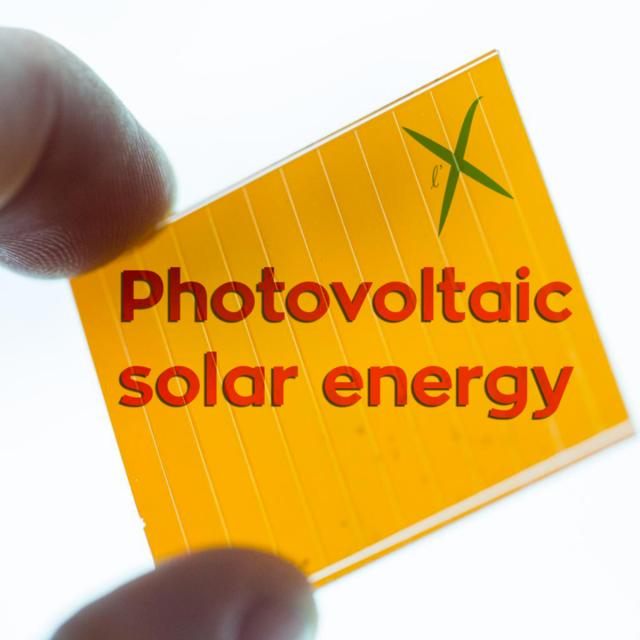
The course is an introduction to the photovoltaic (PV) applications in the general mix energetic context dominated by climate warming mitigation. The various uses of solar energy are firstly presented before a short description of the principle of the direct solar photon conversion into electricity (PV). The various PV technologies are reviewed in the current context dominated by crystalline silicon cells. The perspectives of the various technologies are then analysed in terms of R&D investments.

Class Deals by MOOC List - Click here and see Coursera's Active Discounts, Deals, and Promo Codes.

From a more scientific point of view the basis of the solar cell operation is presented from the solar spectrum characteristics. The fundamentals of PV conversion are summarized. In particular the various sources of the conversion efficiency limitations are reviewed.
The solar PV systems, from cells to grids, are also addressed, with a particular emphasis on the challenges of grid-integration of PV and the development of storage technologies.
The environmental and social impacts of PV are compared to the competing energy sources. Generally PV is at advantage as referred to other fossil or renewable sources.
Finally the fast evolution of economics and financing of PV is presented together with the current key players, mostly Asian companies.

Syllabus

WEEK 1
Photovoltaic Solar Energy
General presentation of the solar energy and the photovoltaic cell technologies in the global context energetics.

WEEK 2
Solar cell operation
Description of the solar Spectrum and brief presentation of solar cell and solar module operations.

WEEK 3
Solar photovoltaic systems
Survey of the economics of the Photovoltaic industry. Social impacts, storage and grid integration of the PV energy.
Go to Class
MOOC List is learner-supported. When you buy through links on our site, we may earn an affiliate commission.

Related Courses

Wind resources for renewable energies (Coursera) Coursera
École Polytechnique

Wind resources for renewable energies (Coursera)

The main goal of this course is to get the necessary knowledge on atmospheric and fluid dynamics in order to quantify the wind resource of a local or regional area. We’ll learn about basic meteorology, the specific dynamics of turbulent boundary layers and some standard techniques to estimate wind resources regardless of the type of turbine used or the level of efficiency achieved.

Aug 10th 2026
4 Weeks
Outsmarting intermittency (Coursera) Coursera
École Polytechnique

Outsmarting intermittency (Coursera)

Solar and wind offer clean and renewable ways to produce large amounts of electricity. They have boomed over the last few years, evolving from an eco-daydream to a major market and showing unprecedented growth rates. Yet, installing solar panels and wind turbines is by no means the end of the story. The electrical grid, which connects production means to the end-users’ sockets, is not a simple electron pipe. It is the beating heart of our electricity system and ensures its stability. Solar and wind raise specific challenges for the grid, and these challenges will have to be tackled if we want to deploy larger amounts of renewable sources.

Aug 3rd 2026
4 Weeks
Explorando la Energía Sustentable (Coursera) Coursera
Pontificia Universidad Católica de Chile

Explorando la Energía Sustentable (Coursera)

Este curso introductorio aborda conceptos de energía sustentable y describe tecnologías avanzadas que pueden sustituir progresivamente las actuales dominadas por el carbón, el petróleo y gas natural, cuyas emisiones está perturbando progresivamente el clima, lo que puede afectar el desarrollo y la convivencia internacional.

Jul 27th 2026
4 Weeks
Physics of silicon solar cells (Coursera) Coursera
École Polytechnique

Physics of silicon solar cells (Coursera)

The first MOOC “Photovoltaic solar energy” is a general presentation of the solar photovoltaics technologies in the global energetic context, without extensive details. In particular the description of the solar cell operation is restricted to the ideal case. In contrast this second MOOC allows a deep understanding of the properties of solar cells based on crystalline semiconductors.

Aug 3rd 2026
5-12 Weeks
Municipal Solid Waste Management in Developing Countries (Coursera) Coursera
École Polytechnique Fédérale de Lausanne

Municipal Solid Waste Management in Developing Countries (Coursera)

Have you come across large piles of garbage in neighborhoods and streets, or smelly waste disposal sites polluting the environment of low and middle income countries? Are you also convinced that improvements are necessary and do you want to know what kind of sustainable solutions are appropriate to better manage waste and enhance recycling and recovery? If yes, this course is for you!

Aug 10th 2026
5-12 Weeks
Greening the Economy: Sustainable Cities (Coursera) Coursera
Lund University

Greening the Economy: Sustainable Cities (Coursera)

How can we shape urban development towards sustainable and prosperous futures? This course will explore sustainable cities as engines for greening the economy. We place cities in the context of sustainable urban transformation and climate change. Sustainable urban transformation refers to structural transformation processes – multi-dimensional and radical change – that can effectively direct urban development towards ambitious sustainability and climate goals. We will connect the key trends of urbanization, decarbonisation and sustainability.

Aug 3rd 2026
5-12 Weeks
Mécanique du point matériel (Coursera) Coursera
École Polytechnique Fédérale de Lausanne

Mécanique du point matériel (Coursera)

Pour illustrer les concepts introduits dans la première partie, on traite ici des problèmes pour lesquels le système mécanique peut être considéré comme un point matériel. Cette partie couvre notamment les problèmes à traiter en coordonnées cylindriques ou sphériques, le problème des orbites des planètes et les référentiels accélérés.

Aug 10th 2026
5-12 Weeks
Solar Energy System Design (Coursera) Coursera
The State University of New York

Solar Energy System Design (Coursera)

Solar Energy System Design builds upon the introduction to PV systems from Solar Energy Basics course, which included basic system components and functions, as well as some basic system sizing using simplifying assumptions. You should at this point have a basic understanding of electrical power and energy, be able to calculate the energy needs of a site as well as energy production potential for a PV system at a given location under optimal conditions.

Aug 3rd 2026
5-12 Weeks
Physics 101 - Forces and Kinematics (Coursera) Coursera
Rice University

Physics 101 - Forces and Kinematics (Coursera)

This course serves as an introduction to the physics of force and motion. Upon completion, learners will have an understanding of how mathematical laws and conservation principles describe the motions and interactions of objects all around us. They will gain experience in solving physics problems with tools such as graphical analysis, algebra, vector analysis, and calculus.

Jul 27th 2026
4 Weeks
Introduction to Sustainability (Coursera) Coursera
University of Illinois at Urbana-Champaign

Introduction to Sustainability (Coursera)

This course introduces the academic approach of Sustainability and explores how today’s human societies can endure in the face of global change, ecosystem degradation and resource limitations. The course focuses on key knowledge areas of sustainability theory and practice, including population, ecosystems, global change, energy, agriculture, water, environmental economics and policy, ethics, and cultural history.

Aug 3rd 2026
5-12 Weeks
From the Big Bang to Dark Energy (Coursera) Coursera
The University of Tokyo

From the Big Bang to Dark Energy (Coursera)

We have learned a lot recently about how the Universe evolved in 13.7 billion years since the Big Bang. More than 80% of matter in the Universe is mysterious Dark Matter, which made stars and galaxies to form. The newly discovered Higgs-boson became frozen into the Universe a trillionth of a second after the Big Bang and brought order to the Universe.

Aug 10th 2026
4 Weeks