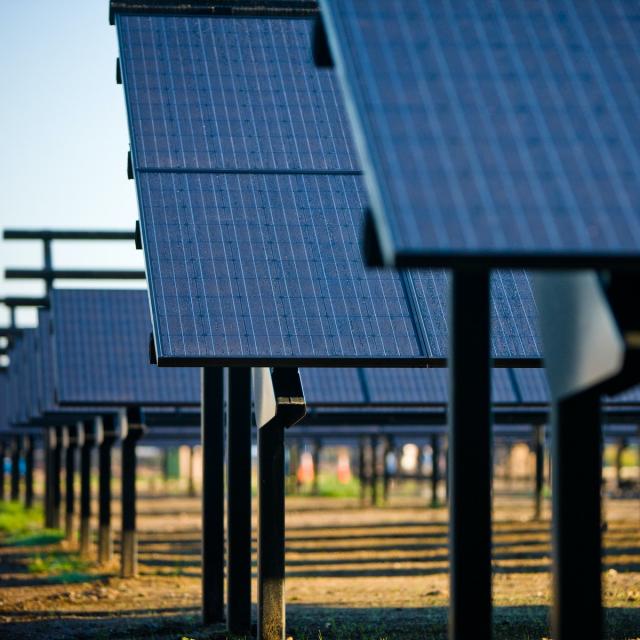
Solar Energy Systems Overview (Coursera)

Offered by University at Buffalo,
Solar Energy Systems Overview (Coursera)

By the end of this course, learners will have acquired a broad understanding of the history and mechanics behind converting light into electricity, commonly known as photovoltaics (PV). They are empowered to recognize and describe elements of a PV system, enabling them to: compare the most common types of solar cells, sketch a solar PV system, and analyze differences between rooftop and ground mounting configurations.

Class Deals by MOOC List - Click here and see Coursera's Active Discounts, Deals, and Promo Codes.

The course explores economic considerations, touching on solar PV costs for residential and commercial use, incentives, and contrasts solar power with fossil fuel and nuclear plants.
This course is ideal for anyone interested in entering the solar power sector, whether fresh to the workforce or switching industries. The curriculum is especially useful for engineers, HVAC installers, architects, and building code inspectors.
What You Will Learn

  • Differentiate the value of solar energy versus alternatives
  • Explain how PV works in technical and economic terms, and identify its components
  • Estimate solar system costs

Course 1 of 3 in the Solar Energy for Engineers, Architects and Code Inspectors Specialization.

Syllabus

WEEK 1
Acknowledgement
Solar Power
This module introduces learners to the history of solar power and the nature of photovoltaics (PV).

WEEK 2
The Nature of PV
This module provides an understanding of the structure and function of different types of PV systems and their components.

WEEK 3
Solar Power ROI
This modules provides an understanding of the costs and ROI that can be expected when installing a PV system.
PV System Analysis Project: Theory to Practice
Go to Class
MOOC List is learner-supported. When you buy through links on our site, we may earn an affiliate commission.

Related Courses

Ressources minérales et transition (Coursera) Coursera
Institut Mines-Telecom

Ressources minérales et transition (Coursera)

Ce MOOC sur les ressources minérales et les transitions invite à se questionner sur la soutenabilité de nos choix technologiques. Les transitions énergétiques et numériques sont en effet confrontées aux enjeux d'approvisionnement des ressources minérales et aux impacts que leur cycle de vie génère sur l’environnement et la société.

Sep 14th 2026
4 Weeks
Ecosystem Services: a Method for Sustainable Development (Coursera) Coursera
University of Geneva

Ecosystem Services: a Method for Sustainable Development (Coursera)

Ecosystem services are a way of thinking about – and evaluating – the goods and services provided by nature that contribute to the well-being of humans. This MOOC will cover scientific (technical), economic, and socio-political dimensions of the concept through a mix of theory, case-studies, interviews with specialists and a serious-game.

Sep 7th 2026
5-12 Weeks
Strategy and Sustainability (Coursera) Coursera
IESE Business School

Strategy and Sustainability (Coursera)

Business and environmental sustainability are not natural bedfellows. Business is about making money. Sustainability is about protecting the planet. Business is measured in months and quarters. Sustainability often requires significant short term costs to secure a sometimes uncertain long-term benefit. To some activists, all executives are exploitative, selfish one percenters. To some executives, all activists are irresponsible, unyielding extremists.

Sep 14th 2026
5-12 Weeks
Becoming a changemaker: Introduction to Social Innovation (Coursera) Coursera
University of Cape Town

Becoming a changemaker: Introduction to Social Innovation (Coursera)

This free 6 week course is for anyone who wants to make a difference. Whether you are already familiar with the field of social innovation or social entrepreneurship, working for an organization that wants to increase its social impact, or just starting out, this course will take you on a journey of exploring the complex problems that surround us and how to start thinking about solutions.

Sep 7th 2026
5-12 Weeks
Management of Urban Infrastructures – part 1 (Coursera) Coursera
École Polytechnique Fédérale de Lausanne

Management of Urban Infrastructures – part 1 (Coursera)

Sustainability, Resilience and Efficiency are fundamental considerations for city managers in managing urban infrastructures. Today, more than 3.9 billion people, making up more than 54% of the global population, live in cities. Urbanization is expected to continue in the coming years, raising the urban population to 6.0 billion by 2045. This dramatic increase in urban populations will inevitably increase the demand for energy, mobility (transportation), water, and other urban services in every city around the world. Without functional governance and management structures that ensure efficient, resilient and sustainable performance in cities, the current urbanization growth might become a catastrophic risk threatening the quality of life of the humanity.

Sep 14th 2026
5-12 Weeks
Sustainable high-end tourism (Coursera) Coursera
Universitat Autònoma de Barcelona

Sustainable high-end tourism (Coursera)

Welcome to the sustainable high-end tourism course. Why should you take this course? High-end tourism is a sector and industry that has grown in the last 50 years in an exponential way across the globe. The recent developments in our world -with globalization and sustainability- need to be addressed in this high-end industry. In this course we will have a look at what makes that high-end tourism, what is essential in high-end luxury tourism, and what is not.

Sep 14th 2026
5-12 Weeks
Wind resources for renewable energies (Coursera) Coursera
École Polytechnique

Wind resources for renewable energies (Coursera)

The main goal of this course is to get the necessary knowledge on atmospheric and fluid dynamics in order to quantify the wind resource of a local or regional area. We’ll learn about basic meteorology, the specific dynamics of turbulent boundary layers and some standard techniques to estimate wind resources regardless of the type of turbine used or the level of efficiency achieved.

Sep 7th 2026
4 Weeks
Our Earth's Future (Coursera) Coursera
American Museum of Natural History

Our Earth's Future (Coursera)

Our Earth’s Future is about the science of climate change and how to talk about it. You will learn from scientists in the fields of climatology, oceanography, Earth science, and anthropology who study how climate change is affecting people, populations, and ways of life. Explore the multiple lines of evidence for the human-induced climate change that is happening today, and consider what that means for the future of our planet. At the end of this course you will be able to understand key scientific principles, identify and address misconceptions, and contribute confidently to conversations about climate change.

Sep 7th 2026
5-12 Weeks
Planning for Climate Change in African Cities (Coursera) Coursera
Erasmus University Rotterdam,United Cities and Local Governments of Africa,African Local Government Academy,Institute for Housing and Urban Development

Planning for Climate Change in African Cities (Coursera)

Climate change poses a threat to economic growth and long-term prosperity of many countries around the world. Africa is not an exception, considering the actual and potential impacts of climate change and climate variability that will threaten its vulnerable sectors and human populations. African countries are projected to experience changing rainfall patterns, rising sea levels, and higher temperatures that will affect food security, agricultural production, water availability, and public health, among others. These climate change impacts and climate variability can further produce social and political problems, such as rural-urban migration and water resource disputes.

Sep 14th 2026
5-12 Weeks