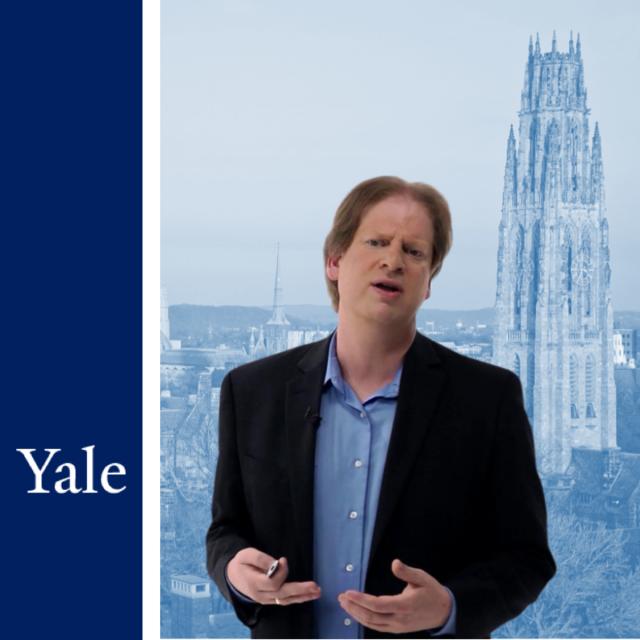
Moralities of Everyday Life (Coursera)

Offered by Yale University,
Moralities of Everyday Life (Coursera)

How can we explain kindness and cruelty? Where does our sense of right and wrong come from? Why do people so often disagree about moral issues? This course explores the psychological foundations of our moral lives.

Class Deals by MOOC List - Click here and see Coursera's Active Discounts, Deals, and Promo Codes.

Syllabus

Week 1
Welcome to Moralities of Everyday Life!
The Big Questions
What is morality, anyway? What are the big debates in the field of moral psychology?

Week 2
Compassion
Where does concern for others come from? How is it related to empathy—and is more empathy necessarily a good thing? And what can we learn from the study of those who seemingly lack normal moral feelings, such as violent psychopaths?

Week 3
Origins of Morality
Here, we ask about which aspects of morality are universal. We discuss evolution, cross-cultural research, and the fascinating new science of the moral life of babies.

Week 4
Differences
How does culture influence our moral thought and moral action? What role does religion play? Why are some of us conservative and others liberal, and how do political differences influence our sense of right and wrong?

Week 5
Family, Friends, and Strangers
Our moral feelings are usually most powerful towards our kin (such as our parents and our children) and our friends and allies. We will discuss these special bonds, and then turn to the morality of racial and ethnic bias. Then we use the tools of behavioral economics to explore the controversial question of whether we are ever truly altruistic to strangers.

Week 6
The Big Answers
We’ll discuss some clever studies that show how our moral behavior is powerfully influenced—often at the unconscious level—by the situations that we find ourselves in. Such findings raise some hard problems about determinism, free will, and moral responsibility. Most of all, if our actions are determined by our brains, our genes, and our situations, in what sense can we be said to be moral agents? The course will end by trying to address this question.

Go to Class
MOOC List is learner-supported. When you buy through links on our site, we may earn an affiliate commission.

Related Courses

Big History - From the Big Bang until Today (Coursera) Coursera
University of Amsterdam

Big History - From the Big Bang until Today (Coursera)

Welcome to this Big History course! In this course, renowned scientists and scholars from the University of Amsterdam and beyond will take you on a journey from the Big Bang until today while addressing key questions in their fields. After completing this journey you will have developed a better understanding of how you and everything around you became the way they are today.

Aug 3rd 2026
4 Weeks
Understanding Violence (Coursera) Coursera
Emory University

Understanding Violence (Coursera)

We are so pleased to have you join us as we investigate this crucial topic. Violence is a leading cause of death, disability and health care use worldwide. Violence is a complex problem and can only be understood and reduced though a multidisciplinary approach. This course introduces you to experts who study different forms of violence and we will discuss the various causes of violence. You will also learn about efforts to reduce violence and engage in a day of compassion.

Jul 27th 2026
5-12 Weeks
Customer Value in Pricing Strategy (Coursera) Coursera
University of Virginia,Boston Consulting Group - BCG

Customer Value in Pricing Strategy (Coursera)

The traditional approach to pricing based on costs works to pay the bills, but it leaves revenue on the table. You can, in fact, price your products in a way that increases sales--if you know what your customers are willing to pay and can leverage psychology to create better deal and discount plans. In this course, we'll show you how to price a product based on how your customers value it and the psychology behind their purchase decisions.

Jul 27th 2026
4 Weeks
Understanding Obesity (Coursera) Coursera
University of Edinburgh

Understanding Obesity (Coursera)

In this course, we’ll look at the facts and misconceptions around obesity and discuss key physiological and psychological concepts around the brain’s control of appetite and body weight. We’ll consider the biological and environmental pressures that make it easy to gain weight (and hard to lose it!). Most importantly, we'll give you the opportunity to reflect on your own knowledge and assumptions around the subject.

Jul 27th 2026
4 Weeks
The Bilingual Brain (Coursera) Coursera
University of Houston System

The Bilingual Brain (Coursera)

This course explores the brain bases of bilingualism by discussing literature relevant to differences in age of initial learning, proficiency, and control in the nonverbal, single language and dual-language literature. Participants will learn about the latest research related to how humans learn one or two languages and other cognitive skills.

Aug 10th 2026
5-12 Weeks
Positive Psychology: Martin E. P. Seligman’s Visionary Science (Coursera) Coursera
University of Pennsylvania

Positive Psychology: Martin E. P. Seligman’s Visionary Science (Coursera)

Dr. Martin E.P. Seligman—renowned worldwide as the “father of Positive Psychology”—has led visionary leaps in the scientific research, empirical data and personal understandings of human flourishing. This course explores the past, present and future of positive psychology as a journey through the key scientific leaps led by Dr. Seligman and his colleagues at the University of Pennsylvania's Positive Psychology Center and Master of Applied Positive Psychology program.

Jul 27th 2026
4 Weeks
Introduction to Genetics and Evolution (Coursera) Coursera
Duke University

Introduction to Genetics and Evolution (Coursera)

Introduction to Genetics and Evolution is a college-level class being offered simultaneously to new students at Duke University. The course gives interested people a very basic overview of some principles behind these very fundamental areas of biology. We often hear about new "genome sequences," commercial kits that can tell you about your ancestry (including pre-human) from your DNA or disease predispositions, debates about the truth of evolution, why animals behave the way they do, and how people found "genetic evidence for natural selection." This course provides the basic biology you need to understand all of these issues better, tries to clarify some misconceptions, and tries to prepare students for future, more advanced coursework in Biology (and especially evolutionary genetics). No prior coursework is assumed.

Aug 3rd 2026
5-12 Weeks
Social Norms, Social Change I (Coursera) Coursera
University of Pennsylvania

Social Norms, Social Change I (Coursera)

This is a course on social norms, the rules that glue societies together. It teaches how to diagnose social norms, and how to distinguish them from other social constructs, like customs or conventions. These distinctions are crucial for effective policy interventions aimed to create new, beneficial norms or eliminate harmful ones. The course teaches how to measure social norms and the expectations that support them, and how to decide whether they cause specific behaviors.

Aug 3rd 2026
4 Weeks
Psychological First Aid (Coursera) Coursera
Johns Hopkins University

Psychological First Aid (Coursera)

Learn to provide psychological first aid to people in an emergency by employing the RAPID model: Reflective listening, Assessment of needs, Prioritization, Intervention, and Disposition. Utilizing the RAPID model (Reflective listening, Assessment of needs, Prioritization, Intervention, and Disposition), this specialized course provides perspectives on injuries and trauma that are beyond those physical in nature. The RAPID model is readily applicable to public health settings, the workplace, the military, faith-based organizations, mass disaster venues, and even the demands of more commonplace critical events, e.g., dealing with the psychological aftermath of accidents, robberies, suicide, homicide, or community violence.

Aug 10th 2026
5-12 Weeks