Introduzione alla matematica per l'università: Pre-Calculus (POK)

Offered by Politecnico di Milano,
Introduzione alla matematica per l'università: Pre-Calculus (POK)

Il corso copre la matematica di base, permettendo di colmare eventuali lacune e di mettere a punto la preparazione necessaria all'ingresso all'università. Il corso si articola in 5 “settimane” ognuna dedicata ad un settore della matematica utile per affrontare al meglio il primo anno di studi universitari (Logica e Aritmetica, Algebra, Geometria, Funzioni, Probabilità e Statistica).

Ogni settimana è articolata in brevi lezioni, esercitazioni e quiz. Le esercitazioni servono a fissare i concetti visti a lezione ed hanno due livelli di difficoltà (* facile, ** medio); al termine di ogni “settimana” un quiz di autovalutazione permette di controllare l’apprendimento e le capacità di rielaborazione delle nozioni acquisite. Alla fine del corso ci sarà un quiz finale per verificare la comprensione dei contenuti presentati.

Durante il corso sarà attiva un’attività di PEER ASSESSMENT sul tema delle probabilità.
Il corso può essere utile per la preparazione all’esame di maturità ma le lezioni e le esercitazioni non rappresentano una simulazione della prova scritta: esso propone solo alcuni degli argomenti trattati alle scuole medie superiori, necessari ad affrontare al meglio il primo anno di università. Il corso è fortemente consigliato a tutti coloro che vorrebbero iscriversi al Politecnico. Una volta consolidate queste nozioni, per affrontare la parte di matematica dei test di ingegneria e di architettura è comunque opportuno esercitarsi utilizzando anche gli altri strumenti disponibili gratuitamente che riproducono le condizioni particolari del test: tempo limitato, domande a scelta multipla, etc.
Le nozioni di matematica di base abitualmente ritenute necessarie per l’accesso e la frequenza ai corsi del primo anno sono in buona misura le stesse per tutte le università italiane, quindi il corso può essere senz’altro utile anche agli studenti che si iscriveranno ad altri Atenei. Per valutare se sono necessarie eventuali integrazioni (o possibili alleggerimenti) si consiglia comunque di consultare i siti dedicati all’orientamento della propria università.
Al termine del corso verrà attivata una nuova edizione.
I video e i materiali didattici rimarranno disponibili anche dopo la conclusione dell’edizione.

Go to Class
MOOC List is learner-supported. When you buy through links on our site, we may earn an affiliate commission.

Related Courses

Calculus: Single Variable Part 4 - Applications (Coursera) Coursera
University of Pennsylvania

Calculus: Single Variable Part 4 - Applications (Coursera)

Calculus is one of the grandest achievements of human thought, explaining everything from planetary orbits to the optimal size of a city to the periodicity of a heartbeat. This brisk course covers the core ideas of single-variable Calculus with emphases on conceptual understanding and applications. The course is ideal for students beginning in the engineering, physical, and social sciences.

Sep 28th 2026
5-12 Weeks
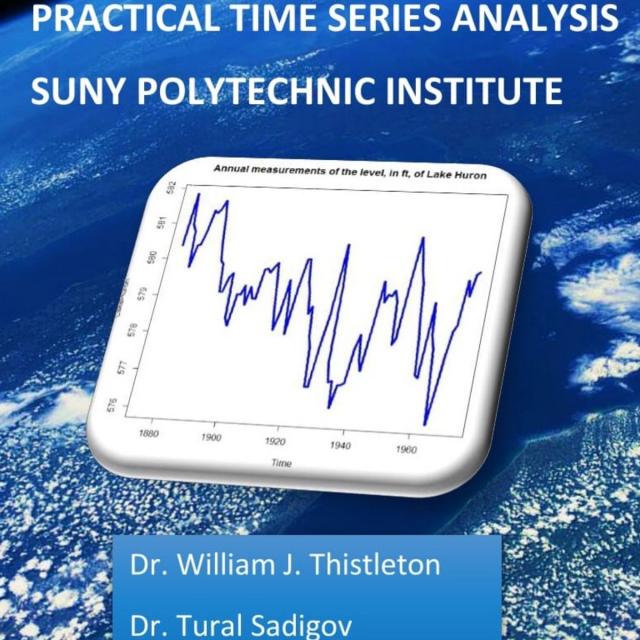
Practical Time Series Analysis (Coursera) Coursera
The State University of New York

Practical Time Series Analysis (Coursera)

Many of us are "accidental" data analysts. We trained in the sciences, business, or engineering and then found ourselves confronted with data for which we have no formal analytic training. This course is designed for people with some technical competencies who would like more than a "cookbook" approach, but who still need to concentrate on the routine sorts of presentation and analysis that deepen the understanding of our professional topics.

Oct 5th 2026
5-12 Weeks
Understanding Clinical Research: Behind the Statistics (Coursera) Coursera
University of Cape Town

Understanding Clinical Research: Behind the Statistics (Coursera)

If you’ve ever skipped over`the results section of a medical paper because terms like “confidence interval” or “p-value” go over your head, then you’re in the right place. You may be a clinical practitioner reading research articles to keep up-to-date with developments in your field or a medical student wondering how to approach your own research. Greater confidence in understanding statistical analysis and the results can benefit both working professionals and those undertaking research themselves.

Sep 28th 2026
5-12 Weeks
Probability and Statistics: To p or not to p? (Coursera) Coursera
University of London

Probability and Statistics: To p or not to p? (Coursera)

We live in an uncertain and complex world, yet we continually have to make decisions in the present with uncertain future outcomes. Indeed, we should be on the look-out for "black swans" - low-probability high-impact events. To study, or not to study? To invest, or not to invest? To marry, or not to marry?

Oct 5th 2026
5-12 Weeks
Fundamentals of Engineering Exam Review (Coursera) Coursera
Georgia Institute of Technology

Fundamentals of Engineering Exam Review (Coursera)

The purpose of this course is to review the material covered in the Fundamentals of Engineering (FE) exam to enable the student to pass it. It will be presented in modules corresponding to the FE topics, particularly those in Civil and Mechanical Engineering. Each module will review main concepts, illustrate them with examples, and provide extensive practice problems.

Oct 5th 2026
5-12 Weeks
Machine Learning, Maths & Ethics: Hands-on (POK) Polimi OPEN KNOWLEDGE
Politecnico di Milano

Machine Learning, Maths & Ethics: Hands-on (POK)

A meaningful learning opportunity to empower young people, especially young women to pursue a career in machine learning through a gender conscious narrative. Would you like to know the basics of machine learning, but don't know where to start? Would you like to learn about the societal challenges of machine learning? Then, this course is for you!

Available
5-12 Weeks
Introduction to Calculus (Coursera) Coursera
The University of Sydney

Introduction to Calculus (Coursera)

The focus and themes of the Introduction to Calculus course address the most important foundations for applications of mathematics in science, engineering and commerce. The course emphasises the key ideas and historical motivation for calculus, while at the same time striking a balance between theory and application, leading to a mastery of key threshold concepts in foundational mathematics.

Oct 5th 2026
5-12 Weeks
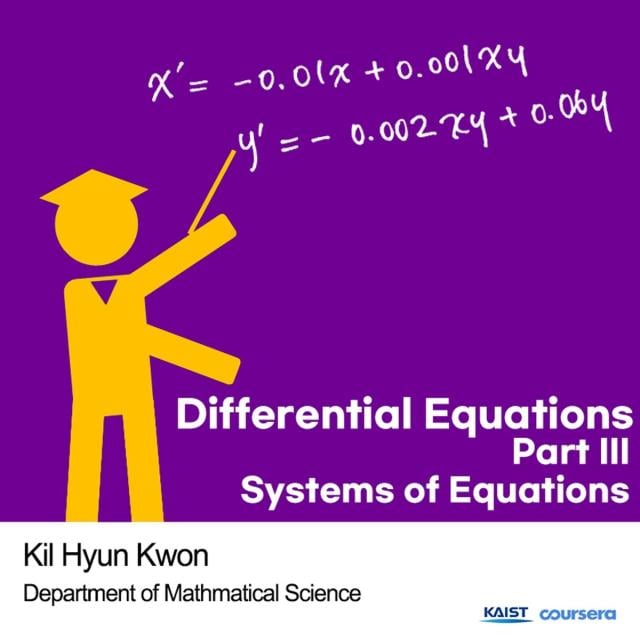
Differential Equations Part III Systems of Equations (Coursera) Coursera
Korea Advanced Institute of Science and Technology - KAIST

Differential Equations Part III Systems of Equations (Coursera)

This introductory courses on (Ordinary) Differential Equations are mainly for the people, who need differential equations mostly for the practical use in their own fields. So we try to provide basic terminologies, concepts, and methods of solving various types of differential equations as well as a rudimentary but indispensable knowledge of the underlying theory and some related applications.

Oct 5th 2026
5-12 Weeks