Data Science Math Skills (Coursera)

Offered by Duke University,
Data Science Math Skills (Coursera)

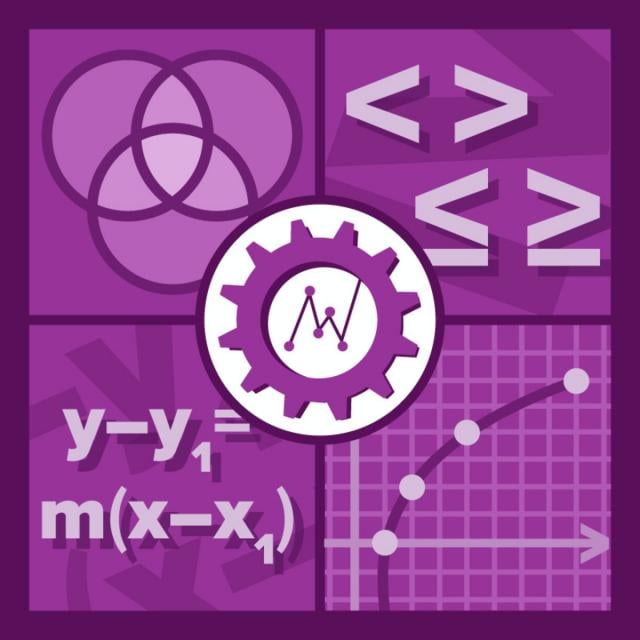
Data science courses contain math—no avoiding that! This course is designed to teach learners the basic math you will need in order to be successful in almost any data science math course and was created for learners who have basic math skills but may not have taken algebra or pre-calculus. Data Science Math Skills introduces the core math that data science is built upon, with no extra complexity, introducing unfamiliar ideas and math symbols one-at-a-time.

Class Deals by MOOC List - Click here and see Coursera's Active Discounts, Deals, and Promo Codes.

Learners who complete this course will master the vocabulary, notation, concepts, and algebra rules that all data scientists must know before moving on to more advanced material.
Topics include:
~Set theory, including Venn diagrams
~Properties of the real number line
~Interval notation and algebra with inequalities
~Uses for summation and Sigma notation
~Math on the Cartesian (x,y) plane, slope and distance formulas
~Graphing and describing functions and their inverses on the x-y plane,
~The concept of instantaneous rate of change and tangent lines to a curve
~Exponents, logarithms, and the natural log function.
~Probability theory, including Bayes’ theorem.
While this course is intended as a general introduction to the math skills needed for data science, it can be considered a prerequisite for learners interested in the course, "Mastering Data Analysis in Excel," which is part of the Excel to MySQL Data Science Specialization. Learners who master Data Science Math Skills will be fully prepared for success with the more advanced math concepts introduced in "Mastering Data Analysis in Excel."

Syllabus

WEEK 1
Welcome to Data Science Math Skills
This short module includes an overview of the course's structure, working process, and information about course certificates, quizzes, video lectures, and other important course details. Make sure to read it right away and refer back to it whenever needed
Building Blocks for Problem Solving
This module contains three lessons that are build to basic math vocabulary. The first lesson, "Sets and What They’re Good For," walks you through the basic notions of set theory, including unions, intersections, and cardinality. It also gives a real-world application to medical testing. The second lesson, "The Infinite World of Real Numbers," explains notation we use to discuss intervals on the real number line. The module concludes with the third lesson, "That Jagged S Symbol," where you will learn how to compactly express a long series of additions and use this skill to define statistical quantities like mean and variance.

WEEK 2
Functions and Graphs
This module builds vocabulary for graphing functions in the plane. In the first lesson, "Descartes Was Really Smart," you will get to know the Cartesian Plane, measure distance in it, and find the equations of lines. The second lesson introduces the idea of a function as an input-output machine, shows you how to graph functions in the Cartesian Plane, and goes over important vocabulary.

WEEK 3
Measuring Rates of Change
This module begins a very gentle introduction to the calculus concept of the derivative. The first lesson, "This is About the Derivative Stuff," will give basic definitions, work a few examples, and show you how to apply these concepts to the real-world problem of optimization. We then turn to exponents and logarithms, and explain the rules and notation for these math tools. Finally we learn about the rate of change of continuous growth, and the special constant known as “e” that captures this concept in a single number—near 2.718.

WEEK 4
Introduction to Probability Theory
This module introduces the vocabulary and notation of probability theory – mathematics for the study of outcomes that are uncertain but have predictable rates of occurrence. We start with the basic definitions and rules of probability, including the probability of two or more events both occurring, the sum rule and the product rule, and then proceed to Bayes’ Theorem and how it is used in practical problems.
Go to Class
MOOC List is learner-supported. When you buy through links on our site, we may earn an affiliate commission.

Related Courses

Practical Time Series Analysis (Coursera) Coursera
The State University of New York

Practical Time Series Analysis (Coursera)

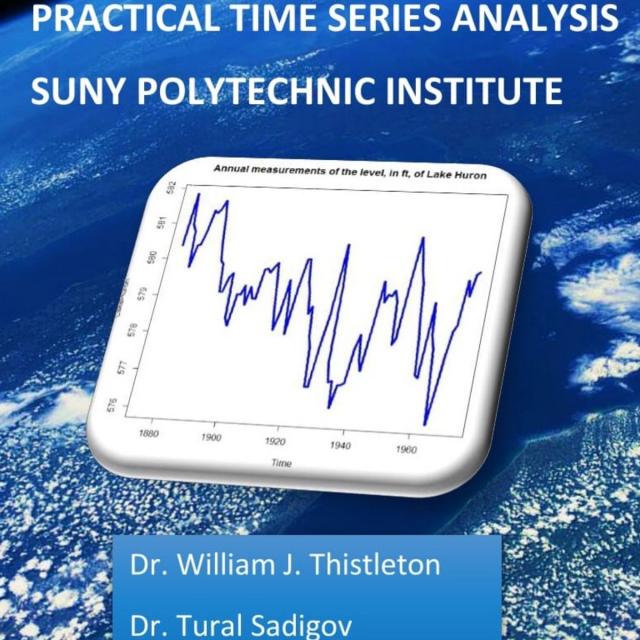
Many of us are "accidental" data analysts. We trained in the sciences, business, or engineering and then found ourselves confronted with data for which we have no formal analytic training. This course is designed for people with some technical competencies who would like more than a "cookbook" approach, but who still need to concentrate on the routine sorts of presentation and analysis that deepen the understanding of our professional topics.

Oct 5th 2026
5-12 Weeks
Materials Data Sciences and Informatics (Coursera) Coursera
Georgia Institute of Technology

Materials Data Sciences and Informatics (Coursera)

This course aims to provide a succinct overview of the emerging discipline of Materials Informatics at the intersection of materials science, computational science, and information science. Attention is drawn to specific opportunities afforded by this new field in accelerating materials development and deployment efforts.

Oct 5th 2026
5-12 Weeks
Programming for Everybody (Getting Started with Python) (Coursera) Coursera
University of Michigan

Programming for Everybody (Getting Started with Python) (Coursera)

This course aims to teach everyone the basics of programming computers using Python. We cover the basics of how one constructs a program from a series of simple instructions in Python. The course has no pre-requisites and avoids all but the simplest mathematics. Anyone with moderate computer experience should be able to master the materials in this course.

Sep 28th 2026
5-12 Weeks
Ferramentas para Ciência de Dados: Introdução ao R (Coursera) Coursera
FIA Business School

Ferramentas para Ciência de Dados: Introdução ao R (Coursera)

Nossas boas-vindas ao Curso Ferramentas para Ciência de Dados: Introdução ao R. Neste curso, você aprenderá que o mundo evoluiu muito quando o assunto é tomada de decisão baseada em dados e já não é possível comparar a quantidade de informações a que temos acesso atualmente com o que tínhamos disponíveis décadas atrás.

Oct 5th 2026
4 Weeks
Analytic Combinatorics (Coursera) Coursera
Princeton University

Analytic Combinatorics (Coursera)

Analytic Combinatorics teaches a calculus that enables precise quantitative predictions of large combinatorial structures. This course introduces the symbolic method to derive functional relations among ordinary, exponential, and multivariate generating functions, and methods in complex analysis for deriving accurate asymptotics from the GF equations. All the features of this course are available for free. It does not offer a certificate upon completion.

Oct 5th 2026
5-12 Weeks
Probability and Statistics: To p or not to p? (Coursera) Coursera
University of London

Probability and Statistics: To p or not to p? (Coursera)

We live in an uncertain and complex world, yet we continually have to make decisions in the present with uncertain future outcomes. Indeed, we should be on the look-out for "black swans" - low-probability high-impact events. To study, or not to study? To invest, or not to invest? To marry, or not to marry?

Oct 5th 2026
5-12 Weeks
Making Data Science Work for Clinical Reporting (Coursera) Coursera
Genentech

Making Data Science Work for Clinical Reporting (Coursera)

This course is aimed to demonstrate how principles and methods from data science can be applied in clinical reporting. By the end of the course, learners will understand what requirements there are in reporting clinical trials, and how they impact on how data science is used. The learner will see how they can work efficiently and effectively while still ensuring that they meet the needed standards.

Oct 5th 2026
4 Weeks
Data science perspectives on pandemic management (Coursera) Coursera
Politecnico di Milano

Data science perspectives on pandemic management (Coursera)

The COVID-19 pandemic is one of the first world-wide scenarios where data made a difference in capturing and analyzing the diffusion and impact of the disease. We offer an introductory course for decision makers, policy makers, public bodies, NGOs, and private organizations about methods, tools, and experiences on the use of data for managing current and future pandemic scenarios.

Oct 5th 2026
5-12 Weeks
Understanding China, 1700-2000: A Data Analytic Approach, Part 2 (Coursera) Coursera
The Hong Kong University of Science and Technology - HKUST

Understanding China, 1700-2000: A Data Analytic Approach, Part 2 (Coursera)

The purpose of this course is to summarize new directions in Chinese history and social science produced by the creation and analysis of big historical datasets based on newly opened Chinese archival holdings, and to organize this knowledge in a framework that encourages learning about China in comparative perspective. Our course demonstrates how a new scholarship of discovery is redefining what is singular about modern China and modern Chinese history.

Sep 28th 2026
4 Weeks
Geometría Analítica Preuniversitaria (Coursera) Coursera
Universidad Autónoma Metropolitana

Geometría Analítica Preuniversitaria (Coursera)

Líneas rectas, círculos, parábolas, elipses e hipérbolas son figuras geométricas que encontramos en nuestro derredor. Por ejemplo, mucha gente sabe que los planetas en nuestro sistema solar se mueven en órbitas elípticas teniendo al astro rey en un foco de esta figura. Sin embargo, pocos saben que la plaza de San Pedro en el Vaticano está construída sobre elipses donde sus focos se encuentran sobre las fuentes donde mucha gente se toma fotos. Estos son dos ejemplos que muestran la importancia de las figuras geométricas en nuestra vida.

Oct 5th 2026
5-12 Weeks
Data Science in Stratified Healthcare and Precision Medicine (Coursera) Coursera
University of Edinburgh

Data Science in Stratified Healthcare and Precision Medicine (Coursera)

An increasing volume of data is becoming available in biomedicine and healthcare, from genomic data, to electronic patient records and data collected by wearable devices. Recent advances in data science are transforming the life sciences, leading to precision medicine and stratified healthcare. In this course, you will learn about some of the different types of data and computational methods involved in stratified healthcare and precision medicine.

Oct 5th 2026
5-12 Weeks