Fibonacci Numbers and the Golden Ratio (Coursera)

Fibonacci Numbers and the Golden Ratio (Coursera)

Learn the mathematics behind the Fibonacci numbers, the golden ratio, and how they are related. These topics are not usually taught in a typical math curriculum, yet contain many fascinating results that are still accessible to an advanced high school student. The course culminates in an explanation of why the Fibonacci numbers appear unexpectedly in nature, such as the number of spirals in the head of a sunflower.

Class Deals by MOOC List - Click here and see Coursera's Active Discounts, Deals, and Promo Codes.

What You Will Learn

  • Fibonacci numbers
  • Golden ratio
  • Fibonacci identities and sums
  • Continued fractions

Syllabus

WEEK 1
Fibonacci: It's as easy as 1, 1, 2, 3
We learn about the Fibonacci numbers, the golden ratio, and their relationship. We derive the celebrated Binet's formula, an explicit formula for the Fibonacci numbers in terms of powers of the golden ratio and its reciprical.

WEEK 2
Identities, sums and rectangles
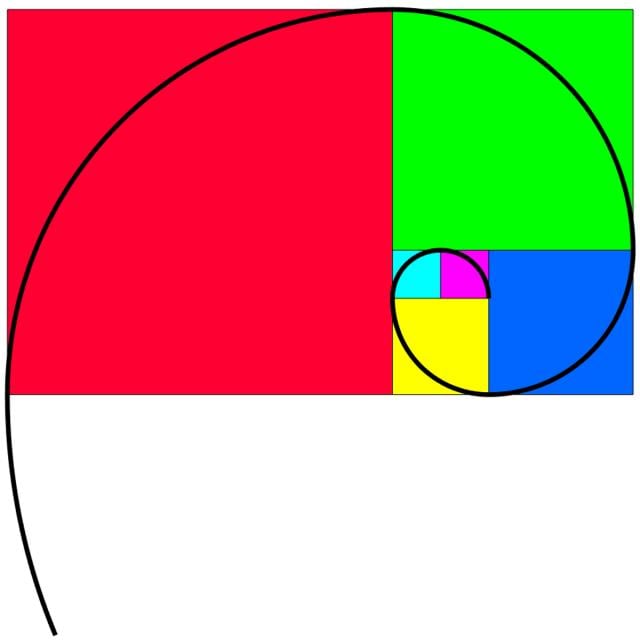
We learn about the Fibonacci Q-matrix and Cassini's identity. Cassini's identity is the basis for a famous dissection fallacy colourfully named the Fibonacci bamboozlement. A dissection fallacy is an apparent paradox arising from two arrangements of different area from one set of puzzle pieces. We also derive formulas for the sum of the first n Fibonacci numbers, and the sum of the first n Fibonacci numbers squared. Finally, we show how to construct a golden rectangle, and how this leads to the beautiful image of spiralling squares.

WEEK 3
The most irrational number
We learn about the golden spiral and the Fibonacci spiral. Because of the relationship between the Fibonacci numbers and the golden ratio, the Fibonacci spiral eventually converges to the golden spiral. You will recognise the Fibonacci spiral because it is the icon of our course. We next learn about continued fractions. To construct a continued fraction is to construct a sequence of rational numbers that converges to a target irrational number. The golden ratio is the irrational number whose continued fraction converges the slowest. We say that the golden ratio is the irrational number that is the most difficult to approximate by a rational number, or that the golden ratio is the most irrational of the irrational numbers. We then define the golden angle, related to the golden ratio, and use it to model the growth of a sunflower head. Use of the golden angle in the model allows a fine packing of the florets, and results in the unexpected appearance of the Fibonacci numbers in the sunflower.

Go to Class
MOOC List is learner-supported. When you buy through links on our site, we may earn an affiliate commission.

Related Courses

Calculus: Single Variable Part 3 - Integration (Coursera) Coursera
University of Pennsylvania

Calculus: Single Variable Part 3 - Integration (Coursera)

Calculus is one of the grandest achievements of human thought, explaining everything from planetary orbits to the optimal size of a city to the periodicity of a heartbeat. This brisk course covers the core ideas of single-variable Calculus with emphases on conceptual understanding and applications. The course is ideal for students beginning in the engineering, physical, and social sciences.

Sep 28th 2026
4 Weeks
Mathematical Foundations for Cryptography (Coursera) Coursera
University of Colorado System

Mathematical Foundations for Cryptography (Coursera)

Welcome to Course 2 of Introduction to Applied Cryptography. In this course, you will be introduced to basic mathematical principles and functions that form the foundation for cryptographic and cryptanalysis methods. These principles and functions will be helpful in understanding symmetric and asymmetric cryptographic methods examined in Course 3 and Course 4. These topics should prove especially useful to you if you are new to cybersecurity. It is recommended that you have a basic knowledge of computer science and basic math skills such as algebra and probability.

Sep 28th 2026
4 Weeks
Discrete Mathematics (Coursera) Coursera
Shanghai Jiao Tong University

Discrete Mathematics (Coursera)

Discrete mathematics forms the mathematical foundation of computer and information science. It is also a fascinating subject in itself. Learners will become familiar with a broad range of mathematical objects like sets, functions, relations, graphs, that are omnipresent in computer science. Perhaps more importantly, they will reach a certain level of mathematical maturity - being able to understand formal statements and their proofs; coming up with rigorous proofs themselves; and coming up with interesting results.

Sep 28th 2026
5-12 Weeks
Introduction to Mathematical Thinking (Coursera) Coursera
Stanford University

Introduction to Mathematical Thinking (Coursera)

Learn how to think the way mathematicians do - a powerful cognitive process developed over thousands of years. Mathematical thinking is not the same as doing mathematics – at least not as mathematics is typically presented in our school system. School math typically focuses on learning procedures to solve highly stereotyped problems. Professional mathematicians think a certain way to solve real problems, problems that can arise from the everyday world, or from science, or from within mathematics itself.

Oct 5th 2026
5-12 Weeks
Differential Equations Part III Systems of Equations (Coursera) Coursera
Korea Advanced Institute of Science and Technology - KAIST

Differential Equations Part III Systems of Equations (Coursera)

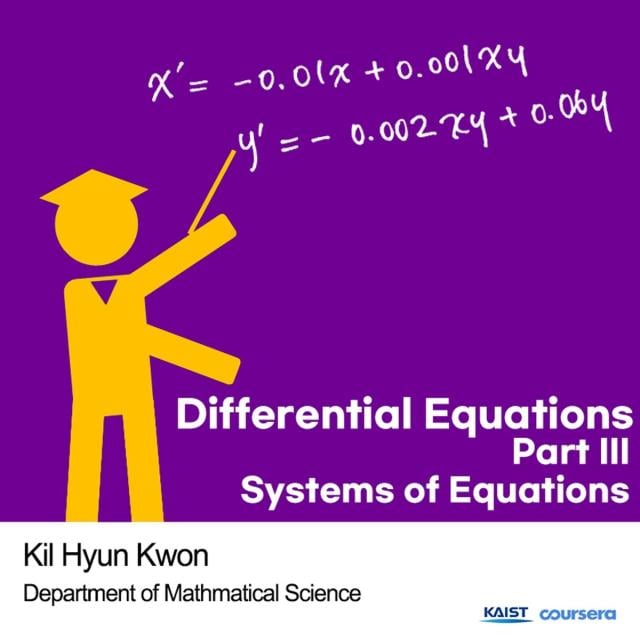
This introductory courses on (Ordinary) Differential Equations are mainly for the people, who need differential equations mostly for the practical use in their own fields. So we try to provide basic terminologies, concepts, and methods of solving various types of differential equations as well as a rudimentary but indispensable knowledge of the underlying theory and some related applications.

Oct 5th 2026
5-12 Weeks
Aléatoire : une introduction aux probabilités - Partie 1 (Coursera) Coursera
École Polytechnique

Aléatoire : une introduction aux probabilités - Partie 1 (Coursera)

Ce cours d'introduction aux probabilités a la même contenu que le cours de tronc commun de première année de l'École polytechnique donné par Sylvie Méléard. Le cours introduit graduellement la notion de variable aléatoire et culmine avec la loi des grands nombres et le théorème de la limite centrale. Les notions mathématiques nécessaires sont introduites au fil du cours et de nombreux exercices corrigés sont proposés.

Oct 5th 2026
5-12 Weeks
Matrix Methods (Coursera) Coursera
University of Minnesota

Matrix Methods (Coursera)

Mathematical Matrix Methods lie at the root of most methods of machine learning and data analysis of tabular data. Learn the basics of Matrix Methods, including matrix-matrix multiplication, solving linear equations, orthogonality, and best least squares approximation. Discover the Singular Value Decomposition that plays a fundamental role in dimensionality reduction, Principal Component Analysis, and noise reduction.

Oct 12th 2026
5-12 Weeks
Analysis of Algorithms (Coursera) Coursera
Princeton University

Analysis of Algorithms (Coursera)

This course teaches a calculus that enables precise quantitative predictions of large combinatorial structures. In addition, this course covers generating functions and real asymptotics and then introduces the symbolic method in the context of applications in the analysis of algorithms and basic structures such as permutations, trees, strings, words, and mappings.

Sep 28th 2026
5-12 Weeks