Inequality and Democracy (Coursera)

Offered by Universiteit Utrecht,
Inequality and Democracy (Coursera)

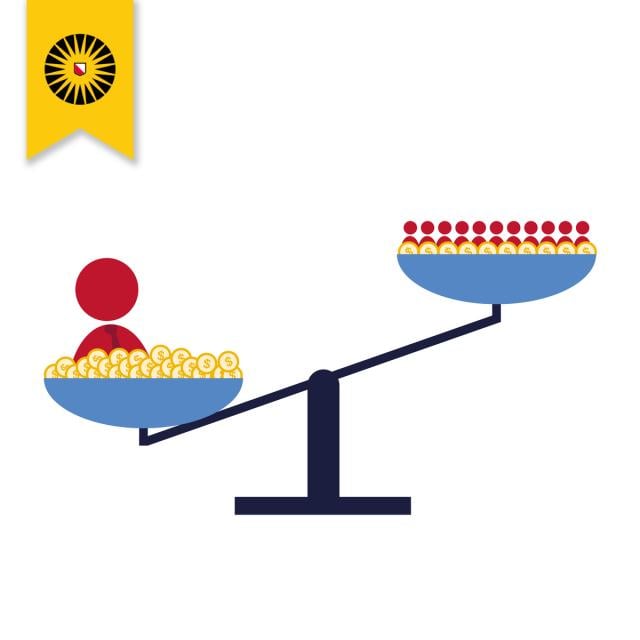
Most countries are getting more and more unequal. But the core of democracy is political equality: that everyone should have an equal say in how their country is run. Can we really expect these things to go together? Can people have equal political power while economic inequality grows and grows? Take this course and decide for yourself.

Class Deals by MOOC List - Click here and see Coursera's Active Discounts, Deals, and Promo Codes.

You’ll learn about:
• The rise of economic inequality
• Property rights and the corporation
• Democracy: Its value and history
• Campaign finance and lobbying
• Tax avoidance and capital flight
• Alternatives to our economic system
This is an interdisciplinary course combining:
• Politics
• Philosophy
• Economics
• History
• Law
Our course is for anyone looking for an accessible introduction to these topics. You might a concerned citizen, or someone who works in a field like politics, media, education, government or law. The difficulty level is similar to the first-year of an undergraduate degree. No prior knowledge is assumed.

Syllabus

WEEK 1: Economic inequality
WEEK 2: Property and corporations
WEEK 3: Democracy
WEEK 4: Lobbying and campaign finance
WEEK 5: Capital flight and tax avoidance
WEEK 6: Alternative economic institutions


Go to Class
MOOC List is learner-supported. When you buy through links on our site, we may earn an affiliate commission.

Related Courses

What are the Chances? Probability and Uncertainty in Statistics (Coursera) Coursera
Johns Hopkins University

What are the Chances? Probability and Uncertainty in Statistics (Coursera)

This course focuses on how analysts can measure and describe the confidence they have in their findings. The course begins with an overview of the key probability rules and concepts that govern the calculation of uncertainty measures. We’ll then apply these ideas to variables (which are the building blocks of statistics) and their associated probability distributions. The second half of the course will delve into the computation and interpretation of uncertainty. We’ll discuss how to conduct a hypothesis test using both test statistics and confidence intervals. Finally, we’ll consider the role of hypothesis testing in a regression context, including what we can and cannot learn from the statistical significance of a coefficient. By the end of the course, you should be able to discuss statistical findings in probabilistic terms and interpret the uncertainty of a particular estimate.

Sep 21st 2026
4 Weeks
After the Arab Spring – Democratic Aspirations and State Failure (Coursera) Coursera
University of Copenhagen

After the Arab Spring – Democratic Aspirations and State Failure (Coursera)

Learn why the hope and excitement of the Arab Spring is gone, why so many Arab states are falling apart, why the youth are so frustrated, why there are so many refugees, and what can be done about it. The so-called Arab Spring appeared to end decades of exceptionalism and bring the Arab world back into the mainstream of global developments. The rebellions promised the return of politics and the reassertion of popular sovereignty against their corrupt and geriatric leaders. Much hope and flowery language greeted the young men and women who deposed their leaders and tried to build new, better societies.

Sep 28th 2026
5-12 Weeks
Economie du sol et de l'immobilier II (Coursera) Coursera
École Polytechnique Fédérale de Lausanne

Economie du sol et de l'immobilier II (Coursera)

Quels sont les liens entre les prix fonciers, les prix immobiliers et les prix pour l'usage des immeubles? Est-ce que les prix immobiliers permettent de comprendre les prix fonciers? Ou l'inverse? Quels sont les calculs faits par les opérateurs sur ces marchés? On a le sentiment que ces marchés sont liés les uns aux autres. Avec ce cours, vous comprendrez mieux comment. En passant, vous aurez acquis une meilleure compréhension des mécanismes économiques qui peut être utile dans d'autres domaines.

Sep 21st 2026
5-12 Weeks
Data Literacy Capstone – Evaluating Research (Coursera) Coursera
Johns Hopkins University

Data Literacy Capstone – Evaluating Research (Coursera)

This is the final course in the Data Literacy Specialization. In this capstone course, you'll apply the skills and knowledge you have acquired in the specialization to the critical evaluation of an original quantitative analysis. The project will first require you to identify and read a piece of high-quality, original, quantitative research on a topic of your choosing. You’ll then interpret and evaluate the findings as well as the methodological approach. As part of the project, you’ll also review other students’ submissions. By the end of the project, you should be empowered to be a critical consumer and user of quantitative research.

Sep 21st 2026
3 Weeks
Comparative Political Systems (Coursera) Coursera
University of Naples Federico II

Comparative Political Systems (Coursera)

Comparative politics covers a wide variety of topics and themes. The course starts with the definition of the comparative method giving special emphasis to concept formation and historical and institutional approaches. The bulk of the course is devoted to the theory of coalitions and the processes of government formation, functioning, termination. Through several in-depth analyses, the course will throw light on the way democratic regimes are governed. Electoral rules will receive special attention and their impact both on citizens’ behavior and parties and the party system will be thoroughly examined.

Sep 28th 2026
4 Weeks
Understanding Political Concepts (Coursera) Coursera
University of Naples Federico II

Understanding Political Concepts (Coursera)

Political science discourse brings us face to face with many important concepts like authority, democracy, and power. However, all of them are used differently in different contexts, and their specific meaning depends on the theory they relate to. There is no way around such puzzling diversity. Students of political science simply have to accept this challenge. Yet, the diversity of political science concepts can be used as a powerful resource for learning, through intellectual techniques for stirring personal creativity.

Sep 28th 2026
4 Weeks
Model Thinking (Coursera) Coursera
University of Michigan

Model Thinking (Coursera)

We live in a complex world with diverse people, firms, and governments whose behaviors aggregate to produce novel, unexpected phenomena. We see political uprisings, market crashes, and a never ending array of social trends. How do we make sense of it? Models. Evidence shows that people who think with models consistently outperform those who don't. And, moreover people who think with lots of models outperform people who use only one. Why do models make us better thinkers? Models help us to better organize information - to make sense of that fire hose or hairball of data (choose your metaphor) available on the Internet.

Sep 21st 2026
5-12 Weeks
Economic Growth and Distributive Justice Part II - Maximize Social Wellbeing (Coursera) Coursera
Tel Aviv University

Economic Growth and Distributive Justice Part II - Maximize Social Wellbeing (Coursera)

If you really care about the big questions in the economies and societies of the 21st century, such as distributive justice - namely, inequality of income or wealth, and its correlation with economic growth - this course is meant for you. The knowledge you will gain can truly change your outlook on our world.

Sep 28th 2026
5-12 Weeks
The Ancient Greeks (Coursera) Coursera
Wesleyan University

The Ancient Greeks (Coursera)

This is a survey of ancient Greek history from the Bronze Age to the death of Socrates in 399 BCE. Along with studying the most important events and personalities, we will consider broader issues such as political and cultural values and methods of historical interpretation.

Sep 21st 2026
5-12 Weeks
Civic Engagement in American Democracy (Coursera) Coursera
Duke University

Civic Engagement in American Democracy (Coursera)

So how does the American political system work? Who are some of the key actors? What are key concepts for a student trying to understand what’s going on? How can I as a citizen influence politics? Civic Engagement in American Democracy takes on these and other key questions. We’re Dr. Nicholas Carnes and Dr. Bruce Jentleson, the principal course instructors. Along with our Duke faculty colleagues who also contributed modules, we’ve designed the course to provide a strong foundational introduction to US politics.

Oct 5th 2026
4 Weeks
Paradoxes of War (Coursera) Coursera
Princeton University

Paradoxes of War (Coursera)

The Paradoxes of War teaches us to understand that war is not only a normal part of human existence, but is arguably one of the most important factors in making us who we are. Through this course, I hope that you will come to appreciate that war is both a natural expression of common human emotions and interactions and a constitutive part of how we cohere as groups. That is, war is paradoxically an expression of our basest animal nature and the exemplar of our most vaunted and valued civilized virtues.

Sep 21st 2026
13-24 Weeks
Firm Level Economics: Consumer and Producer Behavior (Coursera) Coursera
University of Illinois at Urbana-Champaign

Firm Level Economics: Consumer and Producer Behavior (Coursera)

All goods and services are subject to scarcity at some level. Scarcity means that society must develop some allocation mechanism – rules to determine who gets what. Over recorded history, these allocation rules were usually command based – the king or the emperor would decide. In contemporary times, most countries have turned to market based allocation systems. In markets, prices act as rationing devices, encouraging or discouraging production and encouraging or discouraging consumption in such a way as to find an equilibrium allocation of resources.

Sep 21st 2026
4 Weeks