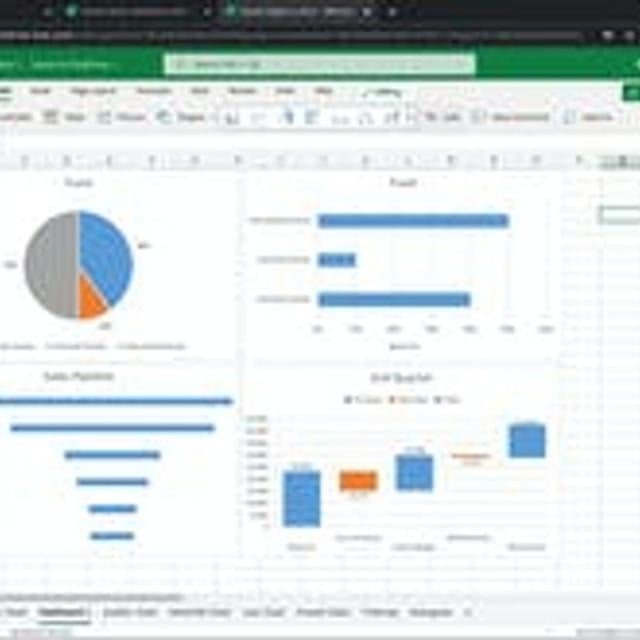
Excel Basics for Data Visualizations (Coursera)

Excel Basics for Data Visualizations (Coursera)

By the end of this project, you will create different types of charts and graphs using Excel spreadsheets and built interactive dashboards. You will acquire basic skills needed to manipulate and create data visualizations and their importance for storytelling. This project is a first step in the development of data visualizations and telling a story.

Class Deals by MOOC List - Click here and see Coursera's Active Discounts, Deals, and Promo Codes.

We will learn about the importance of charts and graphs and how they are able to shape our data providing meaningful information for decision making. Also, we will understand if we have a clean and clear data visualizations we will have a much clear picture of what is happening with our data.

In this Guided Project, you will:

  • Create an Excel for the Web account.
  • Create pie, bar, line, scatter, funnel, waterfall, histograms and treemaps charts using Excel spreadsheets.
  • Create an interactive dashboard and understand the importance of data visualizations.

Learn step-by-step

  1. Data Visualization and more
  2. Creating an Interactive Dashboard
  3. Create Funnel and Waterfall Charts
  4. Create Histograms and Treemaps Charts
  5. Create Scatter and Line Charts
  6. Create Pie and Bar Charts
  7. Create an Excel for the Web account
Go to Class
MOOC List is learner-supported. When you buy through links on our site, we may earn an affiliate commission.
Related Courses

Visual Analytics with Tableau (Coursera) Coursera
University of California, Davis

Visual Analytics with Tableau (Coursera)

In this third course of the specialization, we’ll drill deeper into the tools Tableau offers in the areas of charting, dates, table calculations and mapping. We’ll explore the best choices for charts, based on the type of data you are using. We’ll look at specific types of charts including scatter plots, Gantt charts, histograms, bullet charts and several others, and we’ll address charting guidelines.

Jun 1st 2026
4 Weeks
Research Report: Delivering Insights (Coursera) Coursera
University of California, Davis

Research Report: Delivering Insights (Coursera)

You have completed all the hard work of conducting your internal, secondary, and primary research. You have analyzed all the data and are able to formulate insights and recommendations based on your research proposal. But what is the best way to present your findings and be able to make a decision? In this course, you will discuss how to incorporate a story in your marketing presentation to help you capture the attention and gain support of stakeholders and business leaders.

Jun 1st 2026
4 Weeks
Data-driven Decision Making (Coursera) Coursera
PwC

Data-driven Decision Making (Coursera)

Welcome to Data-driven Decision Making. In this course, you'll get an introduction to Data Analytics and its role in business decisions. You'll learn why data is important and how it has evolved. You'll be introduced to “Big Data” and how it is used. You'll also be introduced to a framework for conducting Data Analysis and what tools and techniques are commonly used. Finally, you'll have a chance to put your knowledge to work in a simulated business setting. This course was created by PricewaterhouseCoopers LLP with an address at 300 Madison Avenue, New York, New York, 10017.

Jun 1st 2026
4 Weeks
Supply Chain Planning (Coursera) Coursera
Rutgers University

Supply Chain Planning (Coursera)

Have you ever wondered how companies know how much to produce in advance so that they do not make too much or too little? Matching supply and demand requires planning. This course introduces you to the exciting area of supply chain planning. Part of a broader specialization on Supply Chain Management, you will master different forecasting techniques, essential for building a Sales and Operations Plan. At the completion of this course you will have the tools and techniques to analyze demand data, construct different forecasting techniques, and choose the most suitable one for projecting future demand.

Jun 1st 2026
4 Weeks
Data Visualization (Coursera) Coursera
Ball State University

Data Visualization (Coursera)

In the era of big data, acquiring the ability to analyze and visually represent “Big Data” in a compelling manner is crucial. Therefore, it is essential for data scientists to develop the skills in producing and critically interpreting digital maps, charts, and graphs. Data visualization is an increasingly important topic in our globalized and digital society. It involves graphically representing data or information, enabling decision-makers across various industries to comprehend complex concepts and processes that may otherwise be challenging to grasp.

Jun 2nd 2026
5-12 Weeks
Exploratory Data Analysis with MATLAB (Coursera) Coursera
MathWorks

Exploratory Data Analysis with MATLAB (Coursera)

In this course, you will learn to think like a data scientist and ask questions of your data. You will use interactive features in MATLAB to extract subsets of data and to compute statistics on groups of related data. You will learn to use MATLAB to automatically generate code so you can learn syntax as you explore. You will also use interactive documents, called live scripts, to capture the steps of your analysis, communicate the results, and provide interactive controls allowing others to experiment by selecting groups of data.

Jun 1st 2026
5-12 Weeks
Financing for Startup Businesses (Coursera) Coursera
Duke University

Financing for Startup Businesses (Coursera)

This course will teach you how to manage a startup’s financing strategy, where you will learn how to build capitalization tables (or “cap tables”) in Excel. Cap tables will help you explore different financing strategies for your startup company and determine which financing decisions are best for your entrepreneurial venture. You will also learn about innovations in the digital space that allow new ways to finance entrepreneurial ventures. These include different forms of crowdfunding, and alternative credit scoring mechanisms based on web-based data.

Jun 1st 2026
4 Weeks
Data Science Companion (Coursera) Coursera
MathWorks

Data Science Companion (Coursera)

The Data Science Companion provides an introduction to data science. You will gain a quick background in data science and core machine learning concepts, such as regression and classification. You’ll be introduced to the practical knowledge of data processing and visualization using low-code solutions, as well as an overview of the ways to integrate multiple tools effectively to solve data science problems.

Jun 5th 2026
4 Weeks
Fundamentals of Visualization with Tableau (Coursera) Coursera
University of California, Davis

Fundamentals of Visualization with Tableau (Coursera)

In this first course of the specialization, you will discover just what data visualization is, and how we can use it to better see and understand data. Using Tableau, we’ll examine the fundamental concepts of data visualization and explore the Tableau interface, identifying and applying the various tools Tableau has to offer.

Jun 1st 2026
4 Weeks
Data – What It Is, What We Can Do With It (Coursera) Coursera
Johns Hopkins University

Data – What It Is, What We Can Do With It (Coursera)

This course introduces students to data and statistics. By the end of the course, students should be able to interpret descriptive statistics, causal analyses and visualizations to draw meaningful insights. The course first introduces a framework for thinking about the various purposes of statistical analysis. We’ll talk about how analysts use data for descriptive, causal and predictive inference. We’ll then cover how to develop a research study for causal analysis, compute and interpret descriptive statistics and design effective visualizations. The course will help you to become a thoughtful and critical consumer of analytics.

Jun 1st 2026
4 Weeks
Data Management and Visualisation (Coursera) Coursera
Wesleyan University

Data Management and Visualisation (Coursera)

Whether being used to customize advertising to millions of website visitors or streamline inventory ordering at a small restaurant, data is becoming more integral to success. Too often, we’re not sure how use data to find answers to the questions that will make us more successful in what we do. In this course, you will discover what data is and think about what questions you have that can be answered by the data – even if you’ve never thought about data before. Based on existing data, you will learn to develop a research question, describe the variables and their relationships, calculate basic statistics, and present your results clearly.

Jun 1st 2026
4 Weeks
Understanding and Visualizing Data with Python (Coursera) Coursera
University of Michigan

Understanding and Visualizing Data with Python (Coursera)

In this course, learners will be introduced to the field of statistics, including where data come from, study design, data management, and exploring and visualizing data. Learners will identify different types of data, and learn how to visualize, analyze, and interpret summaries for both univariate and multivariate data. Learners will also be introduced to the differences between probability and non-probability sampling from larger populations, the idea of how sample estimates vary, and how inferences can be made about larger populations based on probability sampling.

Jun 1st 2026
4 Weeks