EdX

Early Christian Outlook and its Jewish Matrix: Narratives of Gospels and Acts (edX)

Offered by IsraelX,
Early Christian Outlook and its Jewish Matrix: Narratives of Gospels and Acts (edX)

What exactly do we mean by saying that Christianity was born out of Judaism? Looking closer, you discover that various scholars disagree on the issue. This course, presented by the Hebrew University of Jerusalem, offers you a Jerusalem perspective.

Class Deals by MOOC List - Click here and see EdX's Active Discounts, Deals, and Promo Codes.

When the earliest followers of Jesus suggested that their teacher was the anointed one, the Messiah, promised by ancient prophets who would bring redemption to Israel, they applied a broader Jewish messianic belief to Jesus.

  • What different kinds of messianic ideas were people nurturing?
  • Was a messianic expectation a mainstream or a marginal viewpoint?
  • To which Jewish groups first Jesus followers felt close and from whom they were estranged?

The movement that had started in the Land of Israel would reach out at an early stage to the broader Greco-Roman world, to both Jews and non-Jews there.

  • How much were the earliest Christian texts, coming from that Greek-speaking phase, influenced by their new cultural environment?
  • Do they still reflect faithfully the initial beliefs of Jesus' followers? Do they reinterpret them dramatically? Or do they even turn their back on them?

These are all complicated questions, which are also crucial for understanding the birth of Christianity from within the Jewish matrix, as well as various modern religious movements. And these are only part of the questions to be asked if we truly want to reach such an understanding. Our inquiry may lead us to some unexpected answers.
If you are ready to be part of the ongoing discussion and are willing to discover what may be called a Jerusalem perspective on the topic, you are invited to join our course.

What you'll learn
Students will learn:

  • To recognize the importance of contextualizing nascent Christianity within late Second Temple Judaism.
  • To name the main genres of the surviving early Christian sources and describe the process that eventually led to the canonization of the New Testament.
  • To describe the historical circumstances of the birth of Christianity and variegated settings of the first decades of its existence.
  • To comprehend the transition of the earliest Jesus-centered tradition on the way from its oral Semitic stage to written Greek compositions.
  • To discern various strategies employed by the Synoptic tradition (Matthew, Mark and Luke) to define Jesus' messiahship vis-a-vis the variety of Second Temple Jewish messianic beliefs.
  • To recognize the multifaceted character of references to "the Jews" in the Fourth Gospel and acknowledge the variegated explanations of the Gospel's harsh polemical stance raised in the research.
  • To discern the roots of the notion of Messiah's pre-existence in Second Temple Jewish literature and its metamorphosis in rabbinic sources.
  • To discern John's reworking of the Synoptic tradition of Jesus' miracles into the narrative of signs and wonders, using the story of Exodus as its focal point of reference.
  • To recognize the conflict within the Jesus movement about inclusion of the Gentiles and their obligations to the Torah observance as reflection of differences of opinion in broaderSecond Temple Judaism.

Syllabus

Week 1
Introduction to the course. Second Temple Judaism as setting of nascent Christianity. From the Land of Israel to broader Greco-Roman context. Gospels and Acts as part of the early Jesus movement literary output. Formation of Gospel tradition and evolution in perception of Jesus' mission.

Week 2
Early Christian message and Jewish messianic beliefs (A) Variety of messianic outlooks in late Second Temple Judaism. The Synoptic Gospels as a reflection of that variety. (B) Problematic side of Jesus' kingly messiahship. A switch to another Second Temple idea, that of a heavenly savior.

Week 3
Hebrew Bible as the Gospels' point of reference (A) The claim for Jesus' messiahship in the light of other Jewish exegetical trends. Messianic interpretation of Scripture at Qumran. (B) Jesus as Interpreter of the Torah vis-a-vis the Torah exegesis in the Dead Sea Scrolls and among proto-rabbinic sages.

Week 4
The Kingdom of God idea: its Jewish setting The kingdom and the End of Days. Eschatology in the Gospels and at Qumran.

Week 5
Struggle for self-identity (A) Strategies of identity building in the Synoptics. Jesus as a Torah sage/Pharisee? The polemic against Pharisees in the Gospels, Qumran and rabbinic sources. (B) Gospel of John's sectarian tendency compared to that of the Scrolls. Polemical function of "the Jews" in John's narrative.

Week 6
Gospel of John's special stance (A) Messiah as revealer of God's Word. Messiah's preexistence: the question of Jewish setting. (B) Jesus as second Moses.

Week 7
Jesus' death and resurrection as the focal point of the Gospel narrative Various meanings of Messiah's death: Synoptic narrative vs. John's version. A suffering Messiah: precedents in Jewish thought.

Week 8
Early Christian outlook reflected in Acts (A) Preaching to the Jews in preparation for the Kingdom of Israel. Expectation of Jesus' return and the meaning of the interim period. (B) Preaching to the Gentiles as fulfillment of biblical prophecies and metamorphoses in the movement's outlook. Paul's mission and trends in Hellenistic Jewry. The issue of Torah observance.

Week 9
Delay in redemption and the response of Acts.
Renewal of prophecy/gift of the Spirit and the mission to the Gentiles as the signs of the interim period. Temple in Acts' eschatological scenario. Between quasi-Qumranian beliefs and broader universalistic ideas. Concluding remarks.
Go to Class
MOOC List is learner-supported. When you buy through links on our site, we may earn an affiliate commission.

Related Courses

The Holocaust: an Introduction - Part 2 (FutureLearn) FutureLearn
Tel Aviv University

The Holocaust: an Introduction - Part 2 (FutureLearn)

Part 2 of 2. This course depicts the complex history of the Holocaust, highlighting its impact on our world today. The Holocaust was an inconceivable historical event, which forever robbed Western culture of its innocence. As civilized human beings, we fail to understand how events of such horror could have taken place, and how an idea so inhumanly warped could have spread like wildfire through an entire continent, instigating the systematic annihilation of millions of Jews.

No sessions available
3 Weeks
The Talmud: A Methodological Introduction (Coursera) Coursera
Northwestern University

The Talmud: A Methodological Introduction (Coursera)

The Talmud is one of the richest and most complicated works of literature the world has ever known. Since being composed around 1500 years ago it has inspired not only religious reverence but significant intellectual engagement. In this course learners will be introduced to the unique characteristics of this text and the challenges that inhere in studying it while studying a chapter of the Talmud.

Jun 1st 2026
5-12 Weeks
Arch of Titus: Rome and the Menorah (Coursera) Coursera
Yeshiva University

Arch of Titus: Rome and the Menorah (Coursera)

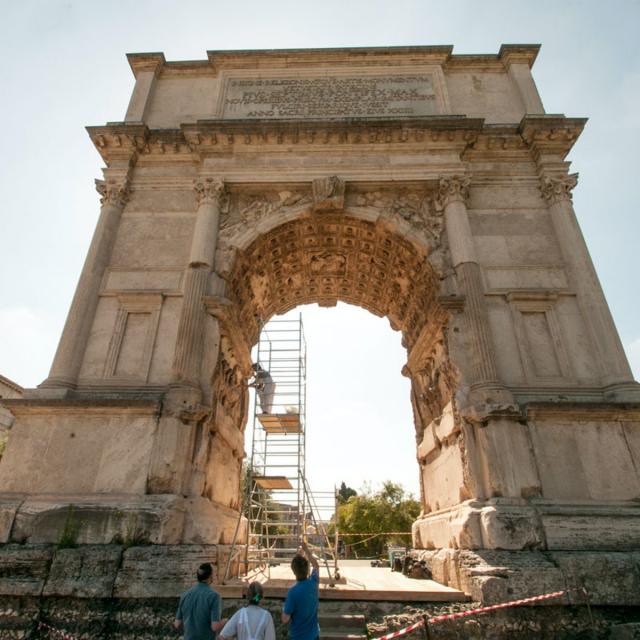
The Arch of Titus: Rome and the Menorah explores one of the most significant Roman monuments to survive from antiquity, from the perspectives of Roman, Jewish and later Christian history and art. The Arch of Titus commemorates the destruction of Jerusalem by the emperor Titus in 70 CE, an event of pivotal importance for the history of the Roman Empire, of Judaism, of Christianity and of modern nationalism. Together with your guide, Professor Steven Fine, you will examine ancient texts and artifacts, gaining skills as a historian as you explore the continuing significance of the Arch of Titus from antiquity to the very present.

Jun 8th 2026
5-12 Weeks
Change of Era: The Origins of Christian Culture through the Lens of Archaeology (FutureLearn) FutureLearn
University of Padova

Change of Era: The Origins of Christian Culture through the Lens of Archaeology (FutureLearn)

Learn about innovative approaches to the study of early Christianity and discover its role in a crucial period of history. Delve into early Christianity. On this four-week course, you’ll gain a better understanding of a crucial period in history – one characterised by deep political, economic, cultural, and environmental transformations in the context of the end of the Western Roman Empire.

Dec 5th 2022
4 Weeks
Biblical Archaeology: The archaeology of ancient Israel and Judah (edX) EdX
IsraelX

Biblical Archaeology: The archaeology of ancient Israel and Judah (edX)

Join me as I share with you my passion for archaeological discovery and learn about the exciting methods of modern archaeology. Explore how archaeology illuminates biblical Israel and Judah, and the archaeological finds relate to the bible. Join me for an introductory course on biblical archaeology of ancient Israel and Judah during the Iron Age (ca. 1200-586 BCE).

Nov 1st 2022
5-12 Weeks
Deciphering Secrets: Unlocking the Manuscripts of Medieval Burgos (Spain) (edX) EdX
Universidad Carlos III de Madrid - UC3M,UC3Mx

Deciphering Secrets: Unlocking the Manuscripts of Medieval Burgos (Spain) (edX)

Explore the medieval city of Burgos (Spain) and assess its history of Jewish, Christian, and Muslim religious and cultural coexistence. This history course delves into the medieval history of the city of Burgos, from its inception in 884 c.e. as the homeland of the Spanish Kingdom of Castile and Leon, until the completion of the Spanish Reconquista in 1492.

No sessions available
5-12 Weeks
Toledo: Deciphering Secrets of Medieval Spain (Coursera) Coursera
University of Colorado System

Toledo: Deciphering Secrets of Medieval Spain (Coursera)

This course evaluates the medieval history of Toledo from the era of the Visigoth Kingdom (6th-8th centuries) through its Islamic period (8th to 11th centuries) and into its reintegration into Christian Spain (after 1085 c.e.) In particular, we take note of the cultural and religious transformations that characterized the city with a special effort to understand how many peoples and religions came to settle and live amongst one another.

Jul 1st 2024
5-12 Weeks
Storytelling in Advertising (FutureLearn) FutureLearn
D&AD

Storytelling in Advertising (FutureLearn)

Learn from top creatives how to engage audiences by using storytelling in advertising, from crafting a narrative to using digital. We’re D&AD – a global organisation that inspires, celebrates and enables creative excellence worldwide. Discovering and nurturing talent is at the heart of what we do, supporting creatives throughout all stages of their careers.

No sessions available
4 Weeks
A Global History of Architecture (edX) EdX
MIT,MITx

A Global History of Architecture (edX)

Learn about humanity’s rich architectural history on this journey around the globe – from 100,000 BCE to ca. 1,600 CE. How do we understand architecture? One way of answering this question is by looking through the lens of history, beginning with First Societies and extending to the 16th century. This course in architectural history is not intended as a linear narrative, but rather aims to provide a more global view, by focusing on different architectural "moments."

Oct 18th 2023
5-12 Weeks
Transmedia Storytelling: Narrative worlds, emerging technologies, and global audiences (Coursera) Coursera
UNSW Sydney - University of New South Wales

Transmedia Storytelling: Narrative worlds, emerging technologies, and global audiences (Coursera)

Transmedia storytelling is the practice of designing, sharing, and participating in a cohesive story experience across multiple traditional and digital delivery platforms - for entertainment, advertising and marketing, or social change. Have you ever read a book, seen a movie, watched a television show, or played a game that centred around different aspects of a larger story or universe? You may be familiar with popular examples of such universes like Star Wars, Marvel, and The Walking Dead (to name a few). How do the professionals develop such expansive narratives? How do they ensure that each element stays true to the original story? How do they innovatively use different technologies to share the stories, grow audiences and create an active and involved community of fans?

May 18th 2026
5-12 Weeks
Christianity Through Its Scriptures (edX) EdX
HarvardX,Harvard University

Christianity Through Its Scriptures (edX)

Learn about Christianity through a study of its sacred scriptures. We will explore how diverse Christians have interpreted these writings and practiced their teachings over a 2000 year, global history. Christianity is a global religion. From modest beginnings 2,000 years ago, it has grown to encompass nearly a third of the human population. Diverse in languages, cultures, histories and creeds, Christians nonetheless share a common collection of sacred scripture called the Bible.

Self Paced
Self-Paced
Jesus in Scripture and Tradition (edX) EdX
University of Notre Dame,NotreDameX

Jesus in Scripture and Tradition (edX)

The Bible says that Jesus was identified as God's beloved son at his baptism. The same identification was made about Israel in the Old Testament and the disciples of Christ at their baptism. The striking similarity of these titles establishes a tight interrelationship between the people Israel, the person of Jesus Christ, and the church.

No sessions available
4 Weeks