CAM and Design Manufacturing for Mechanical Engineers with Autodesk Fusion 360 (Coursera)

Offered by Autodesk,
CAM and Design Manufacturing for Mechanical Engineers with Autodesk Fusion 360 (Coursera)

With design for manufacturing, our design process focused on the design over its cost, but always keeping in mind how parts needed to be made. With manufacturing at the core of a design, we're able to fix potential problems in the design phase rather than after production. In many cases, the end product is made up of an assembly of different pieces to simplify manufacturing or to achieve specific design goals. Each piece represents a certain tolerance and put together, things might not work or fit if they weren’t accounted for in the design.

Class Deals by MOOC List - Click here and see Coursera's Active Discounts, Deals, and Promo Codes.

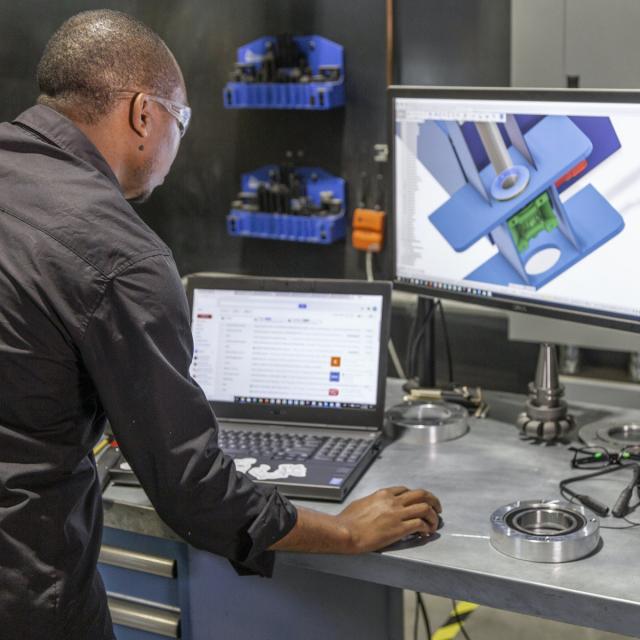
We'll take a closer look at design and detail for manufacture and create toolpaths to cut parts. Even if the end goal as an engineer isn’t to fabricate your own parts, it’s a valuable skill to understand how things are made and what design decisions can ultimately affect how something is created.
After taking this course, you'll be able to:

  • Inspect a multicomponent assembly.
  • Identify manufacturing methods based on part inspection.
  • Create detailed drawings for manufacturing.
  • Practice creating toolpaths for manufacture.

What You Will Learn

  • Inspect a multicomponent assembly.
  • Identify manufacturing methods based on part inspection.
  • Create detailed drawings for manufacturing.
  • Practice creating toolpaths for manufacture.

Course 4 of 4 in the Autodesk CAD/CAM/CAE for Mechanical Engineering Specialization.

Syllabus

WEEK 1
Drafting for Manufacture
In Week 1, we’ll focus on the creation of detailed drawings for production. Understanding not only how to create or customize a drawing, but also how to identify critical features or aspects of a design on a drawing is key to helping ensure the parts you get are the parts you want.

WEEK 2
Design for Manufacture
In Week 2, we’ll discuss topics surrounding the review and modification of designs for manufacture. From tool accessibility, to understanding the required tools and the design of fixturing and soft jaws for vises, this week will help prepare for programming toolpaths. We explore and understand the cost associated with part setup, raw stock, and material removal to better identify design changes for production.

WEEK 3
Setting up a CNC Milling program
In Week 3, we’ll focus on setting up and creating a CNC milling program. We’ll lay the foundation for all programs by creating and managing a tool library, defining a setup, and creating milling and drilling toolpaths. The setup and creation of these will be the basis for nearly every milling program.

WEEK 4
Machining complex geometry
In Week 4, we’ll cover additional toolpaths required to help rough and finish complex 3D shapes. Understanding the toolpaths available and the types of geometry they can be used on will help you to make informed decisions on any part. Toolpaths often have strengths and weaknesses based on the geometry and we'll identify some of these to help get your parts to the shop floor quicker.
Go to Class
MOOC List is learner-supported. When you buy through links on our site, we may earn an affiliate commission.

Related Courses

Perspectives in Digital Transformation: Manufacturing (Coursera) Coursera
Inter-American Development Bank - IDB

Perspectives in Digital Transformation: Manufacturing (Coursera)

Are you interested in learning how Digital Transformation is driving the manufacturing sector in Latin America and the Caribbean? This course will help you identify challenges and opportunities that digitalization can offer in the industry. Along with specialists from BID Invest and the private sector, you will learn firsthand about the tools and best practices that illustrate the potential of digital solutions, with a cross-cutting focus on sustainability.

Aug 3rd 2026
4 Weeks
Fundamentals of waves and vibrations (Coursera) Coursera
École Polytechnique

Fundamentals of waves and vibrations (Coursera)

Waves are everywhere. On water of course, but also in the air as you hear a plane, and under your feet during an earthquake certainly. Vibrations, too, are everywhere In your bike as you go over a bump, in you guitar as you play, and of course in your smartphone. You can guess that there is something in common behind all this. This is exactly the purpose of this course !

Aug 3rd 2026
5-12 Weeks
Supply Chain Principles (Coursera) Coursera
Georgia Institute of Technology

Supply Chain Principles (Coursera)

This course will provide a solid understanding of what a supply chain is all about. The course: provides an introduction to Supply Chain; leverages graphics to promote the Integrated Supply Chain model; emphasizes understanding the Extended Supply Chain; presents a holistic approach – Incorporating People, Process, and Technology; calls-out industry-specific supply chain; leverages discussions, videos, quizzes, and questions for consideration; provides awareness of career path opportunities; presents emerging and futuristic trends in supply chain and given that at GT we are focused on developing what’s next in the world, we include Discussion of emerging and futuristic trends in supply chain. There is very little math involved in this course – so don’t worry at all about your math skills.

Aug 3rd 2026
5-12 Weeks
Advanced Manufacturing Process Analysis (Coursera) Coursera
University at Buffalo,The State University of New York

Advanced Manufacturing Process Analysis (Coursera)

Extreme variability is a fact of life in manufacturing environments, impacting product quality and yield. Through this course, students will learn why performing advanced analysis of manufacturing processes is integral for diagnosing and correcting operational flaws in order to improve yields and reduce costs. Gain insights into the best ways to collect, prepare and analyze data, as well as computational platforms that can be leveraged to collect and process data over sustained periods of time. Become better prepared to participate as a member of an advanced analysis team and share valuable inputs on effective implementation.

Jul 27th 2026
3 Weeks
Intro to Acoustics (Part 1) (Coursera) Coursera
Korea Advanced Institute of Science and Technology - KAIST

Intro to Acoustics (Part 1) (Coursera)

This course introduces acoustics by using the concept of impedance. In the previous part, the course starts with vibrations and waves, demonstrating how vibration can be envisaged as a kind of wave, mathematically and physically. They are realized by one-dimensional examples, which provide mathematically simplest but clear enough physical insights. Then the part 1 ends with explaining waves on a flat surface of discontinuity, demonstrating how propagation characteristics of waves change in space where there is a distributed impedance mismatch.

Jul 27th 2026
5-12 Weeks
Modern Robotics, Course 3: Robot Dynamics (Coursera) Coursera
Northwestern University

Modern Robotics, Course 3: Robot Dynamics (Coursera)

Do you want to know how robots work? Are you interested in robotics as a career? Are you willing to invest the effort to learn fundamental mathematical modeling techniques that are used in all subfields of robotics? If so, then the "Modern Robotics: Mechanics, Planning, and Control" specialization may be for you. This specialization, consisting of six short courses, is serious preparation for serious students who hope to work in the field of robotics or to undertake advanced study. It is not a sampler.

Jul 27th 2026
4 Weeks
Fundamentals of Engineering Exam Review (Coursera) Coursera
Georgia Institute of Technology

Fundamentals of Engineering Exam Review (Coursera)

The purpose of this course is to review the material covered in the Fundamentals of Engineering (FE) exam to enable the student to pass it. It will be presented in modules corresponding to the FE topics, particularly those in Civil and Mechanical Engineering. Each module will review main concepts, illustrate them with examples, and provide extensive practice problems.

Aug 10th 2026
5-12 Weeks