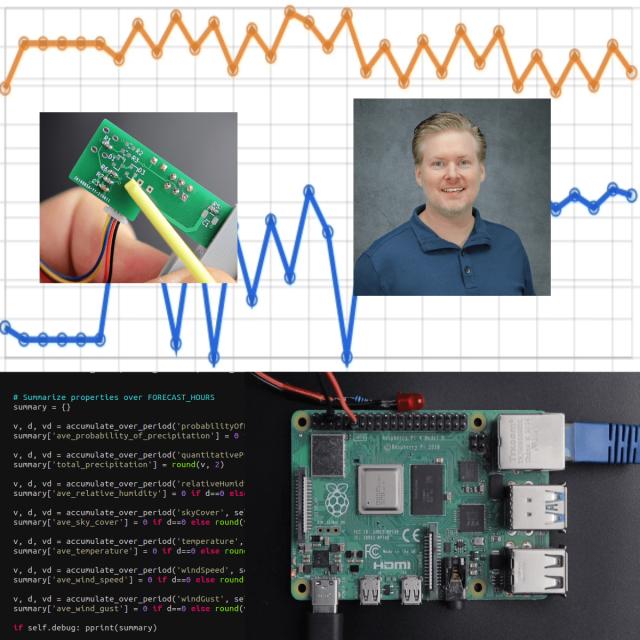
Designing Hardware for Raspberry Pi Projects (Coursera)

Designing Hardware for Raspberry Pi Projects (Coursera)

This is course 4 of this specialization (although it can be taken out of order) and focuses on applying experience and knowledge gained in the first three courses to build physical electronics hardware. Specifically, this course focuses on four areas: circuit simulation, schematic entry, PCB layout, and 3D CAD modeling. There are many excellent commercial applications available in these areas, however to give everyone access we'll be using all free and open-source software.

Class Deals by MOOC List - Click here and see Coursera's Active Discounts, Deals, and Promo Codes.

By the end of this course you should feel comfortable using free and open-source software to design your own printed circuit board and any bracketry or case to hold it, customized for your application.
Module 1 covers circuit simulation using several open-source projects and simulation methods for simulating transient response of circuits as well as frequency-domain response of filters. Additionally, we'll use open-source filter synthesis tools to help you quickly design and simulation filters.
Module 2 is all about creating professional looking electrical schematics. This is both an art and a skill and we'll cover the technical elements of using schematic entry software as well as broad concepts that are portable to any commercial application.
Module 3 takes our schematic and turns it into a physical PCB design. Understanding this process of how the schematic and the PCB layout work together is critical. We'll be demonstrating this with open-source software, but again, the concepts apply to any commercial software you may have access to.
Module 4 demonstrates the powerful idea of co-designing your electrical and mechanical systems together. We'll create a 3D model of our electrical PCB and bring it into 3D CAD software to design mechanical parts around it. Tying together these two applications opens another dimension in customizing your projects.

Course 4 of 4 in the Powering your Home Projects with Raspberry Pi Specialization.

Syllabus

WEEK 1
Circuit Simulation
When you are building your projects and need a circuit (maybe to interface to a sensor, motor, or something else in the physical world) wouldn't it be nice to have a high confidence that the circuit will work, before you invest in physically constructing it? That's where circuit simulation comes in. In this first module, we will discuss several free and open source circuit simulator applications, the underlying computational engines they use, and how to simulate circuits for your projects.

WEEK 2
Drafting Schematics
Producing professional looking schematic drawings serves two purposes. First, they are a document for you, the designer, to communicate how the circuit works and how to use and troubleshoot the circuit. Second, they are necessary step in the process to create a printed circuit board (PCB). This module will get you up and running using the open source project Kicad to create professional level schematics. And keep in mind that this is a stepping stone to Module 3, where we will convert the schematic into a physical PCB design.

WEEK 3
Designing Printed Circuit Boards
Designing printed circuit boards (PCBs) is both an art and a skill. There is a game-like challenge of optimizing the layout and sometimes solving the puzzle of how to correctly route all traces in a confined space. This module will cover the conceptual stages of layout out your PCB and we'll demonstrate every step from importing the schematic data to having a board fabricated by a commercial board manufacturer.

WEEK 4
Co-Designing PCBs and Mechanical Parts
Now that we're confident in designing printed circuit boards, let's turn our attention to 3D modeling custom parts such as brackets and cases for our PCB. We'll use the open source project Freecad to import our PCB design and draw 3D models around it. Co-designing parts together is a powerful skill for creating truly custom projects.
Go to Class
MOOC List is learner-supported. When you buy through links on our site, we may earn an affiliate commission.

Related Courses

VLSI CAD Part II: Layout (Coursera) Coursera
University of Illinois at Urbana-Champaign

VLSI CAD Part II: Layout (Coursera)

A modern VLSI chip is a remarkably complex beast: billions of transistors, millions of logic gates deployed for computation and control, big blocks of memory, embedded blocks of pre-designed functions designed by third parties (called “intellectual property” or IP blocks). How do people manage to design these complicated chips? Answer: a sequence of computer aided design (CAD) tools takes an abstract description of the chip, and refines it step-wise to a final design.

Sep 21st 2026
5-12 Weeks
VLSI CAD Part I: Logic (Coursera) Coursera
University of Illinois at Urbana-Champaign

VLSI CAD Part I: Logic (Coursera)

A modern VLSI chip has a zillion parts -- logic, control, memory, interconnect, etc. How do we design these complex chips? Answer: CAD software tools. Learn how to build thesA modern VLSI chip is a remarkably complex beast: billions of transistors, millions of logic gates deployed for computation and control, big blocks of memory, embedded blocks of pre-designed functions designed by third parties (called “intellectual property” or IP blocks). How do people manage to design these complicated chips? Answer: a sequence of computer aided design (CAD) tools takes an abstract description of the chip, and refines it step-wise to a final design.

Sep 21st 2026
5-12 Weeks
Introduction to Semiconductor Process 2 (Coursera) Coursera
Korea Advanced Institute of Science and Technology - KAIST

Introduction to Semiconductor Process 2 (Coursera)

This course aims to provide a general understanding of semiconductor process. This course explores the principles and basic theory of semiconductor device and process. Furthermore, the students will learn the overall semiconductor process such as oxidation, diffusion, ion implantation, lithography, etching, thin film deposition, plasma, metallization, and packaging.

Sep 21st 2026
5-12 Weeks
Siemens NX Mastery: Advanced Design & Applications (Coursera) Coursera
Siemens

Siemens NX Mastery: Advanced Design & Applications (Coursera)

Welcome to Siemens NX Mastery: Advanced Design & Applications! This course builds upon the foundational knowledge found in our introductory course, "Intro to Siemens NX: Engineering Essentials and Part Design". Siemens NX is an integrated solution for computer-aided design (CAD), computer-aided manufacturing (CAM), and computer-aided engineering (CAE). It is a flexible and powerful tool that helps engineers and designers in various disciplines to create, simulate, and manufacture products.

Sep 28th 2026
4 Weeks
IoT Devices (Coursera) Coursera
University of Illinois at Urbana-Champaign

IoT Devices (Coursera)

The Internet of Things (IoT) stands to be the next revolution in computing. Billions of data-spouting devices connected to the Internet are already fundamentally changing the way we live and work. This course teaches a deep understanding of IoT technologies from the ground up. Students will learn IoT device programming (Arduino and Raspberry Pi), sensing and actuating technologies, IoT protocol stacks (Zigbee, 5G, NFC, MQTT, etc), networking backhaul design and security enforcement, data science for IoT, and cloud-based IoT platforms such as AWS IoT.

Sep 21st 2026
4 Weeks
Plastic electronics (Coursera) Coursera
École Polytechnique

Plastic electronics (Coursera)

Plastic electronics is a concept that emerged forty years ago, with the discovery of electrically conductive polymers. Ten years later, the first electronic devices using organic solids in place of the ubiquitous inorganic semiconductors were realised. The best achievement of plastic electronics is constituted by Organic Light-Emitting Diodes (OLEDs) that equip the display of many smartphones, and even TV sets.

Sep 28th 2026
5-12 Weeks
Foundations of Computer Science (Coursera) Coursera
LearnQuest

Foundations of Computer Science (Coursera)

Welcome to Introduction to Programming: Visual Basic. In the course sequence you will learn to write programs that utilize both procedural and object oriented techniques to solve business problems. In the first course in the sequence we will provide you with a solid foundation in the computer science topics that are important to understand when programming Visual Basic. In courses two through four, we will role up our sleeves and start coding in Visual Basic. In these courses you need to have access to a computer that is running Windows, macOS or Linux with the .NET 5 installed. We will show you how to install .NET 5.

Sep 21st 2026
4 Weeks
3D Printing Capstone Coursera
University of Illinois at Urbana-Champaign

3D Printing Capstone

The capstone will integrate the learning acquired from the four courses in the 3D Printing Specialization through a hands-on project. This project will enable you to turn an idea into an object using the knowledge and skills acquired through the other courses. Specifically, you will be guided through a step-by-step process in which you imagine, design, make, and share a 3D printed object. Thus, through this capstone, you will be able to put course concepts into action and utilize the skills that you have acquired throughout the Specialization.

Sep 28th 2026
4 Weeks
Introduction to Solid Edge (Coursera) Coursera
Siemens

Introduction to Solid Edge (Coursera)

The Introduction to Siemens Solid Edge software will enable you to learn basic design concepts in both 2D and 3D environments using Computer-Aided Design (CAD) software. The concepts include 2D sketches, basic shapes, 3D models, and simple assemblies. You’ll gain experience using commands such as extrude, revolve, rounds, blend, and thinwall to more efficiently design solid models. Additionally, you’ll learn about drafting concepts such as detailing, drawing view, section cuts, and design intent.

Sep 28th 2026
5-12 Weeks
Architecting Smart IoT Devices (Coursera) Coursera
EIT Digital

Architecting Smart IoT Devices (Coursera)

This course will teach you how to develop an embedded systems device. In order to reduce the time to market, many pre-made hardware and software components are available today. You'll discover all the available hardware and software components, such as processor families, operating systems, boards and networks. You'll also learn how to actually use and integrate these components.

Sep 21st 2026
5-12 Weeks
Fundamentals of Audio and Music Engineering: Part 1 Musical Sound & Electronics (Coursera) Coursera
University of Rochester

Fundamentals of Audio and Music Engineering: Part 1 Musical Sound & Electronics (Coursera)

In this course students learn the basic concepts of acoustics and electronics and how they can applied to understand musical sound and make music with electronic instruments. Topics include: sound waves, musical sound, basic electronics, and applications of these basic principles in amplifiers and speaker design.

Sep 28th 2026
5-12 Weeks