Embedded Hardware and Operating Systems (Coursera)

Offered by EIT Digital,
Embedded Hardware and Operating Systems (Coursera)

This course is intended for the Bachelor and Master's students, who like practical programming and making IoTs applications! In this course we will talk about two components of a cyber physical system, namely hardware and operating systems. After completing this course, you will have the knowledge of both hardware components and operating systems. You are able to plan and use embedded operating systems in resource-constraint devices for Internet-of-Things (cyber physical system) applications.

Class Deals by MOOC List - Click here and see Coursera's Active Discounts, Deals, and Promo Codes.

In addition, you can use Cooja simulation for designing and simulating wireless sensor network applications.
We have 4 modules, each with a graded quiz in the end and finally we have one peer reviewed programming assignment.
The course is actually quite fun at the end when you are playing around with Cooja simulation for IoTs applications. So you can create and simulate your own design for sensor network applications. A lot of features and examples of Contiki and Cooja can be explored via assignments. There are some optional assignments of wireless sensor network applications for students who want to explore more about embedded OS in IoTs applications.

  • Marco Ramirez /University of Turku
  • Igor Tcarenko/ University of Turku
  • Nguyen Gia Tuan /University of Turku

Course 1 of 4 in the Development of Secure Embedded Systems Specialization

Syllabus

WEEK 1
Introduction to Embedded Hardware
This week will start from the basic information about Embedded Systems. Specifically, you will learn (1) what are embedded systems and where they are applied as well as (2) the main characteristics and challenges of embedded systems. (3) You will discover how embedded systems communicate with the outer world.

WEEK 2
Processing Elements of an Embedded System
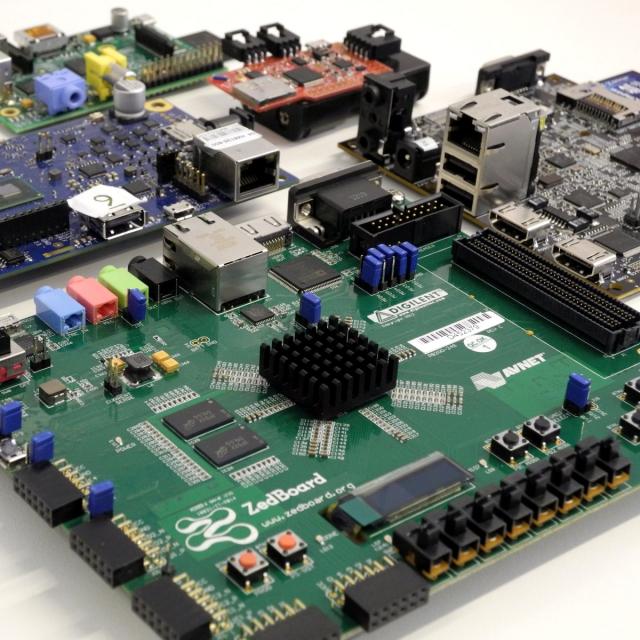
This week we will go into details of what embedded systems consist of. Specifically you learn about the main blocks of any processing element of embedded systems. We will show you what (1) embedded processors consists of and its main features. You will learn what (3) reconfigurable architectures and FPGAs are, and what kind of (4) ready-made platforms you can use to start working with processing elements.

WEEK 3
Overview of operating systems and embedded operating systems
In this week, we start with an overview of operating systems and embedded operating systems for IoT. Primary functionalities of embedded operating systems are discussed. We learn how operating systems work: how memory is managed, how tasks are scheduled, what interrupts are and how they are handled. After this, we deepen our learning with the popular kernels for general and embedded operating systems. Linux (monolithic) kernel, micro kernel and modular kernel are presented. In addition, several popular embedded operating systems for IoT are presented. Concretely, after attending this week, you will able to (1) explain why embedded systems often require an operating system (2) describe how an embedded operating system works such as how memory is managed, how tasks are scheduled and how interrupts are handled. (3) You will be able to differentiate between popular kernels for embedded operating systems. (4) Differentiate between popular embedded operating systems for IoT.

WEEK 4
Contiki OS and Cooja simulation
In this week, we start to explore the Contiki Os in detail. First we discuss about the Contiki system and its kernel architecture. Furthermore, we explore how loadable programs are actually implemented in Contiki. Second, we go through services and libraries in Contiki to see how they are built and when they can be invoked. Third, we discuss communication in Contiki via details of uIp and Rime communication stacks in Contiki. Next, prototheads are discussed to describe how application code is processed in Contiki. Furthermore, APIs of multi-threading is discussed. Last but not least, the Cooja simulator - a simulator for wireless sensor networks based on Contiki is introduced. All steps of installing and applying Cooja for a wireless sensor network applications are presented in detailed via an example application. Concretely, after attending this week, you will able to (1) describe how Contiki system and its kernel architecture are built. (2) Distinguish Contiki services and libraries in terms of how they are built, when they are invoked and why they are used. (3) Describe how communication is implemented and supported in Contiki and what protocols Contiki can support. (4) Explore how application's code is processed in Contiki and important functions of API for multithreading in Contiki (5) use Cooja for simulating wireless sensor networks applications.

Go to Class
MOOC List is learner-supported. When you buy through links on our site, we may earn an affiliate commission.

Related Courses

Hardware Security (Coursera) Coursera
University of Maryland, College Park

Hardware Security (Coursera)

In this course, we will study security and trust from the hardware perspective. Upon completing the course, students will understand the vulnerabilities in current digital system design flow and the physical attacks to these systems. They will learn that security starts from hardware design and be familiar with the tools and skills to build secure and trusted hardware.

Jul 20th 2026
5-12 Weeks
Programming Mobile Applications for Android Handheld Systems: Part 2 (Coursera) Coursera
University of Maryland, College Park

Programming Mobile Applications for Android Handheld Systems: Part 2 (Coursera)

This course introduces you to the design and implementation of Android applications for mobile devices. You will build upon concepts from the prior course, including handling notifications, using multimedia and graphics and incorporating touch and gestures into your apps.

Aug 3rd 2026
5-12 Weeks
3D Printing Capstone Coursera
University of Illinois at Urbana-Champaign

3D Printing Capstone

The capstone will integrate the learning acquired from the four courses in the 3D Printing Specialization through a hands-on project. This project will enable you to turn an idea into an object using the knowledge and skills acquired through the other courses. Specifically, you will be guided through a step-by-step process in which you imagine, design, make, and share a 3D printed object. Thus, through this capstone, you will be able to put course concepts into action and utilize the skills that you have acquired throughout the Specialization.

Aug 3rd 2026
4 Weeks
Securing Digital Democracy (Coursera) Coursera
University of Michigan

Securing Digital Democracy (Coursera)

In this course, you'll learn what every citizen should know about the security risks--and future potential — of electronic voting and Internet voting. We'll take a look at the past, present, and future of election technologies and explore the various spaces intersected by voting, including computer security, human factors, public policy, and more.

Jul 27th 2026
5-12 Weeks
Interfacing with the Arduino (Coursera) Coursera
University of California, Irvine

Interfacing with the Arduino (Coursera)

Arduino senses the environment by receiving inputs from add-on devices such as sensors, and can control the world around it by adjusting lights, motors, and other actuators. In this class you will learn how and when to use the different types of sensors and how to connect them to the Arduino. Since the external world uses continuous or analog signals and the hardware is digital you will learn how these signals are converted back-and-forth and how this must be considered as you program your device. You'll also learn about the use of Arduino-specific shields and the shields software libraries to interface with the real world.

Jul 20th 2026
4 Weeks
Requirement Specifications for Autonomous Systems (Coursera) Coursera
University of Colorado Boulder

Requirement Specifications for Autonomous Systems (Coursera)

This course will discuss different ways of formally modeling requirements of interest for autonomous systems. Examples of such requirements include stability, invariance, reachability, regular languages, omega-regular languages, and linear temporal logic properties. In addition, it will introduce non-deterministic finite and büchi automata for recognizing, respectively, regular languages and omega-regular languages.

Jul 27th 2026
5-12 Weeks
Introduction to the Internet of Things and Embedded Systems (Coursera) Coursera
University of California, Irvine

Introduction to the Internet of Things and Embedded Systems (Coursera)

The explosive growth of the “Internet of Things” is changing our world and the rapid drop in price for typical IoT components is allowing people to innovate new designs and products at home. In this first class in the specialization you will learn the importance of IoT in society, the current components of typical IoT devices and trends for the future. IoT design considerations, constraints and interfacing between the physical world and your device will also be covered. You will also learn how to make design trade-offs between hardware and software. We'll also cover key components of networking to ensure that students understand how to connect their device to the Internet.

Jul 20th 2026
4 Weeks
Intro to Operating Systems 3: Concurrency (Coursera) Coursera
Codio

Intro to Operating Systems 3: Concurrency (Coursera)

Learn the inner workings of operating systems without installing anything! This course is designed for learners who are looking to maximize performance by understanding how operating systems work at a fundamental level. The modules in this course cover concurrency, threads, locks, locking data structures and multi-CPU scheduling.

Jul 20th 2026
4 Weeks
Web Connectivity and Security in Embedded Systems (Coursera) Coursera
EIT Digital

Web Connectivity and Security in Embedded Systems (Coursera)

In this course, we will explore several technologies that bring modern devices together, facilitating a network of connected things and making devices internet enabled. We will discuss rules, protocols, and standards for these devices to communicate with each other in the network. We will also go through security and privacy issues and challenges in cyber physical systems (CPS). We will explore measures and techniques for securing systems from different perspectives. Possible attack models are introduced and solutions to tackle such attacks are discussed. Moreover, some basic concepts related to privacy in cyber physical systems are presented.

Jul 20th 2026
5-12 Weeks
Real-Time Embedded Systems Concepts and Practices (Coursera) Coursera
University of Colorado Boulder

Real-Time Embedded Systems Concepts and Practices (Coursera)

This course can also be taken for academic credit as ECEA 5315, part of CU Boulder’s Master of Science in Electrical Engineering degree. Course Description: In this course, students will design and build a microprocessor-based embedded system application using a real-time operating system or RT POSIX extensions with Embedded Linux. The course focus is on the process as well as fundamentals of integrating microprocessor-based embedded system elements for digital command and control of typical embedded hardware systems.

Jul 20th 2026
4 Weeks
Introduction to Computers and Office Productivity Software (Coursera) Coursera
The Hong Kong University of Science and Technology - HKUST

Introduction to Computers and Office Productivity Software (Coursera)

In this course, you will learn the following essential computer skills for the digital age: major hardware components of a computer system; different types of software on a computer system; photo Editing using GIMP; and word processing applications, including MS Word, MS Excel, and MS PowerPoint.

Aug 3rd 2026
5-12 Weeks