Bacterial Bioinformatics (Coursera)

Bacterial Bioinformatics (Coursera)

This course provides demonstrations and exercises for performing common genomics-based analysis tasks of bacterial sequence data. It uses PATRIC, the PathoSystems Resource Integration Center, as the platform for analysis. PATRIC is the NIH/NIAID-funded bacterial Bioinformatics Resource Center, providing comprehensive bacterial genomic data with integrated analysis tools and visualizations.

Class Deals by MOOC List - Click here and see Coursera's Active Discounts, Deals, and Promo Codes.

PATRIC also provides a private workspace where users can upload and analyze their own data.
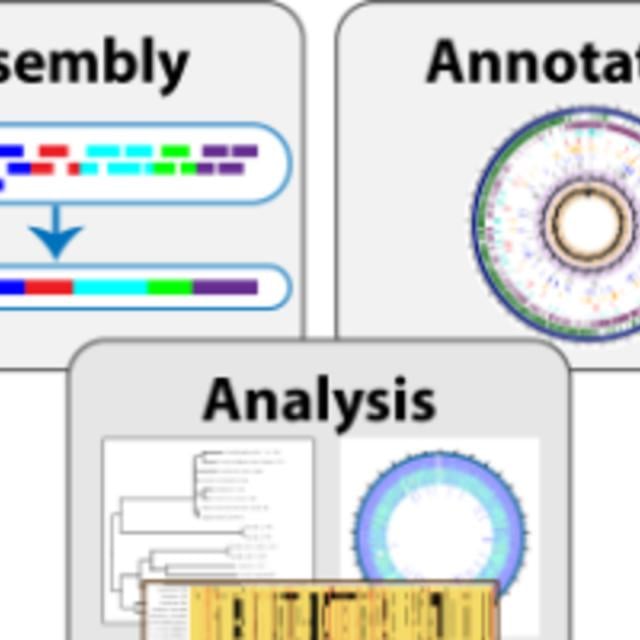
Course participants will gain skills needed to do comparative analysis of bacterial genomes, starting with raw sequence data.The lessons in the first module cover genome assembly, annotation, phylogenetic tree construction, and protein family / proteome comparisons. Each lesson builds on the previous, creating a complete baseline analysis workflow.

Syllabus

WEEK 1
Introduction
This lesson provides an introduction to PATRIC, the PathoSystems Resource Integration Center, a Bioinformatics Resource Center dedicated to supporting bacterial research. PATRIC provides comprehensive bacterial genomic data with integrated analysis tools and visualizations. PATRIC also provides a private workspace where users can upload and analyze their own data. PATRIC will serve as the platform for the analysis methods covered in this module.

WEEK 2
Assembly
This lesson provides step-by-step instructions for assembling a genome from a set of bacterial sequence reads using the PATRIC Genome Assembly Service. Exercises are included to enhance comprehension and build proficiency in using the assembly process.

WEEK 3
Annotation
This lesson provides step-by-step instructions for annotating a genome from contigs using the PATRIC Genome Annotation Service. Exercises are included to enhance comprehension and build proficiency in using the annotation process.

WEEK 4
Comprehensive Genome Analysis
This lesson provides step-by-step instructions for assembling, annotating, and performing an automated analysis of a genome from a set of bacterial sequence reads using the PATRIC Comprehensive Genome Analysis Service. Exercises are included to enhance comprehension and build proficiency in using the service.

WEEK 5
Codon-Based Phyogenetic Trees
This lesson provides step-by-step instructions for generating a codon-based phylogentic tree from a set of genomes using the PATRIC Codon Tree Service. Exercises are included to enhance comprehension and build proficiency in using the service.

WEEK 6
Similar Genome Finder
This lesson provides step-by-step instructions for finding genomes (and associated taxonomy) in PATRIC similar to your genome or sequences using the Similar Genome Finder Service. Exercises are included to enhance comprehension and build proficiency in using the service.

WEEK 7
Protein Family Sorter
This lesson provides step-by-step instructions for using the PATRIC Protein Family Sorter to compare presence, absence, and counts of proteins in protein families across a set of genomes. Exercises are included to enhance comprehension and build proficiency in using the tool.

WEEK 8
Proteome Comparison
This lesson provides step-by-step instructions for using the PATRIC Proteome Comparison Service to compare a set of genomes against a reference genome, feature group, or FASTA file. Exercises are included to enhance comprehension and build proficiency in using the tool.
Go to Class
MOOC List is learner-supported. When you buy through links on our site, we may earn an affiliate commission.

Related Courses

Making sense of genomic data: COVID-19 web-based bioinformatics (FutureLearn) FutureLearn
Wellcome Connecting Science,COG-Train

Making sense of genomic data: COVID-19 web-based bioinformatics (FutureLearn)

Explore the tools for web-based SARS-CoV-2 sequencing analyses and learn techniques to prepare data and share genomic outputs. Discover how to analyse SARS-CoV-2 sequences using web-based tools. Over the past decade, sequencing technologies have become more accessible and sequencing data has increased exponentially. However, bioinformatics capacity is still limited. On this three-week course, you will learn the basics of bioinformatics concepts and explore the web-based tools used for viral data and sequencing analyses.

Jul 25th 2022
3 Weeks
Bioinformatics: Introduction and Methods 生物信息学: 导论与方法 (Coursera) Coursera
Peking University

Bioinformatics: Introduction and Methods 生物信息学: 导论与方法 (Coursera)

A big welcome to “Bioinformatics: Introduction and Methods” from Peking University! In this MOOC you will become familiar with the concepts and computational methods in the exciting interdisciplinary field of bioinformatics and their applications in biology, the knowledge and skills in bioinformatics you acquired will help you in your future study and research.

Jul 20th 2026
13-24 Weeks
Finding Hidden Messages in DNA (Bioinformatics I) (Coursera) Coursera
University of California, San Diego

Finding Hidden Messages in DNA (Bioinformatics I) (Coursera)

This course begins a series of classes illustrating the power of computing in modern biology. Please join us on the frontier of bioinformatics to look for hidden messages in DNA without ever needing to put on a lab coat. In the first half of the course, we investigate DNA replication, and ask the question, where in the genome does DNA replication begin? We will see that we can answer this question for many bacteria using only some straightforward algorithms to look for hidden messages in the genome.

Jul 20th 2026
5-12 Weeks
Essentials of Genomics and Biomedical Informatics (edX) EdX
IsraelX

Essentials of Genomics and Biomedical Informatics (edX)

This course presents clinicians and digital health enthusiasts with an overview of the data revolution in medicine and how to exploit it for research and in the clinic. The course will not make you a bioinformatician but will introduce the main concepts, tools, algorithms, and databases in this field.

Self Paced
5-12 Weeks
Finding Mutations in DNA and Proteins (Bioinformatics VI) (Coursera) Coursera
University of California, San Diego

Finding Mutations in DNA and Proteins (Bioinformatics VI) (Coursera)

In previous courses in the Specialization, we have discussed how to sequence and compare genomes. This course will cover advanced topics in finding mutations lurking within DNA and proteins. In the first half of the course, we would like to ask how an individual's genome differs from the "reference genome" of the species.

Jul 20th 2026
5-12 Weeks
Big Data, Genes, and Medicine (Coursera) Coursera
The State University of New York

Big Data, Genes, and Medicine (Coursera)

This course distills for you expert knowledge and skills mastered by professionals in Health Big Data Science and Bioinformatics. You will learn exciting facts about the human body biology and chemistry, genetics, and medicine that will be intertwined with the science of Big Data and skills to harness the avalanche of data openly available at your fingertips and which we are just starting to make sense of.

Jul 20th 2026
5-12 Weeks
Metagenomics applied to surveillance of pathogens and antimicrobial resistance (Coursera) Coursera
Technical University of Denmark - DTU

Metagenomics applied to surveillance of pathogens and antimicrobial resistance (Coursera)

The field of metagenomics and whole community sequencing is a promising area to unravel the content of microbial communities and their relationship to disease and antimicrobial resistance in the human population. Bioinformatic tools are extremely important for making sense out of metagenomics data, by estimating the presence of pathogens and antimicrobial resistance determinants in complex samples. Combined with relevant explanatory data, metagenomics is a powerful tool for surveillance.

Jun 24th 2024
3 Weeks
Plant Bioinformatics (Coursera) Coursera
University of Toronto

Plant Bioinformatics (Coursera)

The past 15 years have been exciting ones in plant biology. Hundreds of plant genomes have been sequenced, RNA-seq has enabled transcriptome-wide expression profiling, and a proliferation of "-seq"-based methods has permitted protein-protein and protein-DNA interactions to be determined cheaply and in a high-throughput manner. These data sets in turn allow us to generate hypotheses at the click of a mouse.

Jul 27th 2026
5-12 Weeks