Artificial Intelligence (AI) for Earth Monitoring (FutureLearn)

Artificial Intelligence (AI) for Earth Monitoring (FutureLearn)

Explore how artificial intelligence (AI) and machine learning (ML) technologies are helping to advance Earth monitoring. Learn to use AI and ML to improve the use of big data in Earth Monitoring.
This is a fast-changing and critical time for Earth Observation (EO), especially for those involved in its use for climate and meteorology.

Class Deals by MOOC List - Click here and see FutureLearn's Active Discounts, Deals, and Promo Codes.

On this course, you’ll get a comprehensive overview of the Copernicus Programme and the wealth of EO data it provides, as well as how AI and ML are transforming the interpretation of EO data.
Understand key AI and ML concepts
You’ll learn about the Copernicus data and services and the massive amounts of Earth observation data that are collected every day from space, covering the oceans, land, atmosphere and, over longer periods, the climate.
You’ll then learn basic AI and ML concepts and types, exploring how they have transformed many aspects of the EO ‘value chain’.
This includes automatic feature extraction, new ways of processing very large data sets, and the development of new products and services.
Learn Python to fully access the WEkEO platform
The WEkEO platform is a ‘one-stop shop’ for Copernicus and Sentinel satellite data and services.
You’ll learn how to access Earth Observation data through it, using the Python programming language and Jupyter Notebooks to process and analyse EO data with AI.
Explore EO data with international experts
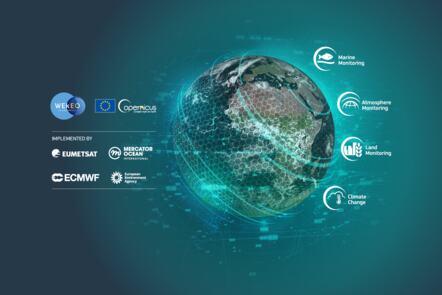
This course is funded by the Copernicus Programme and has been put together by EUMETSAT, ECMWF, Mercator Ocean International and the EEA.
Their experts in AI, EO, and Earth system monitoring will take you through four themed weeks – land, ocean, atmosphere, and climate – leaving you well-versed in the intricacies of EO and satellite data, as well as how AI and ML can unlock its full potential.

What topics will you cover?

  • An introduction to artificial intelligence (AI) and machine learning (ML) in the EU Copernicus Programme.
  • Accessing Earth observation data and working with it through the WEkEO platform
  • An overview of AI and ML types, technology, and terminology.
  • How AI and ML are used in various EO applications
  • Hands-on learning using the Python programming language and Jupyter Notebooks to process and analyse EO data using ML

Learning on this course
You can take this self-guided course and learn at your own pace. On every step of the course you can meet other learners, share your ideas and join in with active discussions in the comments.

What will you achieve?
By the end of the course, you‘ll be able to...

  • Recognise the importance of satellite earth observation (EO) and the EU Copernicus Programme
  • Understand AI and Machine Learning concepts and how we use them with EO
  • Access open and free EO data using the WEkEO platform
  • Explore working examples of using AI and machine learning techniques with Copernicus data and services for each of the 4 themed weeks; Land, Ocean, Atmosphere and Climate.

Who is the course for?
This course would benefit scientists, policy/decision makers, journalists, educators, business owners, and students. It would also appeal to a curious, general interest audience, or professionals who possess some experience in the subject.
Go to Class
MOOC List is learner-supported. When you buy through links on our site, we may earn an affiliate commission.

Related Courses

Applied Data Science (FutureLearn) FutureLearn
Birkbeck, University of London,Coventry University,Institute of Coding

Applied Data Science (FutureLearn)

Develop your data science and analytics skills and improve your understanding of using data in the workplace. Have the opportunity to build data science skills to advance your career. On this course, you’ll be introduced to the tools and techniques used in applied data science. You’ll explore the answers to important questions asked of business professionals today, such as why data science and machine learning have become so prevalent and what problems data science can address.

Jan 16th 2023
2 Weeks
Discovering Science: Atmospheric Chemistry (FutureLearn) FutureLearn
University of Leeds

Discovering Science: Atmospheric Chemistry (FutureLearn)

What can we learn about Earth, and other planets in and beyond our solar system, by studying their atmospheres? Learn about the role that radiation and greenhouse gases play in our understanding of atmospheric chemistry. As levels of CO2 in the atmosphere increase, you will discover the solutions scientists are exploring to reduce levels. And discover how missions to other planets and moons in our solar system are revealing extraordinarily diverse atmospheres.

Self Paced
2 Weeks
MedTech: AI and Medical Robots (FutureLearn) FutureLearn
University of Leeds

MedTech: AI and Medical Robots (FutureLearn)

Explore human robot interaction and enter the fascinating world of robotics and artificial intelligence in healthcare. Learn how medical robots in healthcare are designed, regulated and used. On this course, you will learn what robots are and explore human robot interaction (HRI) in healthcare. You will identify the challenges of designing robots for healthcare and look at what MedTech scientists are doing to solve them.

Self Paced
2 Weeks
Ocean Science in Action: Addressing Marine Ecosystems and Food Security in the Western Indian Ocean (FutureLearn) FutureLearn
National Oceanography Centre

Ocean Science in Action: Addressing Marine Ecosystems and Food Security in the Western Indian Ocean (FutureLearn)

Explore how innovative marine technologies can tackle the challenges of the sustainable management of marine ecosystems. Discover the new technologies that can aid marine resource management. Journey to the Western Indian Ocean alongside experts at the UK’s National Oceanography Centre to learn how we can measure and monitor the oceans in order to better protect them.

Nov 1st 2021
4 Weeks
The Earth in My Pocket: an Introduction to Geology (FutureLearn) FutureLearn
The Open University

The Earth in My Pocket: an Introduction to Geology (FutureLearn)

Get an introduction to geology. Discover where materials that make up everyday objects come from and how to use them sustainably. Everything we use that has not been grown either contains or relies on materials that have been sourced by a geoscientist. Whether we are standing out in the wilderness, in the middle of a city or in our home, geology and the Earth’s natural resources are all around us, forming an integral part of our everyday lives.

No sessions available
4 Weeks
Understanding Quantum Computers (FutureLearn) FutureLearn
Keio University

Understanding Quantum Computers (FutureLearn)

Explore the key concepts of quantum computing and find out how it’s changing computer science with this introductory course. In this course, we will discuss the motivation for building quantum computers, cover the important principles in quantum computing, and take a look at some of the important quantum computing algorithms.

Self Paced
3 Weeks
Monitoring the Oceans from Space (FutureLearn) FutureLearn
EUMETSAT

Monitoring the Oceans from Space (FutureLearn)

Explore our oceans from space. Discover how Earth observation allows us to monitor ocean health, and inform policy and planning. This free online course will provide an introduction to ocean monitoring Earth Observation (EO) satellite data, and its uses, types and challenges. It will explain how the data is acquired and used, the range of data types available, and the terminology and techniques involved.

No sessions available
5-12 Weeks
Planet Partners: Tackling the Climate Crisis Together (FutureLearn) FutureLearn
University of Reading

Planet Partners: Tackling the Climate Crisis Together (FutureLearn)

Investigate the impact of climate change, the research being done to tackle it, and what you can do to take meaningful action. Explore the different areas affected by climate change. The impacts of climate change are being felt worldwide and across many areas of life. This includes our food, our physical and mental health, where and how we live, wildlife and environmental systems, and political direction.

Self Paced
2 Weeks
Monitoring Climate from Space (FutureLearn) FutureLearn
European Space Agency

Monitoring Climate from Space (FutureLearn)

Explore our planet from space and learn how Earth observation is used to monitor climate change, with this free online course. It is increasingly essential for us to study climate change across the planet at the highest level of detail possible. But how can we achieve such a comprehensive worldwide view?

No sessions available
5-12 Weeks
Artificial Intelligence in Bioinformatics (FutureLearn) FutureLearn
Taipei Medical University

Artificial Intelligence in Bioinformatics (FutureLearn)

Discover the future of bioinformatics and learn how AI models of bioinformatics data help us to understand biological processes. Study the use of AI, machine learning, and deep learning in bioinformatics. This course will teach you the fundamentals of how AI is applied in the field of bioinformatics.

Self Paced
3 Weeks
Come Rain or Shine: Understanding the Weather (FutureLearn) FutureLearn
University of Reading

Come Rain or Shine: Understanding the Weather (FutureLearn)

Understand and explore the physical processes behind the weather. Weather affects our lives almost every day through what we wear, what we eat and what we do. But why is it rainy, windy or sometimes even sunny? Explore some of the physical processes driving UK weather systems and get hands on in the world of weather with practical activities and fieldwork.

Self Paced
3 Weeks
AI for Healthcare: Equipping the Workforce for Digital Transformation (FutureLearn) FutureLearn
University of Manchester,Health Education England

AI for Healthcare: Equipping the Workforce for Digital Transformation (FutureLearn)

Learn how artificial intelligence is transforming healthcare and how it can be used to support change in the healthcare workforce. Build your digital understanding and become a champion for AI in healthcare. AI is transforming healthcare in a variety of beneficial ways, from streamlining workflow processes to making more precise patient diagnoses. However, this is not without its challenges.

Self Paced
5-12 Weeks