5G Network Fundamentals (Coursera)

5G Network Fundamentals (Coursera)

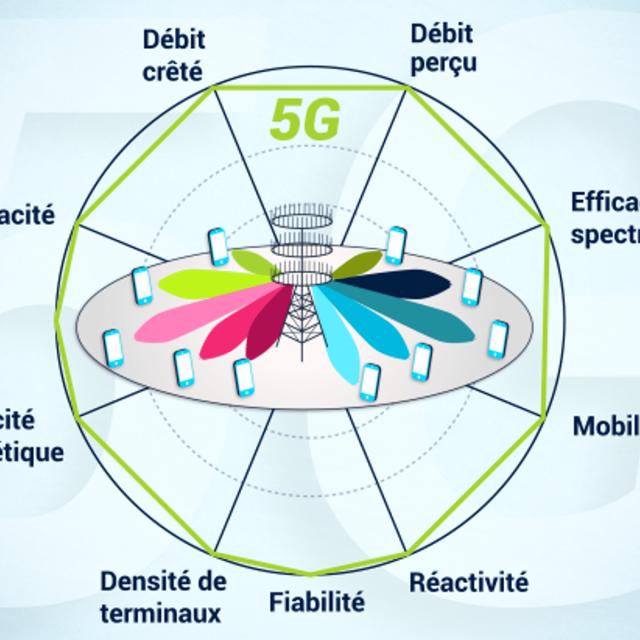
This MOOC presents the services and the architecture of 5G networks, the main principles of the new radio interface (NR), data flow management, security and the new Service-Based Architecture (SBA). In recent years, operators have been deploying 5G technology on commercial mobile networks. The latter is announced as a major technological breakthrough with speeds beyond Gbit/s, very low latencies and above all a distribution in many sectors of activity (industry, transport, medicine, etc.).

Class Deals by MOOC List - Click here and see Coursera's Active Discounts, Deals, and Promo Codes.

Beyond the announcement effects, this technology relies heavily on 4G. The waveform for radio transmission is identical, the management of data flows is similar. However, 5G significantly extends the possible options both in the choice of architectures and in the radio interface configurations as well as in the security mechanisms. All this is explained in the mooc.
A certificate of successful completion is awarded by Coursera to learners who succeed in obtaining a mark greater than 50%.
This MOOC has received financial support from the Patrick & Lina Drahi Foundation.

WHAT YOU WILL LEARN

  • Characterize 5G modes (eMBB, uRLLC, mMTC) and list the main functional entities and their role (gNB, AMF, SMF, UPF, UDM, AUSF)
  • Justify how MIMO and massive MIMO are a technological breakthrough of mobile networks
  • Explain the security weaknesses of 4G and justify how 5G enhances security
  • Describe the interactions between network functions (NF) from the specification of a simple service in a service-based architecture (SBA).

Syllabus

WEEK 1: Module 0: Welcome in this MOOC !
WEEK 2: Module 1 : 5G services and architecture
WEEK 3: Module 2 : The New Radio interface
WEEK 4: Module 3: Data Flow and Mobility Management
WEEK 5: Module 4: Security
WEEK 6: Module 5: Service-Based Interfaces and Virtualization
WEEK 7: Module 6: Security and Interconnection
WEEK 8: Module 8: Final Exam
WEEK 9: Your opinion about this MOOC


Go to Class
MOOC List is learner-supported. When you buy through links on our site, we may earn an affiliate commission.

Related Courses

Competencias digitales. Conceptos y herramientas básicas (Coursera) Coursera
Universitat Autònoma de Barcelona

Competencias digitales. Conceptos y herramientas básicas (Coursera)

Los continuos cambios tecnológicos, sobre todo en aquellos aspectos vinculados a las tecnologías de la información y la comunicación (TIC) hacen que las personas tengan la necesidad de actualizarse de forma continua para que sus conocimientos no queden obsoletos. En este contexto, para las empresas se convierte en algo imprescindible disponer de profesionales que tengan las competencias necesarias para ejercer con éxito las actividades que requieren en su lugar de trabajo.

Nov 23rd 2026
4 Weeks
Microwave engineering and antennas (Coursera) Coursera
Eindhoven University of Technology

Microwave engineering and antennas (Coursera)

This unique Master-level course provides you with in-depth know-how of microwave engineering and antennas. The course combines both passive and active microwave circuits as well as antenna systems. Future applications, like millimeter-wave 5G/beyond-5G wireless communications or automotive radar, require experts that can co-design highly integrated antenna systems that include both antennas and microwave electronics. We will provide you with the required theoretical foundation as well as hands-on experience using state-of-the-art design tools. The web lectures are supported by many on-line quizzes in which you can practice the background theory.

Nov 23rd 2026
5-12 Weeks
The Cybersecurity Culture Blueprint: A Proactive Approach (Coursera) Coursera
LearnQuest

The Cybersecurity Culture Blueprint: A Proactive Approach (Coursera)

In today's rapidly evolving digital landscape, the importance of cybersecurity cannot be overstated. Threats to organizations, both large and small, are on the rise, and the consequences of security breaches can be devastating. It's no longer enough to rely solely on technical solutions; a resilient cybersecurity culture is essential.

Nov 23rd 2026
4 Weeks
Cloud: Platform as a Service - Master's (Coursera) Coursera
Illinois Tech

Cloud: Platform as a Service - Master's (Coursera)

This course is aimed at preparing individuals to gain knowledge, skills, and abilities to demonstrate the knowledge for managing Platform as a Service (PaaS) in the Cloud. Students will learn to deploy, operate, and maintain cloud platforms for storing, processing, and transferring information with architecture design principles and a structured approach. Students will also learn the shared responsibility model and cloud security best practices to secure PaaS platforms for the application-hosting environments.

Nov 23rd 2026
5-12 Weeks
Cybercrime (Coursera) Coursera
Royal Holloway, University of London

Cybercrime (Coursera)

This course introduces fundamental notions of cybercrime. Namely, what cybercrime is, the main questions surrounding cybercrime, how cybercrime can be defined, and how it can be studied. You will learn about the difficulties in measuring the occurrence, the frequency and the impact of cybercrime, and build a scepticism on the reliability and the interpretation of cybercrime reports. You will be introduced to discussion about human aspects of cybercrime, in particular, the actors related to cybercrime, that is, the criminals, the victims, and law enforcement.

Nov 23rd 2026
4 Weeks
How to Get Into Blockchain (Coursera) Coursera
University of Leeds

How to Get Into Blockchain (Coursera)

Blockchain technologies, the driving force behind cryptocurrencies, have the potential to revolutionise the exchange of value, ownership and transactions by providing trust, security and transparency. The blockchain industry is booming and it's projected to grow so if you are looking for a lucrative career path, then a specialisation in blockchain technologies is one of the best tech career moves. This online course teaches you how to navigate the fascinating world of blockchain technologies.

Nov 23rd 2026
2 Weeks
Applied Social Network Analysis in Python (Coursera) Coursera
University of Michigan

Applied Social Network Analysis in Python (Coursera)

This course will introduce the learner to network analysis through the NetworkX library. The course begins with an understanding of what network analysis is and motivations for why we might model phenomena as networks. The second week introduces the concept of connectivity and network robustness.. The third week will explore ways of measuring the importance or centrality of a node in a network. The final week will explore the evolution of networks over time and cover models of network generation and the link prediction problem.

Nov 23rd 2026
4 Weeks
Social and Economic Networks: Models and Analysis (Coursera) Coursera
Stanford University

Social and Economic Networks: Models and Analysis (Coursera)

Learn how to model social and economic networks and their impact on human behavior. How do networks form, why do they exhibit certain patterns, and how does their structure impact diffusion, learning, and other behaviors? We will bring together models and techniques from economics, sociology, math, physics, statistics and computer science to answer these questions.

Nov 23rd 2026
5-12 Weeks
Cybersecurity for Everyone (Coursera) Coursera
University of Maryland, College Park

Cybersecurity for Everyone (Coursera)

Cybersecurity affects everyone, including in the delivery of basic products and services. If you or your organization want to better understand how to address your cybersecurity, this is the course for you and your colleagues to take -- from seasoned professionals to your non-technical colleagues. Your instructor, Dr. Charles Harry, has served on the front lines with the NSA (National Security Agency) and as an expert advising corporate and institutional leaders on managing cybersecurity risk.

Nov 16th 2026
5-12 Weeks
Network Dynamics of Social Behavior (Coursera) Coursera
University of Pennsylvania

Network Dynamics of Social Behavior (Coursera)

How do revolutions emerge without anyone expecting them? How did social norms about same sex marriage change more rapidly than anyone anticipated? Why do some social innovations take off with relative ease, while others struggle for years without spreading? More generally, what are the forces that control the process of social evolution –from the fashions that we wear, to our beliefs about religious tolerance, to our ideas about the process of scientific discovery and the best ways to manage complex research organizations?

Nov 23rd 2026
5-12 Weeks