EdX

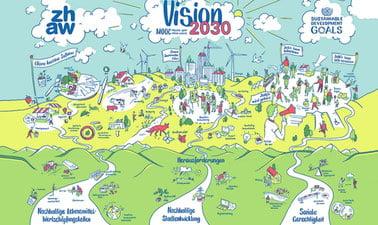
Vision 2030 (edX)

Vision 2030 (edX)

Humanity is facing major global challenges and contradictions: increasing wealth but growing inequality; overconsumption on the one hand; malnutrition on the other; rising economic growth and extreme environmental degradation. Where can we start to solve these problems?

Class Deals by MOOC List - Click here and see EdX's Active Discounts, Deals, and Promo Codes.

Humanity is facing major global challenges and contradictions: increasing prosperity, but also growing inequality; overconsumption on the one hand, malnutrition on the other; increasing economic growth and extreme environmental degradation. We often lack a holistic view. Where can we start to solve these problems?
This course explains the most important global challenges and the possible solutions that already exist today:
With a focus on food, urban development and social justice, you will get an overall view of our system. In the area of nutrition, you will learn about the entire food value chain and how to build sustainable food value chains through studies and examples.
Cities are centres of human life. Experts from the fields of energy, architecture, natural resources and economics will show you how cities can be developed in a socially responsible, green and low-emission way.
How does inequality arise, and how can we do something about it? Experienced social scientists and linguists will explain how inequality arises and which principles can promote social justice.
During the course, you will receive various inputs on how to deal with your health sustainably.
The Vision 2030 course will enable you to take a more holistic view of your work and life and thus contribute to sustainable development.

What you'll learn
After completing this course, you will be able to do the following:
You will be able to explain:

  • what global challenges are and why they need to be looked at holistically.
  • where food waste occurs and how it can be avoided.
  • what principles promote social sustainability.
  • how cities can be developed into Smart Sustainable Cities.

You can describe:

  • what the causes and solutions are for the problem of land consumption.
  • how life cycle assessments of food work.
  • how nutrient cycles can be closed in cities.
  • how inequality arises and can be combated.

You can share and justify your opinion on:

  • urban development projects on synergies and trade-offs within smart city concepts.
  • existing social challenges and possible solutions.
  • different concepts for more sustainable economic systems.

Go to Class
MOOC List is learner-supported. When you buy through links on our site, we may earn an affiliate commission.

Related Courses

Planetary Boundaries (edX) EdX
SDGAcademyX,SDG Academy

Planetary Boundaries (edX)

Can our planet continue to support the current scope of human activity? A thriving global society relies on the stability of the Earth and its resilience across oceans, forests, waterways, biodiversity, the atmosphere and more. So how do we shape sustainability at a global scale? The boundaries set by the planet’s natural resources, the resilience of those resources, and the human activities that impact sustainability all come into play.

Self Paced
Self-Paced
Sustainable Urban Development (edX) EdX
Wageningen University,Delft University of Technology,DelftX,WageningenX

Sustainable Urban Development (edX)

Learn why cities are key in resolving global urbanization and sustainability challenges and how you can engineer tomorrow’s cities today. Did you know that cities take up less than 3% of the earth’s land surface, but more than 50% of the world’s population live in them? And, cities generate more than 70% of the global emissions? Large cities and their hinterlands (jointly called metropolitan regions) greatly contribute to global urbanization and sustainability challenges, yet are also key to resolving these same challenges.

Self Paced
Self-Paced
Sustainable Development: The Post-Capitalist Order (edX) EdX
SDGAcademyX,SDG Academy

Sustainable Development: The Post-Capitalist Order (edX)

Sustainable development represents a shift from our current system of inequitable capitalism to one that prioritizes prosperity for all, while remaining conscious of its environmental impact and sustainability for future generations. Learn why sustainable development has been adopted by countries and multilateral organizations around the world, and how this approach is transforming the way we live, work, and govern our planet.

Self Paced
Self-Paced
Financial Development and Financial Inclusion (edX) EdX
International Monetary Fund - IMF,IMFx

Financial Development and Financial Inclusion (edX)

Learn how to develop an efficient, inclusive and stable financial sector that is essential for a thriving economy. This course was developed by the IMF in collaboration with the European Investment Bank. Higher rates of financial inclusion and financial market development mean more prosperous societies. But how to make it all happen? This course outlines common ways countries develop robust financial sectors – from banks to equity markets.

Self Paced
Self-Paced
Building expertise on developing sustainable and resilient infrastructure (edX) EdX
École Polytechnique Fédérale de Lausanne,EPFLx

Building expertise on developing sustainable and resilient infrastructure (edX)

This course provides knowledge, builds expertise and provides tools on the planning, financing, procurement and contracting of sustainable and resilient infrastructure projects. This course provides knowledge, builds expertise and provides tools on the planning, financing, procurement and contracting of sustainable and resilient infrastructure projects.

Self Paced
Self-Paced
Cities and the Challenge of Sustainable Development (edX) EdX
SDGAcademyX,SDG Academy

Cities and the Challenge of Sustainable Development (edX)

What is a sustainable city? Learn the basics here. According to the United Nations, urbanization and population growth could result in an increase of 2.5 billion people into urban populations by 2050, with associated impacts ranging from increased transportation needs to more building. How do we make cities sustainable to support this growth?

Self Paced
Self-Paced
Environmental Protection and Sustainability (edX) EdX
IsraelX

Environmental Protection and Sustainability (edX)

Uncover better solutions to help manage a wide range of environmental problems and challenges facing our world today. Do you want to understand more about the environmental problems we currently face? Do you want to learn ways we can reduce the negative effects of these problems, and keep our environment more sustainable? If so, this course is for you.

Self Paced
Self-Paced
Sustainable Aviation: The Route to Climate-Neutral Aviation (edX) EdX
Delft University of Technology,DelftX

Sustainable Aviation: The Route to Climate-Neutral Aviation (edX)

To reduce the environmental footprint of the aviation sector we need to start a clean sky revolution. Discover the latest developments in this field – from airplane design, energy carriers, operations – and learn how you can play a role. Sustainable aviation is a key area for climate action. In this course, we will introduce you to various aircraft technologies, and recent innovations and promising future developments in the field of aviation. All necessary mathematical and engineering concepts will explained.

Self Paced
Self-Paced
Conscious Grocery Shopping: Sustainability, Nutrition, Health and Law (edX) EdX
University of Bayreuth,BayreuthX

Conscious Grocery Shopping: Sustainability, Nutrition, Health and Law (edX)

Would you consider yourself a conscious decider when it comes to food grocery shopping? Do you really buy healthy and sustainably? Enroll in this course for a journey through the grocery store with multidisciplinary scientific insights that will empower you to make better food choices. Our professors will give you insights into the fascinating scientific world of food commodities highlighting the aspects of sustainability, nutrition, health and law.

Self Paced
Self-Paced
CitiesX: The Past, Present and Future of Urban Life (edX) EdX
HarvardX,Harvard University

CitiesX: The Past, Present and Future of Urban Life (edX)

Explore what makes cities energizing, amazing, challenging, and perhaps humanity’s greatest invention. For the first time in human history, more than fifty percent of the world’s population lives in urban areas. Cities allow for the exchange of ideas, and generate remarkable innovations in business, art, and ideas. Cities are also home to millions living in poverty. Urban living can provide a pathway to a better life, but that’s not always the case for many people around the world.

Self Paced
Self-Paced