UFOs: Scanning the Skies Teach-Out (FutureLearn)

UFOs: Scanning the Skies Teach-Out (FutureLearn)

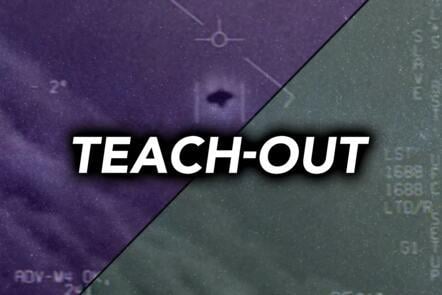
Explore possible explanations for UFO sightings as you delve into fascinating accounts of unidentified flying objects. Unpack the myths and facts surrounding UFOs. Following the release of the U.S. Pentagon UFO report, there has been a surge of interest in unidentified aerial phenomena (UAPs). People across the world are gripped by the history of UFOs and the stories told by those who have witnessed them.

Class Deals by MOOC List - Click here and see FutureLearn's Active Discounts, Deals, and Promo Codes.

On this two-week course, you’ll hear from multidisciplinary experts to understand the importance of investigation and possible explanations for UFO sightings.

Understand what makes a compelling UFO report
The course will guide you through various UFO reports – a crucial aspect of the study of UFOs.
As you explore each one, you’ll learn what factors make a UFO report compelling and begin to understand what conclusions can be drawn.

Apply video analysis practices to UFO videos
You’ll have the opportunity to not only watch but also analyse UFO videos.
You’ll develop the skills and basic techniques used to analyse videos to critically observe UFO videos within the course, and beyond.

Discover how the UFO discussion relates to science and society
With a firm understanding of the history of UFOs, you’ll start to explore the position of UFOs within the larger conversation of science and culture.
Learning from the experts at the University of Michigan and beyond, you’ll hear from top researchers, and scholars in the field to develop your knowledge of the study of UFOs.

What topics will you cover?

  • History of unidentified flying objects (UFOs)
  • Possible explanations for UFO sightings
  • Analysis of UFO videos
  • UFO reports and ufology
  • Research into extraterrestrial life
  • Relation of UFOs to science and society

Learning on this course
You can take this self-guided course and learn at your own pace. On every step of the course you can meet other learners, share your ideas and join in with active discussions in the comments.
What will you achieve?
By the end of the course, you‘ll be able to...

  • Explain the history and cultural phenomena of unidentified flying objects (UFOs)
  • Describe a range of possible explanations of UFO sightings
  • Apply basic techniques used to analyze videos of UFOs
  • Reflect on the connection between UFOs and science and society
  • Summarise UFO reports and describe the study of UFOs

Who is the course for?
This course is designed for anyone interested in learning more about UFOs. You don’t need any prior knowledge or experience.


Go to Class
MOOC List is learner-supported. When you buy through links on our site, we may earn an affiliate commission.

Related Courses

Invisible Worlds: Understanding the Natural Environment (FutureLearn) FutureLearn
University of Exeter,Eden Project

Invisible Worlds: Understanding the Natural Environment (FutureLearn)

Explore the connection between life and the Earth's invisible systems and gain new insights into the natural environment. Discover Earth's invisible systems and transform your understanding of the world. Given the current climate emergency, it’s increasingly important that we have a good understanding of Earth’s life support systems. We rely on these systems for fresh air, clean water, fertile soil, rich biodiversity and a stable climate. On this course, you’ll explore the natural systems we can’t see or feel, from microscopic creatures to gases.

Available Now
4 Weeks
Teaching in University Science Laboratories (Developing Best Practice) (Coursera) Coursera
University of Amsterdam

Teaching in University Science Laboratories (Developing Best Practice) (Coursera)

This course is developed to improve the effectiveness of laboratory classes in higher education. It aims to support teachers to improve their teaching skills for active learning in university science laboratory courses. It will show you how laboratory sessions can differ with respect to their aim and expected learning outcomes, how to engage students for learning and how to cope with their different levels of pre-knowledge and experience and probe their understanding. Last but not least it will show how you could assess students in laboratory courses.

Jun 8th 2026
5-12 Weeks
The History of Medicine: Philosophy, Science, and Psychology (Coursera) Coursera
University of California, Santa Cruz

The History of Medicine: Philosophy, Science, and Psychology (Coursera)

"History of Medicine" provides an accessible historical and interdisciplinary perspective on medicine, focused primarily upon therapy and practice, to achieve better understanding of the scope, practice, and limits of medicine. Medicine is defined as the treatment of disease. Human attempts to understand and treat disease will be seen as evolving from the spiritual and mystical practices of the distant past, to the rational approach of the Classical World, and finally to the scientific thinking of the Renaissance and beyond.

Jun 8th 2026
5-12 Weeks
Teaching for Home Learning: Secondary Science (FutureLearn) FutureLearn
National STEM Learning Centre

Teaching for Home Learning: Secondary Science (FutureLearn)

Ease the transition to teaching science to secondary pupils during the COVID-19 pandemic with online and offline approaches. Overcome the challenges of teaching science remotely to your secondary students. Due to COVID-19 related school closures around the world, many teachers are having to adjust their teaching. Whilst teaching remotely may be new, this course will help you to develop new online and offline teaching strategies for supporting learning at home and at a distance.

No sessions available
2 Weeks
Science Communication and Public Engagement (FutureLearn) FutureLearn
Universidad Autonoma de Madrid,EIT Food,EIT,University of Turin

Science Communication and Public Engagement (FutureLearn)

Discover the importance of public engagement in science, and learn techniques to share and raise awareness of your research. Define your message and share your findings through social and traditional media. Good science communication ensures the public engage with and understand relevant scientific research. On this course, you will learn how best to share your science findings with your intended audience.

Jan 2nd 2023
3 Weeks
Discovering Science: Global Challenges (FutureLearn) FutureLearn
University of Leeds

Discovering Science: Global Challenges (FutureLearn)

Can chemistry help to feed a growing population, or overcome increasing bacterial resistance? Find out how the Penicillin class of antibiotics has been a major breakthrough in the treatment of patients. However, with bacteria developing efficient ways of resisting antibiotic treatment, discover how scientists are treating patients with infections resulting from resistant bacteria.

Sep 23rd 2024
2 Weeks
Image Analysis Methods for Biologists (FutureLearn) FutureLearn
The University of Nottingham

Image Analysis Methods for Biologists (FutureLearn)

Get an introduction to image acquisition and analysis for biologists – from basic techniques to the future of image analysis. Improve your image analysis knowledge and ability to analyse your images. The use of automatic image analysis in the biological sciences has increased significantly in recent years, especially with automated image capture and the rise of phenotyping.

Available now
4 Weeks
Getting a Grip on Mathematical Symbolism (FutureLearn) FutureLearn
Loughborough University

Getting a Grip on Mathematical Symbolism (FutureLearn)

Want to be an engineer or scientist? Lack mathematical confidence? Learn to think mathematically and explore essential concepts. This course is aimed at those who aspire to study science or engineering foundation courses at university level. It draws upon the experience of staff from the Mathematics Education Centre at Loughborough University - a centre that has specialised for many years in mathematics teaching and mathematics support for science and engineering students who find the transition to university mathematics particularly challenging.

No sessions available
3 Weeks
The Many Faces of Dementia (FutureLearn) FutureLearn
University College London

The Many Faces of Dementia (FutureLearn)

Gain a unique insight into dementia through the stories, symptoms and science behind four less common diagnoses. Explore key issues in dementia care and research, through four less common forms. Dementia is one of the foremost priorities in global health and is estimated to affect over 44 million people worldwide.

Jan 4th 2021
4 Weeks
The Discovery of the Higgs Boson (FutureLearn) FutureLearn
University of Edinburgh

The Discovery of the Higgs Boson (FutureLearn)

Should we be excited about the Higgs boson? Find out more about particle physics and understanding the universe. The discovery of a new fundamental particle at the Large Hadron Collider (LHC), CERN is the latest step in a long quest seeking to answer one of physics’ most enduring questions: why do particles have mass? The experiments’ much anticipated success confirms predictions made decades earlier by Peter Higgs and others, and offers a glimpse into a universe of physics beyond the Standard Model.

Feb 13th 2023
5-12 Weeks