Teaching in University Science Laboratories (Developing Best Practice) (Coursera)

Teaching in University Science Laboratories (Developing Best Practice) (Coursera)

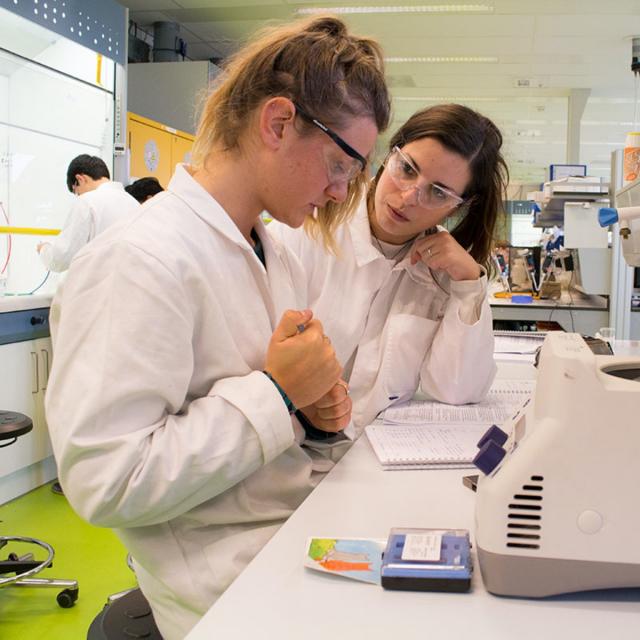
This course is developed to improve the effectiveness of laboratory classes in higher education. It aims to support teachers to improve their teaching skills for active learning in university science laboratory courses. It will show you how laboratory sessions can differ with respect to their aim and expected learning outcomes, how to engage students for learning and how to cope with their different levels of pre-knowledge and experience and probe their understanding. Last but not least it will show how you could assess students in laboratory courses.

Class Deals by MOOC List - Click here and see Coursera's Active Discounts, Deals, and Promo Codes.

This course is developed by ECTN (European Chemistry Thematic Network), Working group Lecturing Qualifications and Innovative Teaching Methods.

What You Will Learn

  • Identify the purposes of implementing laboratory classes in higher education.
  • Provide strategies on how to increase student engagement.
  • Develop effective questions to probe student understanding of laboratory practice.
  • Create a rubric for assessing a student performing a lab activity and subsequent reports.

Syllabus

WEEK 1
Welcome and introduction
In this module you will learn about different types of laboratory sessions and get acquainted with strategies that can improve student’s engagement in lab sessions. You will get an introduction about this course as a whole and set your personal goals for it.

WEEK 2
The Good Laboratory Teacher - Tips and Strategies
This module is about qualities needed to be a good laboratory teacher.

WEEK 3
Learning Theories in Practice
This module is about the learning theories that can be applied to ensure effective teaching of laboratory work.

WEEK 4
Giving Instructions and Questioning Skills
This module is about giving instruction in a lab session. We present different strategies how to support learning by questioning and how to prevent information overload.

WEEK 5
Assessment and Feedback
In this module we present the rubric, a tool which can be used for assessing and giving feedback to students on their learning goals. We also consider the concept of constructive alignment of learning outcomes, teaching and learning activities and assessment.

WEEK 6
Reflection
In this module we ask you to look back on what you have learned in this online course and to make your own plan about the improvements of the laboratory course in which you teach.

WEEK 7
Optional additional week to complete the course
This is an additional week for the ones who need it to finish all the assignments and get the cetificate of the course.
Good luck!

Go to Class
MOOC List is learner-supported. When you buy through links on our site, we may earn an affiliate commission.

Related Courses

Philosophy, Science and Religion: Science and Philosophy (Coursera) Coursera
University of Edinburgh

Philosophy, Science and Religion: Science and Philosophy (Coursera)

Philosophy, Science and Religion mark three of the most fundamental modes of thinking about the world and our place in it. Are these modes incompatible? Put another way: is the intellectually responsible thing to do to ‘pick sides’ and identify with one of these approaches at the exclusion of others? Or, are they complementary or mutually supportive? As is typical of questions of such magnitude, the devil is in the details. For example, it is important to work out what is really distinctive about each of these ways of inquiring about the world. In order to gain some clarity here, we’ll be investigating what some of the current leading thinkers in philosophy, science and religion are actually doing.

Oct 5th 2026
5-12 Weeks
Philosophy, Science and Religion: Philosophy and Religion (Coursera) Coursera
University of Edinburgh

Philosophy, Science and Religion: Philosophy and Religion (Coursera)

Philosophy, Science and Religion mark three of the most fundamental modes of thinking about the world and our place in it. Are these modes incompatible? Put another way: is the intellectually responsible thing to do to ‘pick sides’ and identify with one of these approaches at the exclusion of others? Or, are they complementary or mutually supportive? As is typical of questions of such magnitude, the devil is in the details. For example, it is important to work out what is really distinctive about each of these ways of inquiring about the world. In order to gain some clarity here, we’ll be investigating what some of the current leading thinkers in philosophy, science and religion are actually doing.

Oct 12th 2026
5-12 Weeks
Leading for Equity, Diversity and Inclusion in Higher Education (Coursera) Coursera
University of Michigan

Leading for Equity, Diversity and Inclusion in Higher Education (Coursera)

This course is open to professionals interested in learning more about leadership in higher education for a changing demographic or interested in developing their own leadership skills. The very idea that individuals can be taught to lead is not without its skeptics. Reasonable people, even some scholars in the field, point to the important traits, skills, and attributes that are observed in many visible leaders and contend that certain qualities necessary for effective leadership are not easily transmitted.

Oct 5th 2026
5-12 Weeks
The Brain and Space (Coursera) Coursera
Duke University

The Brain and Space (Coursera)

This course is about how the brain creates our sense of spatial location from a variety of sensory and motor sources, and how this spatial sense in turn shapes our cognitive abilities. Knowing where things are is effortless. But “under the hood,” your brain must figure out even the simplest of details about the world around you and your position in it.

Oct 12th 2026
5-12 Weeks
The Science of Stem Cells (Coursera) Coursera
American Museum of Natural History

The Science of Stem Cells (Coursera)

What promise do stem cells hold for the treatment of medical conditions? In this five-part online course you will explore the history and basic biology of stem cells, learn about new research techniques, and find out how stem cells could lead to cures for diseases and to individualized medicine.

Oct 5th 2026
5-12 Weeks
Assessment in Higher Education: Professional Development for Teachers (Coursera) Coursera
Erasmus University Rotterdam

Assessment in Higher Education: Professional Development for Teachers (Coursera)

Are you a teacher in higher education wanting to get the best out of your students and assessments? Then on behalf of Risbo, Erasmus University Rotterdam, we would like to welcome you to this MOOC on Assessment in Higher Education. In this MOOC we will guide you through the different phases of preparing, creating and evaluating the assessments in your course.

Oct 12th 2026
5-12 Weeks
Multimodal Literacies: Communication and Learning in the Era of Digital Media (Coursera) Coursera
University of Illinois at Urbana-Champaign

Multimodal Literacies: Communication and Learning in the Era of Digital Media (Coursera)

Whereas the focus of traditional literacy pedagogy has been the written word in its standard and literary forms, this courser expands the scope of literacy learning to encompass contemporary multimodal texts and the wide range of ways of making meaning that occur in different social and cultural contexts. Another course, "Literacy Teaching and Learning: Aims, Approaches and Pedagogies" addresses pedagogical aspects of literacies. This "Multimodal Literacies" learning module does not require or expect that participants will have already completed the "Literacy Teaching and Learning" module.

Oct 12th 2026
4 Weeks
Educating Deaf Children: Becoming an Empowered Teacher (Coursera) Coursera
University of Cape Town

Educating Deaf Children: Becoming an Empowered Teacher (Coursera)

Many Deaf children around the world still leave school functionally illiterate. In some cases there is no allowance made for education of Deaf children at all. This 4 week course provides you with invaluable knowledge and skills about teaching Deaf children. You will learn about the importance of Deaf culture and community, the need for a language rich environment for the Deaf child from as young as possible, and that having access to sign language can help Deaf children academically, emotionally, and socially.

Oct 12th 2026
4 Weeks
Innovative Teaching with ChatGPT (Coursera) Coursera
Vanderbilt University

Innovative Teaching with ChatGPT (Coursera)

Despite what you may have heard, ChatGPT offers exciting possibilities for supporting innovative teaching and personalized education. This course provides practical techniques that any educator, from K-12 to higher education, can use to help support their teaching. No experience with ChatGPT, prompt engineering, or Generative AI is required.

Oct 12th 2026
1 Week
Copyright for Educators & Librarians (Coursera) Coursera
Duke University,Emory University,University of North Carolina at Chapel Hill

Copyright for Educators & Librarians (Coursera)

Fear and uncertainty about copyright law often plagues educators and sometimes prevents creative teaching. This course is a professional development opportunity designed to provide a basic introduction to US copyright law and to empower teachers and librarians at all grade levels. Course participants will discover that the law is designed to help educators and librarians.

Oct 12th 2026
5-12 Weeks
Philosophy of Science (Coursera) Coursera
University of Pennsylvania

Philosophy of Science (Coursera)

For the last four centuries, scientists have aimed to provide us with an understanding of the world around us. By all appearances, science has made substantial progress during this time. But is this progress real or illusory? And if it is real, how has this progress been made? This four-week course will consider these important questions.

Oct 5th 2026
4 Weeks