Teaching Physical Computing to 5-11 year olds (FutureLearn)

Teaching Physical Computing to 5-11 year olds (FutureLearn)

Teach your young learners how to create electronic circuits, then learn to control them using block-based programming languages. Learn how to create physical computing projects using a Crumble or micro:bit. Physical computing is the process of designing, building, and programming systems that use physical components such as buttons, lights, and motors.

Class Deals by MOOC List - Click here and see FutureLearn's Active Discounts, Deals, and Promo Codes.

On this three-week course from the Raspberry Pi Foundation, you’ll be introduced to the world of physical computing and how it can encourage learners to use their imaginations to solve problems and develop new ideas.
You’ll learn how to support young children aged 5-11 years old as they work through physical computing projects, whilst also developing your own knowledge and skills.
Gain an understanding of inputs and outputs
On the course, you’ll build projects involving connecting both inputs and outputs to a Crumble microcontroller or a BBC micro:bit.
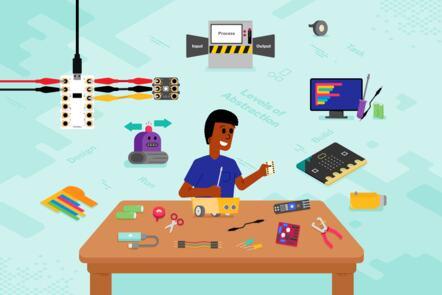
You will use inputs to pass data into the microcontroller, process that data with block-based programming languages, and use outputs to move a robot buggy or provide information to a user.
The course will help you complete several physical computing projects to develop your skills and help you understand the experiences your young learners may have. You’ll also reflect on how your projects use the programming principles of sequence, selection, and repetition.
Learn how to adapt your lessons for young learners, with Raspberry Pi
On the course, you’ll find advice from the experts at Raspberry Pi Foundation on how to make the concepts relevant to young learners.
The projects that you work on also model the use of “levels of abstraction”, a way of splitting up computing projects to help focus on individual aspects, and lower cognitive load.
At the end of the course, you’ll create your own physical computing project involving a buggy to help cement your knowledge and put what you have learned into practice.
What topics will you cover?

  • Using physical computing devices in primary school
  • Using a Crumble to light LEDs and turn motors
  • Using buttons and sensors as inputs to a Crumble
  • The programming concepts of sequence, repetition, selection, and using variables
  • Builidng a buggy with a Crumble
  • An introductino to Micro:bit

Learning on this course
You can take this self-guided course and learn at your own pace. On every step of the course you can meet other learners, share your ideas and join in with active discussions in the comments.

What will you achieve?
By the end of the course, you‘ll be able to...

  • Evaluate different commercially available physical computing tools
  • Apply your programming knowledge to control digital inputs and outputs
  • Develop physical computing projects using a Crumble microcontroller from task to completed build
  • Demonstrate how to use the micro:bit MakeCode editor and emulator
  • Design suitable physical computing projects for your learning context
  • Reflect on your learning and create ideas for your classroom practice

Who is the course for?
This course is designed for educators of all types, in schools or informal settings.
It will help you begin your physical computing journey and use physical computing to help to teach young children how to program.


Go to Class
MOOC List is learner-supported. When you buy through links on our site, we may earn an affiliate commission.

Related Courses

Innovative Teaching: Engaging Adult Learners with Active Learning (FutureLearn) FutureLearn
University of Padova

Innovative Teaching: Engaging Adult Learners with Active Learning (FutureLearn)

Discover the power of active participation in adult learning, encouraging teamwork and collaboration among students. Explore the power of teaching and how interactive learning can aid the classroom. Active learning is the leading innovative teaching approach in education today. It encourages teachers to foster a more student-centred, interactive and participatory approach to learning.

Self Paced
4 Weeks
Teaching Climate and Sustainability in Primary Schools: An Outdoor Learning Approach (FutureLearn) FutureLearn
University of Reading

Teaching Climate and Sustainability in Primary Schools: An Outdoor Learning Approach (FutureLearn)

Build your confidence teaching climate and sustainability outdoors and develop ideas to implement in your school. Discover the importance of climate education and outdoor learning. Children around the world are demanding comprehensive and up-to-date education on climate and sustainability. Most teachers agree climate change education should be compulsory in schools, yet many feel ill-equipped to teach it.

Self Paced
2 Weeks
Professional Development for Early Career Teachers (FutureLearn) FutureLearn
University of East Anglia

Professional Development for Early Career Teachers (FutureLearn)

Find out how to develop and improve your teaching abilities as you start your career as a teacher. Improve your teaching practice and learn to manage your workload. The early stages of a career in teaching can be daunting. You’re regularly faced with new responsibilities and challenges. On this course you will get advice and support on improving your teaching skills as well as juggling your workload so you’re able to handle these challenges.

Self Paced
5-12 Weeks
Blended and Online Learning Design (FutureLearn) FutureLearn
University College London

Blended and Online Learning Design (FutureLearn)

Learn to develop the best pedagogy for your students using blended and online learning methods. Develop the skills you need to teach blended and online learning. Online learning is the future of teaching. This three-week teaching course aims to support teachers’ own innovations in teaching and learning online, whether you teach in a school, college or university.

Self Paced
3 Weeks
Functional Programming in Haskell: Supercharge Your Coding (FutureLearn) FutureLearn
University of Glasgow

Functional Programming in Haskell: Supercharge Your Coding (FutureLearn)

Get an introduction to Haskell, the increasingly popular functional programming language, with this University of Glasgow course. Do you want to develop software using the latest programming language paradigm? Haskell is a functional programming language, based on formal mathematical principles. As such, it is easy to reason about and develop, and it executes efficiently on modern multicore machines. From investment banks to social networks, everyone is adopting Haskell.

Self Paced
5-12 Weeks
Global Education for Teachers (FutureLearn) FutureLearn
University College London

Global Education for Teachers (FutureLearn)

Discover key issues in global citizenship education and learn how to prepare your students for the global challenges of tomorrow. Incorporate global learning and global citizenship education into your teaching. Teachers today must prepare their students for a global future. Young people will need to learn how to positively engage with people from all over the world and build the skills and knowledge to become a global citizen.On this course, you’ll increase your confidence and ability to introduce global issues into your teaching. You’ll get CPD training in how to address global issues in your teaching and support global citizenship in your school.

Self Paced
3 Weeks
Becoming a Student Assistant: Teaching and Mentoring (FutureLearn) FutureLearn
University of Groningen

Becoming a Student Assistant: Teaching and Mentoring (FutureLearn)

Learn how to be professionally involved in teaching, support and governing of higher education institutions. Student assistants are valuable staff members at the University of Groningen. Currently, over 700 students take up teaching duties, support role functions, governing positions, and many other responsibilities. But, how to prepare for a job as a student assistant? What is professional behaviour? How to deal with challenging situations in the classroom? How to support first year students? These and other questions will be covered in this course.

Self Paced
5-12 Weeks
Teaching Entrepreneurial Thinking (FutureLearn) FutureLearn
Queensland University of Technology

Teaching Entrepreneurial Thinking (FutureLearn)

Get an introduction to what entrepreneurial thinking is, and how and why we should teach it. We live in an uncertain and complex world, where the big problems of today and tomorrow are yet to be identified. Teaching young people the skills and resilience to live and thrive in such a world is the purpose of entrepreneurial thinking. This course will introduce you to what entrepreneurial thinking is, and why it’s an important skill for young people to learn.

Self Paced
2 Weeks
Teacher Training: Choosing the Right PGCE for You (FutureLearn) FutureLearn
Coventry University

Teacher Training: Choosing the Right PGCE for You (FutureLearn)

Find the right path into teaching for you and get the chance to build the confidence and skills you need for working in teaching. Explore what it takes to become a teacher – and the skills you need to get there. This course aims to develop your understanding of the teaching sector and identify and improve upon the skills you need to become a great teacher.

Self Paced
2 Weeks
Clinical Supervision: Teaching and Facilitating Learning (FutureLearn) FutureLearn
University of East Anglia

Clinical Supervision: Teaching and Facilitating Learning (FutureLearn)

Create a conducive learning environment and facilitate effective learning with this online course for clinical supervisors. Help your undergraduate and postgraduate learners to learn effectively. This online course will focus on the importance of the learning environment for teaching and facilitating learning among undergraduate and postgraduate learners.

Self Paced
3 Weeks
Learning through Play with LEGO® Braille Bricks (FutureLearn) FutureLearn
The LEGO Foundation

Learning through Play with LEGO® Braille Bricks (FutureLearn)

Discover the benefits of using a play-based approach to teaching children braille – and life skills – using LEGO Braille Bricks. Experience the benefits of play to engage children with learning braille. Children are engaged in learning from birth – tackling problem solving, communication, collaboration, and exploration from their earliest weeks.

Self Paced
5-12 Weeks
Teaching Students Who Have Suffered Complex Trauma (FutureLearn) FutureLearn
Queensland University of Technology

Teaching Students Who Have Suffered Complex Trauma (FutureLearn)

Find out what complex trauma is, how it affects children and adolescents, and what can be done to help. Learn how to support students who have experienced complex trauma. Complex trauma affects the physical, emotional and social development of children and adolescents. In order to minimise harm, teachers and school leaders need to respond appropriately using trauma-informed practices and policies. In this course, you’ll get an introduction to what complex trauma is and how it affects young people’s development at school.

Self Paced
2 Weeks