Robotics: Mobility (Coursera)

Robotics: Mobility (Coursera)

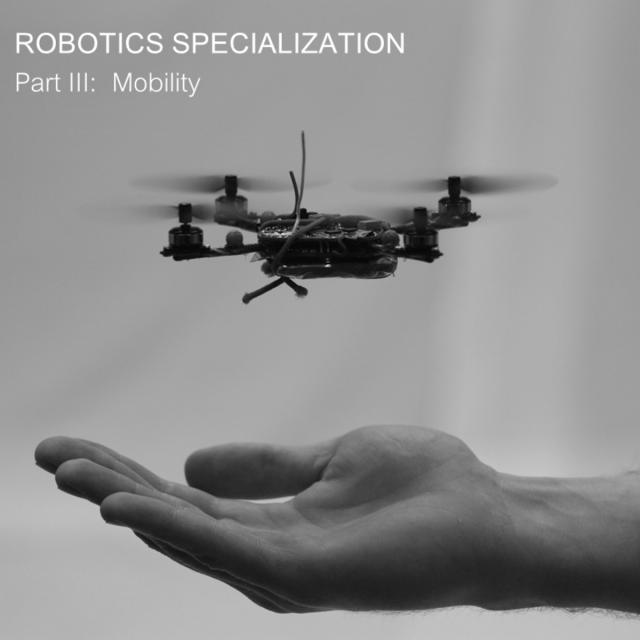
How can robots use their motors and sensors to move around in an unstructured environment? You will understand how to design robot bodies and behaviors that recruit limbs and more general appendages to apply physical forces that confer reliable mobility in a complex and dynamic world. We develop an approach to composing simple dynamical abstractions that partially automate the generation of complicated sensorimotor programs.

Class Deals by MOOC List - Click here and see Coursera's Active Discounts, Deals, and Promo Codes.

Specific topics that will be covered include: mobility in animals and robots, kinematics and dynamics of legged machines, and design of dynamical behavior via energy landscapes.
Course 3 of 6 in the Robotics Specialization.

Syllabus

WEEK 1
Introduction: Motivation and Background
We start with a general consideration of animals, the exemplar of mobility in nature. This leads us to adopt the stance of bioinspiration rather than biomimicry, i.e., extracting principles rather than appearances and applying them systematically to our machines. A little more thinking about typical animal mobility leads us to focus on appendages – limbs and tails – as sources of motion. The second portion of the week offers a bit of background on the physical and mathematical foundations of limbed robotic mobility. We start with a linear spring-mass-damper system and consider the second order ordinary differential equation that describes it as a first order dynamical system. We then treat the simple pendulum – the simplest revolute kinematic limb – in the same manner just to give a taste for the nature of nonlinear dynamics that inevitably arise in robotics. We’ll finish with a treatment of stability and energy basins.

WEEK 2
Behavioral (Templates) & Physical (Bodies)
We’ll start with behavioral components that take the form of what we call “templates:” very simple mechanisms whose motions are fundamental to the more complex limbed strategies employed by animal and robot locomotors. We’ll focus on the “compass gait” (the motion of a two spoked rimless wheel) and the spring loaded inverted pendulum – the abbreviated versions of legged walkers and legged runners, respectively.We’ll then shift over to look at the physical components of mobility. We’ll start with the notion of physical scaling laws and then review useful materials properties and their associated figures of merit. We’ll end with a brief but crucial look at the science and technology of actuators – the all important sources of the driving forces and torques in our robots.

WEEK 3
Anchors: Embodied Behaviors
Now we’ll put physical links and joints together and consider the geometry and the physics required to understand their coordinated motion. We’ll learn about the geometry of degrees of freedom. We’ll then go back to Newton and learn a compact way to write down the physical dynamics that describes the positions, velocities and accelerations of those degrees of freedom when forced by our actuators.Of course there are many different ways to put limbs and bodies together: again, the animals can teach us a lot as we consider the best morphology for our limbed robots. Sprawled posture runners like cockroaches have six legs which typically move in a stereotyped pattern which we will consider as a model for a hexapedal machine. Nature’s quadrupeds have their own varied gait patterns which we will match up to various four-legged robot designs as well. Finally, we’ll consider bipedal machines, and we’ll take the opportunity to distinguish human-like robot bipeds that are almost foredoomed to be slow quasi-static machines from a number of less animal-like bipedal robots whose embrace of bioinspired principles allows them to be fast runners and jumpers.

WEEK 4
Composition (Programming Work)
We now introduce the concept of dynamical composition, reviewing two types: a composition in time that we term “sequential”; and composition in space that we call “parallel.” We’ll put a bit more focus into that last concept, parallel composition and review what has been done historically, and what can be guaranteed mathematically when the simple templates of week 2 are tasked to worked together “in parallel” on variously more complicated morphologies. The final section of this week’s lesson brings you to the horizons of research into legged mobility. We give examples of how the same composition can be anchored in different bodies, and, conversely, how the same body can be made to run using different compositions. We will conclude with a quick look at the ragged edge of what is known about transitional behaviors such as leaping.


Go to Class
MOOC List is learner-supported. When you buy through links on our site, we may earn an affiliate commission.

Related Courses

Machine Learning for Computer Vision (Coursera) Coursera
MathWorks

Machine Learning for Computer Vision (Coursera)

In the second course of the Computer Vision for Engineering and Science specialization, you will perform two of the most common computer vision tasks: classifying images and detecting objects. You will apply the entire machine learning workflow, from preparing your data to evaluating your results. By the end of this course, you’ll train machine learning models to classify images of street signs and detect material defects.

Jun 1st 2026
4 Weeks
Migrations internationales : un enjeu mondial (Coursera) Coursera
Sciences Po

Migrations internationales : un enjeu mondial (Coursera)

Le monde bouge, mais les opinions et les gouvernements ne sont pas tous prêts à accepter cette réalité mal connue. La question affecte à la fois les Etats, mais aussi la planète, dans un processus de mondialisation et de régionalisation des migrations, et pose de nouvelles questions aux relations internationales, en y incluant le sud. Ce cours cherche à la fois à parfaire la connaissance sur le sujet, à traiter les thèmes essentiels induits par les migrations internationales et à dresser les tendances de demain.

Jun 1st 2026
5-12 Weeks
Computer Vision Basics (Coursera) Coursera
University at Buffalo,The State University of New York

Computer Vision Basics (Coursera)

By the end of this course, learners will understand what computer vision is, as well as its mission of making computers see and interpret the world as humans do, by learning core concepts of the field and receiving an introduction to human vision capabilities. They are equipped to identify some key application areas of computer vision and understand the digital imaging process. The course covers crucial elements that enable computer vision: digital signal processing, neuroscience and artificial intelligence.

Jun 1st 2026
4 Weeks
Urban Air Mobility (Coursera) Coursera
Technische Universität München - TUM

Urban Air Mobility (Coursera)

Sneak preview: The course modules will be gradually expanded over the next few weeks and new videos and quizzes will be added to further expand the existing course. // This course is primarily aimed at master students and phd-candidates interested in exploring new fields in aerospace. The course gives a first introduction into the relatively new field of Urban Air Mobility, explaining the technical background as well a giving an overview of all other necessities such as air traffic management, public acceptance or ecological sustainability.

Jun 1st 2026
5-12 Weeks
Data Analysis and Visualization (Coursera) Coursera
University at Buffalo,The State University of New York

Data Analysis and Visualization (Coursera)

By the end of this course, learners are provided a high-level overview of data analysis and visualization tools, and are prepared to discuss best practices and develop an ensuing action plan that addresses key discoveries. It begins with common hurdles that obstruct adoption of a data-driven culture before introducing data analysis tools (R software, Minitab, MATLAB, and Python). Deeper examination is spent on statistical process control (SPC), which is a method for studying variation over time. The course also addresses do’s and don’ts of presenting data visually, visualization software (Tableau, Excel, Power BI), and creating a data story.

Jun 8th 2026
4 Weeks
International migrations: a global issue (Coursera) Coursera
Sciences Po

International migrations: a global issue (Coursera)

The world is moving, but not all opinions and governments are willing to accept this poorly understood reality. The issue affects both states and the planet, in a process of globalization and of regionalization of migrations, and raises new questions for international relations, now including the South. This course aims at improving knowledge of the subject, addressing the key issues raised by international migration, and assessing the trends of tomorrow.

Jun 1st 2026
5-12 Weeks
Controle de Sistemas no Plano-s (Coursera) Coursera
Instituto Tecnológico de Aeronáutica

Controle de Sistemas no Plano-s (Coursera)

Após esse curso você será capaz de esboçar o Lugar Geométrico das Raízes (LGR - Root Locus) do denominador da Função de Transferência em Malha Fechada a partir dos polos e zeros da Função de Transferência em Malha aberta. Você também será capaz de projetar controladores de avanço de fase para atender simultaneamente requisitos de desempenho de amortecimento e de velocidade da resposta.

Jun 8th 2026
5-12 Weeks
Robotics Engineering & Applications (Coursera) Coursera
L&T EduTech

Robotics Engineering & Applications (Coursera)

The "Robotics Engineering & Applications" course stands as a beacon of innovation and opportunity in the realm of collaborative robotics. Comprising three dynamic modules, participants embark on a transformative journey delving into the essentials of robotic engineering, advanced programming techniques, and the integration of vision systems in designing and building robots for real-world applications.

Jun 8th 2026
3 Weeks
Modern Robotics, Course 3: Robot Dynamics (Coursera) Coursera
Northwestern University

Modern Robotics, Course 3: Robot Dynamics (Coursera)

Do you want to know how robots work? Are you interested in robotics as a career? Are you willing to invest the effort to learn fundamental mathematical modeling techniques that are used in all subfields of robotics? If so, then the "Modern Robotics: Mechanics, Planning, and Control" specialization may be for you. This specialization, consisting of six short courses, is serious preparation for serious students who hope to work in the field of robotics or to undertake advanced study. It is not a sampler.

Jun 1st 2026
4 Weeks