Object Localization with TensorFlow (Coursera)

Object Localization with TensorFlow (Coursera)

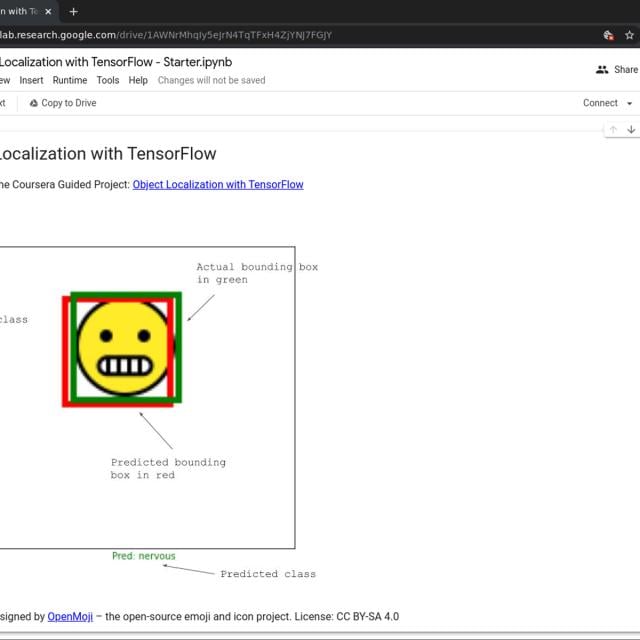
Welcome to this 2 hour long guided project on creating and training an Object Localization model with TensorFlow. In this guided project, we are going to use TensorFlow's Keras API to create a convolutional neural network which will be trained to classify as well as localize emojis in images. Localization, in this context, means the position of the emojis in the images. This means that the network will have one input and two outputs.

Class Deals by MOOC List - Click here and see Coursera's Active Discounts, Deals, and Promo Codes.

Think of this task as a simpler version of Object Detection. In Object Detection, we might have multiple objects in the input images, and an object detection model predicts the classes as well as bounding boxes for all of those objects. In Object Localization, we are working with the assumption that there is just one object in any given image, and our CNN model will classify and localize that object.
Please note that you will need prior programming experience in Python. You will also need familiarity with TensorFlow. This is a practical, hands on guided project for learners who already have theoretical understanding of Neural Networks, Convolutional Neural Networks, and optimization algorithms like Gradient Descent but want to understand how to use use TensorFlow to solve computer vision tasks like Object Localization.

In this Free Guided Project, you will:

  • Create synthetic data for model training
  • Create and train a multi output neural network to perform object localization
  • Create custom metrics and calbacks in Keras
  • Showcase this hands-on experience in an interview

Learn step-by-step:

  • Introduction
  • Download and Visualize Data
  • Create Examples
  • Plot Bouding Boxes
  • Data Generator
  • Model
  • Custom Metric: IoU
  • Compile the Model
  • Custom Callback
  • Model Training
Go to Class
MOOC List is learner-supported. When you buy through links on our site, we may earn an affiliate commission.

Related Courses

Machine Translation (Coursera) Coursera
Karlsruhe Institute of Technology - KIT

Machine Translation (Coursera)

Welcome to the CLICS-Machine Translation MOOC. This MOOC explains the basic principles of machine translation. Machine translation is the task of translating from one natural language to another natural language. Therefore, these algorithms can help people communicate in different languages. Such algorithms are used in common applications, from Google Translate to apps on your mobile device.

Sep 28th 2026
5-12 Weeks
Ethical Issues in Data Science (Coursera) Coursera
University of Colorado Boulder

Ethical Issues in Data Science (Coursera)

Computing applications involving large amounts of data – the domain of data science – impact the lives of most people in the U.S. and the world. These impacts include recommendations made to us by internet-based systems, information that is available about us online, techniques that are used for security and surveillance, data that is used in health care, and many more. In many cases, they are affected by techniques in artificial intelligence and machine learning.

Sep 28th 2026
5-12 Weeks
Foundations of Data Science: K-Means Clustering in Python (Coursera) Coursera
University of London,Goldsmiths, University of London

Foundations of Data Science: K-Means Clustering in Python (Coursera)

This MOOC, designed by an academic team from Goldsmiths, University of London, will quickly introduce you to the core concepts of Data Science to prepare you for intermediate and advanced Data Science courses. It focuses on the basic mathematics, statistics and programming skills that are necessary for typical data analysis tasks.

Oct 5th 2026
5-12 Weeks
Optimización de Redes Neuronales Profundas (Coursera) Coursera
Universidad Austral

Optimización de Redes Neuronales Profundas (Coursera)

Este curso se centrará en la optimización de Redes Neuronales Profundas, cambiando la idea de que todo el proceso es una “caja negra”. Comprenderá qué impulsa el rendimiento y podrá obtener mejores resultados de manera más sistemática. Entenderá cómo optimizar los principales Hiperparámetros y su implementación. Además, aprenderá nuevos conceptos útiles para el entrenamiento de las redes como los mini-batch y las regularizaciones. También, aprenderá a implementar una red neuronal utilizando TensorFlow

Sep 28th 2026
3 Weeks
Alibaba Cloud Native Solutions and Container Service (Coursera) Coursera
Alibaba Cloud Academy

Alibaba Cloud Native Solutions and Container Service (Coursera)

This course demonstrates how to use Alibaba Cloud Container Service and Container Registry Service to design and develop architectures related to cloud native applications, services, and security solutions. This course helps you understand the basic concepts of cloud native, the commercial implementation of container technology, and Kubernetes technology as well as extra benefits provided by Alibaba Cloud. This course is intended to prepare users to take the Alibaba Cloud Native ACA certification exam.

Oct 5th 2026
5-12 Weeks
Machine Teaching for Autonomous AI (Coursera) Coursera
University of Washington

Machine Teaching for Autonomous AI (Coursera)

Just as teachers help students gain new skills, the same is true of artificial intelligence (AI). Machine learning algorithms can adapt and change, much like the learning process itself. Using the machine teaching paradigm, a subject matter expert (SME) can teach AI to improve and optimize a variety of systems and processes. The result is an autonomous AI system.

Oct 5th 2026
4 Weeks
Python and Statistics for Financial Analysis (Coursera) Coursera
The Hong Kong University of Science and Technology - HKUST

Python and Statistics for Financial Analysis (Coursera)

Python is now becoming the number 1 programming language for data science. Due to python’s simplicity and high readability, it is gaining its importance in the financial industry. The course combines both python coding and statistical concepts and applies into analyzing financial data, such as stock data.

Oct 5th 2026
4 Weeks
Probabilistic Graphical Models 1: Representation (Coursera) Coursera
Stanford University

Probabilistic Graphical Models 1: Representation (Coursera)

Probabilistic graphical models (PGMs) are a rich framework for encoding probability distributions over complex domains: joint (multivariate) distributions over large numbers of random variables that interact with each other. These representations sit at the intersection of statistics and computer science, relying on concepts from probability theory, graph algorithms, machine learning, and more. They are the basis for the state-of-the-art methods in a wide variety of applications, such as medical diagnosis, image understanding, speech recognition, natural language processing, and many, many more. They are also a foundational tool in formulating many machine learning problems.

Sep 28th 2026
5-12 Weeks
Data Science in Stratified Healthcare and Precision Medicine (Coursera) Coursera
University of Edinburgh

Data Science in Stratified Healthcare and Precision Medicine (Coursera)

An increasing volume of data is becoming available in biomedicine and healthcare, from genomic data, to electronic patient records and data collected by wearable devices. Recent advances in data science are transforming the life sciences, leading to precision medicine and stratified healthcare. In this course, you will learn about some of the different types of data and computational methods involved in stratified healthcare and precision medicine.

Oct 5th 2026
5-12 Weeks
Visualización de Datos con Python (Coursera) Coursera
IBM

Visualización de Datos con Python (Coursera)

"Una imagen vale mas que mil palabras". Todos estamos familiarizados con esta expresión. Se aplica especialmente cuando se trata de explicar la información obtenida del análisis de conjuntos de datos cada vez más grandes. La visualización de datos juega un papel esencial en la representación de datos tanto a pequeña como a gran escala. Una de las habilidades clave de un científico de datos es la capacidad de contar una historia convincente, visualizando datos y hallazgos de una manera accesible y estimulante

Sep 28th 2026
3 Weeks
Practical Python for AI Coding 1 (Coursera) Coursera
Korea Advanced Institute of Science and Technology - KAIST

Practical Python for AI Coding 1 (Coursera)

This course is for a complete novice of Python coding, so no prior knowledge or experience in software coding is required. This course selects, introduces and explains Python syntaxes, functions and libraries that were frequently used in AI coding. In addition, this course introduces vital syntaxes, and functions often used in AI coding and explains the complementary relationship among NumPy, Pandas and TensorFlow, so this course is helpful for even seasoned python users.

Sep 28th 2026
5-12 Weeks