Machine Translation (Coursera)

Machine Translation (Coursera)

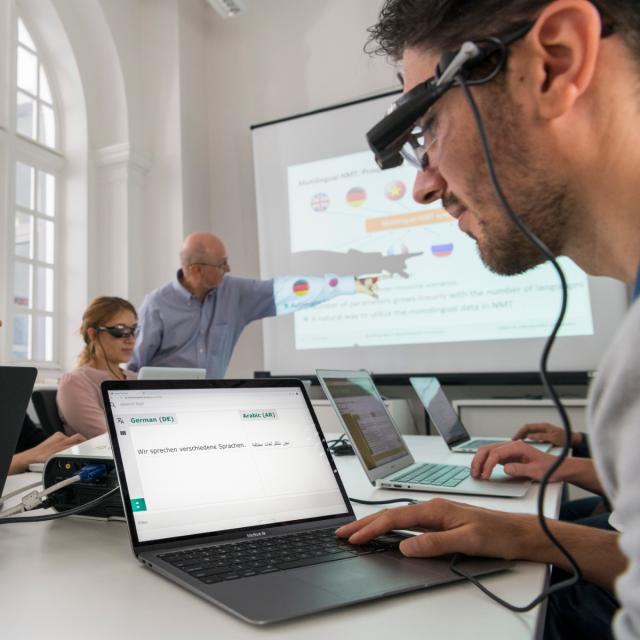
Welcome to the CLICS-Machine Translation MOOC. This MOOC explains the basic principles of machine translation. Machine translation is the task of translating from one natural language to another natural language. Therefore, these algorithms can help people communicate in different languages. Such algorithms are used in common applications, from Google Translate to apps on your mobile device.

Class Deals by MOOC List - Click here and see Coursera's Active Discounts, Deals, and Promo Codes.

After taking this course you will be able to understand the main difficulties of translating natural languages and the principles of different machine translation approaches. A main focus of the course will be the current state-of-the-art neural machine translation technology which uses deep learning methods to model the translation process. You will be able to decide which concepts fit your machine translation application best.

Syllabus

WEEK 1: Introduction to the basics of Machine Translation
WEEK 2: Language
WEEK 3: Evaluation
WEEK 4: Statistical Machine Translation
WEEK 5: Neural Network Models
WEEK 6: NMT
WEEK 7: More NMT
Go to Class
MOOC List is learner-supported. When you buy through links on our site, we may earn an affiliate commission.

Related Courses

Foundations of Data Science: K-Means Clustering in Python (Coursera) Coursera
University of London,Goldsmiths, University of London

Foundations of Data Science: K-Means Clustering in Python (Coursera)

This MOOC, designed by an academic team from Goldsmiths, University of London, will quickly introduce you to the core concepts of Data Science to prepare you for intermediate and advanced Data Science courses. It focuses on the basic mathematics, statistics and programming skills that are necessary for typical data analysis tasks.

Oct 5th 2026
5-12 Weeks
Information Extraction from Free Text Data in Health (Coursera) Coursera
University of Michigan

Information Extraction from Free Text Data in Health (Coursera)

In this MOOC, you will be introduced to advanced machine learning and natural language processing techniques to parse and extract information from unstructured text documents in healthcare, such as clinical notes, radiology reports, and discharge summaries. Whether you are an aspiring data scientist or an early or mid-career professional in data science or information technology in healthcare, it is critical that you keep up-to-date your skills in information extraction and analysis.

Sep 28th 2026
4 Weeks
Introduction to Linear Algebra and Python (Coursera) Coursera
Howard University

Introduction to Linear Algebra and Python (Coursera)

This course is the first of a series that is designed for beginners who want to learn how to apply basic data science concepts to real-world problems. You might be a student who is considering pursuing a career in data science and wanting to learn more, or you might be a business professional who wants to apply some data science principles to your work. Or, you might simply be a curious, lifelong learner intrigued by the powerful tools that data science and math provides. Regardless of your motivation, we’ll provide you with the support and information you need to get started.

Sep 28th 2026
4 Weeks
Translation in Practice (Coursera) Coursera
Nanjing University

Translation in Practice (Coursera)

This course offers you basic but valuable techniques used by a good translator in the translation between English and Chinese. We’ll discuss what is translation, what is good translation, and learn about how to produce good translations. All the examples used in this course are taken from the course instructor's own translations of various genres and topics of writing.

Oct 5th 2026
5-12 Weeks
Code Free Data Science (Coursera) Coursera
University of California, San Diego

Code Free Data Science (Coursera)

The Code Free Data Science class is designed for learners seeking to gain or expand their knowledge in the area of Data Science. Participants will receive the basic training in effective predictive analytic approaches accompanying the growing discipline of Data Science without any programming requirements. Machine Learning methods will be presented by utilizing the KNIME Analytics Platform to discover patterns and relationships in data.

Sep 28th 2026
4 Weeks
Advanced Linear Models for Data Science 2: Statistical Linear Models (Coursera) Coursera
Johns Hopkins University

Advanced Linear Models for Data Science 2: Statistical Linear Models (Coursera)

Welcome to the Advanced Linear Models for Data Science Class 2: Statistical Linear Models. This class is an introduction to least squares from a linear algebraic and mathematical perspective. Before beginning the class make sure that you have the following: a basic understanding of linear algebra and multivariate calculus; a basic understanding of statistics and regression models; at least a little familiarity with proof based mathematics; basic knowledge of the R programming language.

Sep 28th 2026
4 Weeks
Probabilistic Graphical Models 1: Representation (Coursera) Coursera
Stanford University

Probabilistic Graphical Models 1: Representation (Coursera)

Probabilistic graphical models (PGMs) are a rich framework for encoding probability distributions over complex domains: joint (multivariate) distributions over large numbers of random variables that interact with each other. These representations sit at the intersection of statistics and computer science, relying on concepts from probability theory, graph algorithms, machine learning, and more. They are the basis for the state-of-the-art methods in a wide variety of applications, such as medical diagnosis, image understanding, speech recognition, natural language processing, and many, many more. They are also a foundational tool in formulating many machine learning problems.

Sep 28th 2026
5-12 Weeks
AI Materials (Coursera) Coursera
Korea Advanced Institute of Science and Technology - KAIST

AI Materials (Coursera)

Learn about the materials that have advanced the performance of artificial intelligence, and the machine learning models that could help accelerate the design and development of novel materials. This course defines artificial intelligence (AI) as a machine to which some or all of the functions of the human brain have been delegated. It highlights the need, and explains in an easy-to-understand way how machine learning from artificial intelligence can dramatically accelerate the development of new materials.

Oct 5th 2026
5-12 Weeks
Data science perspectives on pandemic management (Coursera) Coursera
Politecnico di Milano

Data science perspectives on pandemic management (Coursera)

The COVID-19 pandemic is one of the first world-wide scenarios where data made a difference in capturing and analyzing the diffusion and impact of the disease. We offer an introductory course for decision makers, policy makers, public bodies, NGOs, and private organizations about methods, tools, and experiences on the use of data for managing current and future pandemic scenarios.

Oct 5th 2026
5-12 Weeks
Decision Making and Reinforcement Learning (Coursera) Coursera
Columbia University

Decision Making and Reinforcement Learning (Coursera)

This course is an introduction to sequential decision making and reinforcement learning. We start with a discussion of utility theory to learn how preferences can be represented and modeled for decision making. We first model simple decision problems as multi-armed bandit problems in and discuss several approaches to evaluate feedback. We will then model decision problems as finite Markov decision processes (MDPs), and discuss their solutions via dynamic programming algorithms. We touch on the notion of partial observability in real problems, modeled by POMDPs and then solved by online planning methods.

Sep 28th 2026
5-12 Weeks
Machine Learning Algorithms (Coursera) Coursera
Sungkyunkwan University - SKKU

Machine Learning Algorithms (Coursera)

In this course you will: understand the naïve Bayesian algorithm; understand the Support Vector Machine algorithm; understand the Decision Tree algorithm; understand the Clustering. Please make sure that you’re comfortable programming in Python and have a basic knowledge of mathematics including matrix multiplications, and conditional probability.

Sep 28th 2026
4 Weeks