An Introduction to Music Therapy with Nordoff Robbins (FutureLearn)

Offered by Nordoff Robbins,
An Introduction to Music Therapy with Nordoff Robbins (FutureLearn)

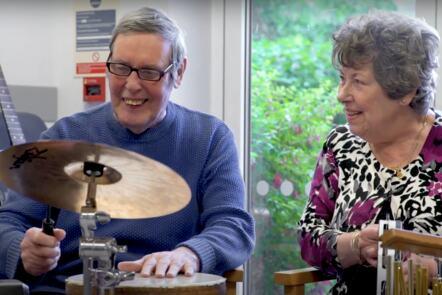
Gain important insights into music therapy and those who pioneered it as you discover the vital skills of a music therapist. Understand a person-centred approach to music therapy. This introductory six-week course will help you explore music therapy through the Nordoff Robbins person-centred approach.

Class Deals by MOOC List - Click here and see FutureLearn's Active Discounts, Deals, and Promo Codes.

You’ll gain an understanding of how music therapy works today, and how the practice has developed over the last half-century.
Exploring your own relationship with music along the way, you’ll discover the key elements of how music therapy works and can help in a range of settings.
Discover the pioneering work of Nordoff Robbins
You’ll examine the early work of Paul Nordoff and Clive Robbins who pioneered ‘music as therapy’.
Once you have understood music therapy’s roots, you’ll discover the current work carried out through the charity, Nordoff Robbins UK. You’ll explore the importance of music-making, the role of groups and communities, and the worldwide impact of the work from the UK’s largest independent provider of music therapy.
Develop the skills of a music therapist
You’ll discover how the approach to music therapy has evolved to meet the needs of our changing world, and the critical skills needed to become a music therapist, such as the importance of listening.
You’ll also have an opportunity to explore therapeutic development through shared music therapy case studies.
By the end of the course, you’ll have a solid understanding of the importance of music therapy, your relationship with music, and the role of a music therapist.

Syllabus

Week 1: Introduction - Music and You
Week 2: The importance of listening
Week 3: The History of Nordoff Robbins
Week 4: It takes two...
Week 5: Nordoff Robbins work in groups and community settings
Week 6: Conclusion

What will you achieve?
By the end of the course, you‘ll be able to...

  • Summarise the core principles underlying Nordoff Robbins music therapy
  • Compare the ideas presented in the course to your own experience of music making
  • Critique older Nordoff Robbins ideas and literature in the context of the culture of their time, and compare to more recent developments
  • Debate the implications of music therapy ideas and practice for wider society, particularly the roles available to disabled and disadvantaged people
  • Evaluate the salient musical details that contribute to a particular musical interaction
  • Reflect on the nature of music, its place in human development, individual experience, society and culture
  • Develop your understanding of music therapy further, and engage with the wider world of practice, opportunities and literature in music therapy

Who is the course for?
This course is designed for anyone interested in music therapy and the Nordoff Robbins approach.
You don’t need any prior experience to join this introductory course.
What software or tools do you need?
You’ll need to be able to access the course through your computer or through a mobile device. Additionally we would recommend the use of a ‘reflective journal’ where you can make your own notes.


Go to Class
MOOC List is learner-supported. When you buy through links on our site, we may earn an affiliate commission.

Related Courses

History of Rock, Part Two (Coursera) Coursera
University of Rochester

History of Rock, Part Two (Coursera)

This course, part 2 of a 2-course sequence, examines the history of rock, primarily as it unfolded in the United States, from the early 1970s to the early 1990s. This course covers the music of Led Zeppelin, the Allman Brothers, Carole King, Bob Marley, the Sex Pistols, Donna Summer, Michael Jackson, Madonna, Prince, Metallica, Run-DMC, and Nirvana, and many more artists, with an emphasis both on cultural context and on the music itself. We will also explore how developments in the music business and in technology helped shape the ways in which styles developed.

Jun 8th 2026
5-12 Weeks
Inside Opera: Why Does It Matter? (FutureLearn) FutureLearn
King's College London,The Royal Opera House,V&A

Inside Opera: Why Does It Matter? (FutureLearn)

Discover the hidden world of opera, find out how it works and debate whether it’s still relevant today. How does opera work? How has it changed over 400 years? And most importantly, is opera relevant today? Get the answers to these questions and more with this course taking you behind opera’s velvet curtain.

No sessions available
4 Weeks
Today’s Music Industry (Coursera) Coursera
West Virginia University

Today’s Music Industry (Coursera)

This course provides an engaging and methodical insight into the past and present cultural and commercial music industry developments, directions, and trends. It will equip the students with the knowledge and skills necessary to appreciate, understand and more productively participate in today’s music industry field.

Jun 8th 2026
5-12 Weeks
Cantonese Opera: from Backstage to the Stage (FutureLearn) FutureLearn
The Hong Kong Academy for Performing Arts

Cantonese Opera: from Backstage to the Stage (FutureLearn)

Interested in Cantonese opera? Join us in an exploration of this artform from the Backstage to the Stage. Get an introduction to how a Cantonese opera show is prepared. Cantonese opera is a form of Chinese opera that can trace its roots back to the 12th century. Combining music, singing, martial arts, acrobatics and acting, Cantonese opera tells stories from Chinese history and myth, reflecting virtues like love, loyalty and patriotism.

No sessions available
4 Weeks
History of Rock, Part One (Coursera) Coursera
University of Rochester

History of Rock, Part One (Coursera)

This course, part 1 of a 2-course sequence, examines the history of rock, primarily as it unfolded in the United States, from the days before rock (pre-1955) to the end of the 1960s. This course covers the music of Elvis Presley, Chuck Berry, Phil Spector, Bob Dylan, the Beatles, the Rolling Stones, Jimi Hendrix, Cream, and many more artists, with an emphasis both on cultural context and on the music itself. We will also explore how developments in the music business and in technology helped shape the ways in which styles developed.

Jun 8th 2026
5-12 Weeks
The Importance of Listening (Coursera) Coursera
Northwestern University

The Importance of Listening (Coursera)

In this second MOOC in the Social Marketing Specialization - "The Importance of Listening" - you will go deep into the Big Data of social and gain a more complete picture of what can be learned from interactions on social sites. You will be amazed at just how much information can be extracted from a single post, picture, or video.

Jun 8th 2026
4 Weeks
How to Write Your First Song (FutureLearn) FutureLearn
The University of Sheffield

How to Write Your First Song (FutureLearn)

Get a practical introduction to the mechanics of songwriting and meet established songwriters with this free online course. Ever wanted to write a song, but not known how? This course will introduce you to the tools and techniques you need to write your first song.

Available Now
5-12 Weeks
String Music Appreciation (FutureLearn) FutureLearn
Chung Yuan Christian University (CYCU)

String Music Appreciation (FutureLearn)

Explore the history, construction and techniques of different string instruments, and analyse the famous Butterfly Lovers Concerto. Discover the fascinating stories behind stringed instruments. From Haydn and Bach in the West to Chen Gang in China, string instruments have inspired some of the world’s most powerful music and gifted composers. On this course, you’ll examine the history of string instruments. You’ll go on to explore famous composers, and the most-celebrated Chinese classical string composition of all: the Butterfly Lovers Concerto.

Feb 27th 2023
4 Weeks
Learn to Code Electronic Music Tools with Javascript (FutureLearn) FutureLearn
Goldsmiths, University of London

Learn to Code Electronic Music Tools with Javascript (FutureLearn)

This course shows you how to build sound synthesizers and drum machines that run in your web browser using Javascript. In this course you will build a range of electronic music tools using the Javascript language and the Web Audio API. You will be shown line by line how to program interactive synthesizers, drum machines and even algorithmic music systems that can generate music automatically.

No sessions available
4 Weeks
The Importance and Power of Music in our Society (Coursera) Coursera
Leiden University,University of the Arts The Hague

The Importance and Power of Music in our Society (Coursera)

Music plays an important role in our daily lives and is woven into the fabric of society. We listen to music while alone or in company, in a dance club or at home, through simple headphones or via high-end speakers, as background or as foreground, after we get up or before we go to bed. Music accompanies us when we are traveling, doing sports, shopping, working or relaxing. This omnipresence of music raises several questions: how does music affect our lives? What is the relation between the society we live in and the role, function, and position of music within that society? How is music influenced by and does music influence social, political, economic, technological, and multiple other developments?

Jun 9th 2026
4 Weeks