Exploring Beethoven's Piano Sonatas Part 3 (Coursera)

Exploring Beethoven's Piano Sonatas Part 3 (Coursera)

Welcome to Part 3 of Exploring Beethoven's Piano Sonatas! I'm delighted to launch another set of new lectures of this course as Part 3. As before, this class is meant for people of all levels of experience with Beethoven's music (including no experience at all!).

Class Deals by MOOC List - Click here and see Coursera's Active Discounts, Deals, and Promo Codes.

Remember that you are able to watch the lectures as many times as you like, at whatever pace is comfortable for you.
As I’ve done with the first two sets of Beethoven lectures, I look forward to meeting with students—online and in person, in various cities. The dates and locations will be posted in the Announcements and Events section, as part of the course content. So please remember to check back there for details.
In these four new lectures, we will explore the following sonatas:
• Sonata Op. 10, No. 1
• Sonata Op. 22
• Sonata Op. 31, No. 2
• Sonata Opp. 78, 79, 81a

Syllabus

WEEK 1
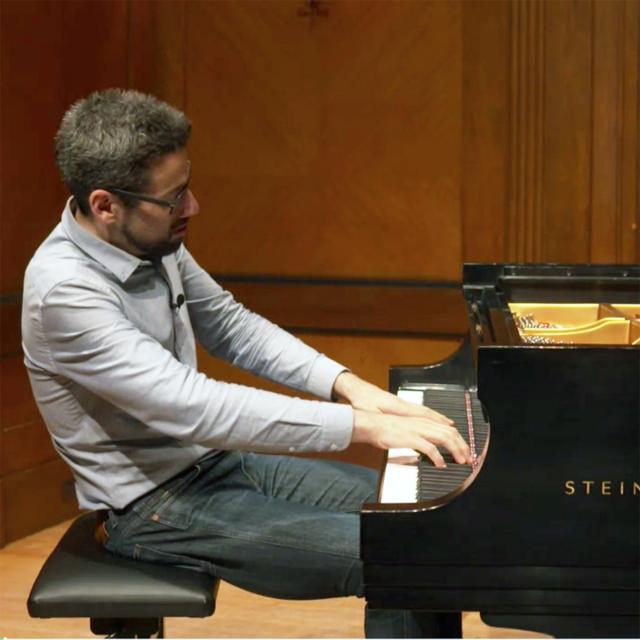
We are glad that you have joined us for Part 3 of Exploring Beethoven's Piano Sonatas course, taught by Curtis faculty member and extraordinary concert artist, Jonathan Biss! This course is considered Part 3, with new and separate sets of lectures. Specifically, in Part 3 we will cover Beethoven's Piano Sonatas Op. 10, No. 1, Op. 22, Op. 31, No. 2 and Opp. 78, 79 and 81a. As with the other two Beethoven courses, it is not necessary to have taken the previous Exploring Beethoven's Piano Sonatas courses. We know you will be perfectly comfortable to start learning with Part 3, if you wish and go from here. There is always the option to go back to Parts 1 and 2 at any time. Between these two courses, there exists a large amount of additional resources and learning that might be helpful as you embark on Part 3. We certainly encourage you to take Parts 1 and 2, if you have not just yet. In the meantime, enjoy the class: Part 3 of Exploring Beethoven’s Piano Sonatas.

WEEK 2
Op. 10 No. 1

WEEK 3
Op. 22

WEEK 4
op. 31 no. 2

WEEK 5
opp. 78, 79 and 81a

WEEK 6
Listening to the Sonatas
To supplement your learning during the course, enjoy free access to several of the Jonathan's Beethoven Sonatas recordings.

WEEK 7
Your Thoughts Welcome

Go to Class
MOOC List is learner-supported. When you buy through links on our site, we may earn an affiliate commission.

Related Courses

Music as Biology: What We Like to Hear and Why (Coursera) Coursera
Duke University

Music as Biology: What We Like to Hear and Why (Coursera)

The course will explore the tone combinations that humans consider consonant or dissonant, the scales we use, and the emotions music elicits, all of which provide a rich set of data for exploring music and auditory aesthetics in a biological framework. Analyses of speech and musical databases are consistent with the idea that the chromatic scale (the set of tones used by humans to create music), consonance and dissonance, worldwide preferences for a few dozen scales from the billions that are possible, and the emotions elicited by music in different cultures all stem from the relative similarity of musical tonalities and the characteristics of voiced (tonal) speech.

Sep 21st 2026
5-12 Weeks
Sharpened Visions: A Poetry Workshop (Coursera) Coursera
California Institute of the Arts

Sharpened Visions: A Poetry Workshop (Coursera)

Why just write poems when you can write better ones? This course is built on the notion that the most exciting writing begins after the first draft. It is specifically for folks who believe that writing poems just to express oneself is like using the Internet just for email. After all, poetry can change the way you and your readers think of the world and its inhabitants; it can break new ground for language; turn a blank sheet of paper into a teeming concert of voices and music.

Sep 28th 2026
5-12 Weeks
Richard Schechner's Introduction to Performance Studies (Coursera) Coursera
New York University

Richard Schechner's Introduction to Performance Studies (Coursera)

Performance Studies: An Introduction explores the wide world of performance--from theatre, dance, and music to ritual, play, political campaigns, social media, and the performances of everyday life. Performance studies also ranges across cultures--Asia, Africa, the Caribbean, Europe, the Americas. And it spans historical periods from the art of the paleolithic caves to YouTube and the avantgarde. This course is devised by Richard Schechner, one of the pioneers of performance studies, in dialogue with more than a dozen expert scholars and artists.

Sep 28th 2026
13-24 Weeks
Princípios Gerais da Técnica do Violino e da Viola de Arco (Coursera) Coursera
Universidade Estadual de Campinas - UNICAMP

Princípios Gerais da Técnica do Violino e da Viola de Arco (Coursera)

Esse curso visa fornecer informações sobre aspectos básicos da técnica do violino e da viola de arco. Ao longo de 18 aulas, com duração média de 7 minutos cada, serão abordados temas como posicionamento do instrumento, maneiras de posicionar a mão esquerda, como segurar o arco, como executar os principais golpes de arco, como estudar mudanças de posição, etapas para desenvolvimento do vibrato e sugestões para a organização do estudo diário do instrumento.

Oct 5th 2026
4 Weeks
Improvisación de jazz (Coursera) Coursera
Berklee College of Music

Improvisación de jazz (Coursera)

Aprenda los conceptos básicos de la improvisación con Gary Burton, uno de los improvisadores más reconocidos en el mundo del jazz, incluidos los procesos mentales, melódicos y armónicos que contribuyen a las habilidades instintivas que aplica un improvisador cuando realiza un solo.

Oct 5th 2026
5-12 Weeks
Exploring Beethoven’s Piano Sonatas Part 2 (Coursera) Coursera
Curtis Institute of Music

Exploring Beethoven’s Piano Sonatas Part 2 (Coursera)

Welcome to Part 2 of Exploring Beethoven's Piano Sonatas! I'm delighted to launch another set of new lectures of this course as Part 2. As before, this class is meant for people of all levels of experience with Beethoven's music (including no experience at all!). Remember that you are able to watch the lectures as many times as you like, at whatever pace is comfortable for you.

Oct 5th 2026
5-12 Weeks
Fundamentals of Music Theory (Coursera) Coursera
University of Edinburgh

Fundamentals of Music Theory (Coursera)

This course will introduce students to the theory of music, providing them with the skills needed to read and write Western music notation, as well as to understand, analyse, and listen informedly. It will cover material such as pitEli Appleby-Donaldches and scales, intervals, clefs, rhythm, form, meter, phrases and cadences, and basic harmony.

Sep 28th 2026
5-12 Weeks
Fundamentals of Audio and Music Engineering: Part 1 Musical Sound & Electronics (Coursera) Coursera
University of Rochester

Fundamentals of Audio and Music Engineering: Part 1 Musical Sound & Electronics (Coursera)

In this course students learn the basic concepts of acoustics and electronics and how they can applied to understand musical sound and make music with electronic instruments. Topics include: sound waves, musical sound, basic electronics, and applications of these basic principles in amplifiers and speaker design.

Sep 28th 2026
5-12 Weeks
The Blues: Understanding and Performing an American Art Form (Coursera) Coursera
University of Rochester

The Blues: Understanding and Performing an American Art Form (Coursera)

The blues is an American art form and the most important musical form in jazz. Although there are other formal paradigms of the blues, such as 8-bar or 16-bar, this course focuses on different incarnations of the 12-bar blues. There are considerable differences between Early Jazz blues, Swing blues, Bebop blues, Modal blues, and Post Bop blues.

Oct 5th 2026
5-12 Weeks
Teaching the Violin and Viola: Creating a Healthy Foundation (Coursera) Coursera
Northwestern University

Teaching the Violin and Viola: Creating a Healthy Foundation (Coursera)

Join us as we explore the fundamental principles and early stages of teaching violin and viola through a series of engaging video lectures and lesson demonstrations, including: 1) Master classes with some of the world’s top string pedagogues, 2) Individual lesson demos of teaching violin/viola set up, left and right hand technique and pieces from the early violin/viola repertoire, 3) Group lesson demos of teaching music theory, ear training and fun activities that encourage good playing habits, and 4) A “field trip” to the violin shop, where we will outfit a new beginning student with a proper instrument and bow.

Sep 28th 2026
5-12 Weeks