Princípios Gerais da Técnica do Violino e da Viola de Arco (Coursera)

Princípios Gerais da Técnica do Violino e da Viola de Arco (Coursera)

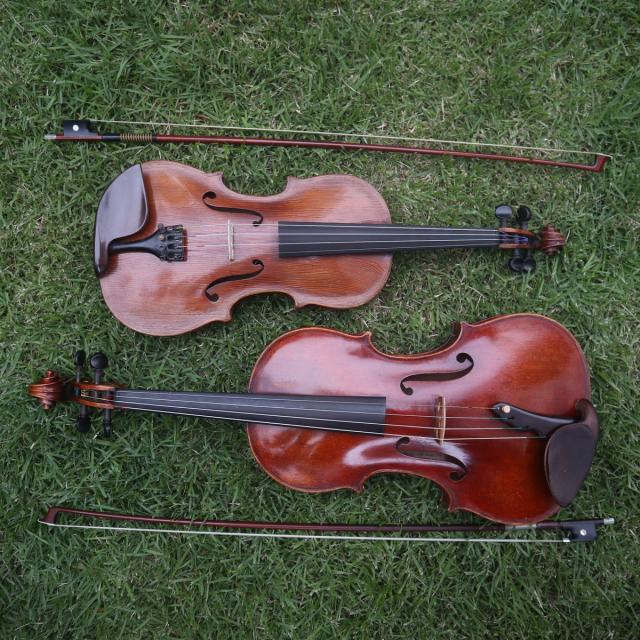
Esse curso visa fornecer informações sobre aspectos básicos da técnica do violino e da viola de arco. Ao longo de 18 aulas, com duração média de 7 minutos cada, serão abordados temas como posicionamento do instrumento, maneiras de posicionar a mão esquerda, como segurar o arco, como executar os principais golpes de arco, como estudar mudanças de posição, etapas para desenvolvimento do vibrato e sugestões para a organização do estudo diário do instrumento.

Class Deals by MOOC List - Click here and see Coursera's Active Discounts, Deals, and Promo Codes.

What You Will Learn

  • Como posicionar o instrumento, como posicionar a mão esquerda, como segurar o arco
  • Conhecer as principais escolas violinísticas e os principais golpes de arco
  • Aprender maneiras de estudar mudanças de posição e vibrato
  • Como organizar o estudo diário do instrumento

Syllabus

WEEK 1
Posicionando o instrumento, a mão esquerda e segurando o arco
Nesse módulo serão explicados os objetivos gerais do curso, formas de acompanhamento e temas abordados nas aulas. Fundamentos sobre posicionamento do instrumento, da mão esquerda e de como segurar o arco

WEEK 2
Escolas de arco e golpes básicos de arco
Nesse segundo módulo serão apresentadas as visões de Carl Flesch e Ivan Galamian sobre técnicas de arco, bem como serão detalhados os movimentos envolvidos nos principais golpes de arco

WEEK 3
Mudanças de posição e notas duplas
Nesse módulo serão detalhados os movimentos envolvidos nas mudanças de posição, com aplicação dos conceitos de forma de mão, dedo-guia e preparação de cotovelo e polegar, bem como sua aplicação em escalas. Também serão discutidas diferentes posições de cotovelo, de acordo com o tipo de intervalo a ser executado em notas duplas

WEEK 4
Vibrato e organização do estudo diário
Nesse último bloco serão detalhados os principais tipos de vibrato e sugerida uma sequência de exercícios para sua aquisição ou melhoria. No final haverá uma reflexão e aconselhamento sobre como organizar o estudo diário do instrumento
Go to Class
MOOC List is learner-supported. When you buy through links on our site, we may earn an affiliate commission.

Related Courses

20世纪西方音乐 Western Music in the 20th Century (Coursera) Coursera
Peking University

20世纪西方音乐 Western Music in the 20th Century (Coursera)

课程所涉不仅涵盖古典音乐如新古典主义、表现主义、民族主义等流派,也对爵士乐、摇滚乐与流行音乐在20世纪的风格情状投以深切关注;在将包括中国音乐在内的世界各国民族民间音乐纳入20世纪大背景予以研究探索之同时,关于大型综合艺术品例如歌剧、音乐剧、电影音乐的考察与分析,也设为专题,绝无偏废。

Sep 21st 2026
5-12 Weeks
So You Think You Know Tango? (Coursera) Coursera
Emory University

So You Think You Know Tango? (Coursera)

How well do you think you know tango? This two-week mini-course is designed for music lovers, musicians, and dancers who are interested in learning more about the Argentine Tango. It will explore the many dimensions of the Argentine Tango music, including its origins, popularization during the Golden Age, dissemination abroad, evolution into an artistic music-dance form, and adoption by Argentine and international art-music composers to date.

Sep 28th 2026
2 Weeks
Today’s Music Industry (Coursera) Coursera
West Virginia University

Today’s Music Industry (Coursera)

This course provides an engaging and methodical insight into the past and present cultural and commercial music industry developments, directions, and trends. It will equip the students with the knowledge and skills necessary to appreciate, understand and more productively participate in today’s music industry field.

Sep 28th 2026
5-12 Weeks
History of Rock, Part One (Coursera) Coursera
University of Rochester

History of Rock, Part One (Coursera)

This course, part 1 of a 2-course sequence, examines the history of rock, primarily as it unfolded in the United States, from the days before rock (pre-1955) to the end of the 1960s. This course covers the music of Elvis Presley, Chuck Berry, Phil Spector, Bob Dylan, the Beatles, the Rolling Stones, Jimi Hendrix, Cream, and many more artists, with an emphasis both on cultural context and on the music itself. We will also explore how developments in the music business and in technology helped shape the ways in which styles developed.

Sep 28th 2026
5-12 Weeks
In the Studio: Postwar Abstract Painting (Coursera) Coursera
The Museum of Modern Art

In the Studio: Postwar Abstract Painting (Coursera)

Want to know how some of the 20th century’s most celebrated artists made abstract paintings? This course offers an in-depth, hands-on look at the materials, techniques, and thinking of seven New York School artists, including Willem de Kooning, Yayoi Kusama, Agnes Martin, Barnett Newman, Jackson Pollock, Ad Reinhardt, and Mark Rothko. Through studio demonstrations and gallery walkthroughs, you’ll form a deeper understanding of what a studio practice means and how ideas develop from close looking, and you’ll gain a sensitivity to the physical qualities of paint.

Sep 28th 2026
5-12 Weeks
Music as Biology: What We Like to Hear and Why (Coursera) Coursera
Duke University

Music as Biology: What We Like to Hear and Why (Coursera)

The course will explore the tone combinations that humans consider consonant or dissonant, the scales we use, and the emotions music elicits, all of which provide a rich set of data for exploring music and auditory aesthetics in a biological framework. Analyses of speech and musical databases are consistent with the idea that the chromatic scale (the set of tones used by humans to create music), consonance and dissonance, worldwide preferences for a few dozen scales from the billions that are possible, and the emotions elicited by music in different cultures all stem from the relative similarity of musical tonalities and the characteristics of voiced (tonal) speech.

Sep 21st 2026
5-12 Weeks
Exploring Beethoven's Piano Sonatas (Coursera) Coursera
Curtis Institute of Music

Exploring Beethoven's Piano Sonatas (Coursera)

Our relationship to Beethoven is a deep and paradoxical one. For many musicians, he represents a kind of holy grail: His music has an intensity, rigor, and profundity which keep us in its thrall, and it is perhaps unequalled in the interpretive, technical, and even spiritual challenges it poses to performers. At the same time, Beethoven’s music is casually familiar to millions of people who do not attend concerts or consider themselves musically inclined. Two hundred years after his death, he is everywhere in the culture, yet still represents its summit. This course takes an inside-out look at the 32 piano sonatas from the point of view of a performer.

Sep 28th 2026
5-12 Weeks
Electronic Music Performance Techniques (Coursera) Coursera
Berklee College of Music

Electronic Music Performance Techniques (Coursera)

From the Moog analog synthesizers in the 1960s to the contemporary usage of computers, performance controllers, and mobile devices, Electronic Digital Instruments (EDIs) have long been capable of offering artists a new range of musical expression. In this one-of-a-kind course, you'll learn the essential skills you need to perform on an EDI.

Sep 28th 2026
4 Weeks
Piano Techniques for Modern Music (Coursera) Coursera
Berklee College of Music

Piano Techniques for Modern Music (Coursera)

If you have always dreamed of playing the piano or keyboard but did not know where to start, this is the course for you. This course will take you through the fundamental skills necessary to build your playing capability quickly and healthily. In addition to the fundamentals, you will learn from exercises and examples from popular music so that you can start playing in multiple styles. You will start by focusing on posture, breathing, movement, and sound production that will help you strengthen your finger independence and control over dynamics, phrasing, articulation, tempo, and pulse.

Sep 21st 2026
5-12 Weeks
Richard Schechner's Introduction to Performance Studies (Coursera) Coursera
New York University

Richard Schechner's Introduction to Performance Studies (Coursera)

Performance Studies: An Introduction explores the wide world of performance--from theatre, dance, and music to ritual, play, political campaigns, social media, and the performances of everyday life. Performance studies also ranges across cultures--Asia, Africa, the Caribbean, Europe, the Americas. And it spans historical periods from the art of the paleolithic caves to YouTube and the avantgarde. This course is devised by Richard Schechner, one of the pioneers of performance studies, in dialogue with more than a dozen expert scholars and artists.

Sep 28th 2026
13-24 Weeks
History of Rock, Part Two (Coursera) Coursera
University of Rochester

History of Rock, Part Two (Coursera)

This course, part 2 of a 2-course sequence, examines the history of rock, primarily as it unfolded in the United States, from the early 1970s to the early 1990s. This course covers the music of Led Zeppelin, the Allman Brothers, Carole King, Bob Marley, the Sex Pistols, Donna Summer, Michael Jackson, Madonna, Prince, Metallica, Run-DMC, and Nirvana, and many more artists, with an emphasis both on cultural context and on the music itself. We will also explore how developments in the music business and in technology helped shape the ways in which styles developed.

Sep 28th 2026
5-12 Weeks