Intro to Physics (Udacity)

Offered by Udacity,
Intro to Physics (Udacity)

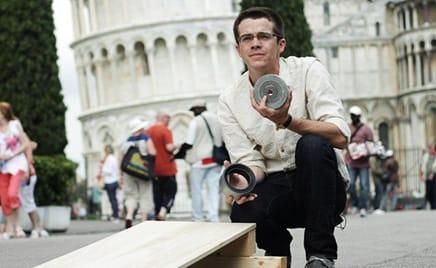
Landmarks in Physics. Study physics abroad in Europe -- virtually! Learn the basics of physics on location in Italy, the Netherlands and the UK, by answering some of the discipline's major questions from over the last 2000 years.

Class Deals by MOOC List - Click here and see Udacity's Active Discounts, Deals, and Promo Codes.

This unique class gives you the chance to see the sites where physics history was made and learn some of the subject's most captivating concepts.

What You Will Learn

Lesson 1
How can we measure the circumference of the Earth?

  • Basics of geometry and trigonometry.

Lesson 2
How do objects move?

  • Data analysis and kinematics.

Lesson 3
What causes motion?

  • Forces
  • acceleration
  • and Newton’s Laws.

Lesson 4
How can we use motion?

  • Work
  • energy
  • and simple machines.

Lesson 5
How can we determine our longitude at sea?

  • Simple harmonic motion.

Lesson 6
What is electricity?

  • Charge and electric fields.

Lesson 7
What is left to discover?

  • Modern physics and open questions.
Go to Class
MOOC List is learner-supported. When you buy through links on our site, we may earn an affiliate commission.
Related Courses

Flight Mechanics - Anemobarometry (Coursera) Coursera
ISAE-SUPAERO

Flight Mechanics - Anemobarometry (Coursera)

This course focuses on the physics of the atmosphere and its consequences on speed and altitude measurements. At the end of this course, you will understand precisely the meaning of the speed and altitude indication available to the pilot of an airplane. You will understand the difference between standard and actual atmosphere and be able to perform basic altitude and speed correction computations.

Jun 1st 2026
3 Weeks
Les deux infinis et nous (Coursera) Coursera
École Polytechnique

Les deux infinis et nous (Coursera)

Partez à la découverte de l'infiniment grand et de l'infiniment petit dans leurs aspects les plus proches de notre quotidien, en compagnie de physiciens et de physiciennes qui vont vous faire découvrir leur présence insoupçonnée dans notre vie de tous les jours. Vous vous initierez à la vie et aux métiers d'une grande collaboration en physique de l'infiniment petit et de l'infiniment grand, vous découvrirez comment les outils développés dans ces domaines ont trouvé des applications inattendues, comment la physique nucléaire a profondément modifié les domaines de l'énergie et de la santé, et comment les propriétés de certaines particules aident à présent d'autres disciplines à sonder la matière d'une manière totalement différente.

Jun 1st 2026
4 Weeks
Our Energy Future (Coursera) Coursera
University of California, San Diego

Our Energy Future (Coursera)

This course is designed to introduce students to the issues of energy in the 21st century – including food and fuels – which are inseparably linked – and will discuss energy production and utilization from the biology, engineering, economics, climate science, and social science perspectives. This course will cover the current production and utilization of energy, as well as the consequences of this use, examining finite fossil energy reserves, how food and energy are linked, impacts on the environment and climate, and the social and economic impacts of our present energy and food production and use.

Jun 1st 2026
5-12 Weeks
The Little Stuff: Energy, Cells, and Genetics (Coursera) Coursera
University of Colorado Boulder

The Little Stuff: Energy, Cells, and Genetics (Coursera)

In this course, we will explore the smaller side of biology: molecular biology. We’ll cover basic topics including cell biology and how cells can go “rogue” and turn into cancer, how energy from the sun is transferred to fuel our bodies, basics of genetics and inheritance, and genetic technologies. At the end of this course, we will discuss ethical and moral implications of several exciting and new genetic technologies.

Jun 1st 2026
4 Weeks
General Chemistry: Concept Development and Application (Coursera) Coursera
Rice University

General Chemistry: Concept Development and Application (Coursera)

This course will cover the topics of a full year, two semester General Chemistry course. We will use a free on-line textbook, Concept Development Studies in Chemistry, available via Rice’s Connexions project. The fundamental concepts in the course will be introduced via the Concept Development Approach developed at Rice University. In this approach, we will develop the concepts you need to know from experimental observations and scientific reasoning rather than simply telling you the concepts and then asking you to simply memorize or apply them.

Jun 1st 2026
5-12 Weeks
Planet Earth ... and You! (Coursera) Coursera
University of Illinois at Urbana-Champaign

Planet Earth ... and You! (Coursera)

Earthquakes, volcanoes, mountain building, ice ages, landslides, floods, life evolution, plate motions—all of these phenomena have interacted over the vast expanses of deep time to sculpt the dynamic planet that we live on today. Planet Earth presents an overview of several aspects of our home, from a geological perspective. We begin with earthquakes—what they are, what causes them, what effects they have, and what we can do about them. We will emphasize that plate tectonics—the grand unifying theory of geology—explains how the map of our planet's surface has changed radically over geologic time, and why present-day geologic activity—including a variety of devastating natural disasters such as earthquakes—occur where they do. We consider volcanoes, types of eruptions, and typical rocks found there.

Jun 1st 2026
5-12 Weeks
Introduction to Thermodynamics: Transferring Energy from Here to There (Coursera) Coursera
University of Michigan

Introduction to Thermodynamics: Transferring Energy from Here to There (Coursera)

This course provides an introduction to the most powerful engineering principles you will ever learn - Thermodynamics: the science of transferring energy from one place or form to another place or form. We will introduce the tools you need to analyze energy systems from solar panels, to engines, to insulated coffee mugs. More specifically, we will cover the topics of mass and energy conservation principles; first law analysis of control mass and control volume systems; properties and behavior of pure substances; and applications to thermodynamic systems operating at steady state conditions.

Jun 1st 2026
5-12 Weeks
Global Warming I: The Science and Modeling of Climate Change (Coursera) Coursera
University of Chicago

Global Warming I: The Science and Modeling of Climate Change (Coursera)

This class describes the science of global warming and the forecast for humans’ impact on Earth’s climate. Intended for an audience without much scientific background but a healthy sense of curiosity, the class brings together insights and perspectives from physics, chemistry, biology, earth and atmospheric sciences, and even some economics—all based on a foundation of simple mathematics (algebra).

Jun 1st 2026
5-12 Weeks
Explorando la Energía Sustentable (Coursera) Coursera
Pontificia Universidad Católica de Chile

Explorando la Energía Sustentable (Coursera)

Este curso introductorio aborda conceptos de energía sustentable y describe tecnologías avanzadas que pueden sustituir progresivamente las actuales dominadas por el carbón, el petróleo y gas natural, cuyas emisiones está perturbando progresivamente el clima, lo que puede afectar el desarrollo y la convivencia internacional.

Jun 1st 2026
4 Weeks
Energy: The Enterprise (Coursera) Coursera
University at Buffalo,The State University of New York

Energy: The Enterprise (Coursera)

This course provides a broad view of the evolving nature of energy and the influence of cost, availability, sustainability, technical advancements, lifestyle, and concern over the environment. Learners get a peek into our energy history, recent technical and societal advancements in clean energy, and some of the more important adjustments we have seen and will continue to see.

Jun 1st 2026
4 Weeks
Flight mechanics - The basis (Coursera) Coursera
ISAE-SUPAERO

Flight mechanics - The basis (Coursera)

More than one century after the Wright brothers' first flight, the flight still defy our intuition. You will learn here how to name the different parts of the airplane and how to describe and quantify its geometry. For that, we need now to share a precise vocabulary to describe the airplane's movement and attitude in space, and a refresher on basic general mechanic principles. You will remind how Newton's 2nd law allows you to determine what force must be applied on an apple - or on an airplane, to modify the magnitude and direction of its speed.

Jun 1st 2026
3 Weeks