FUN

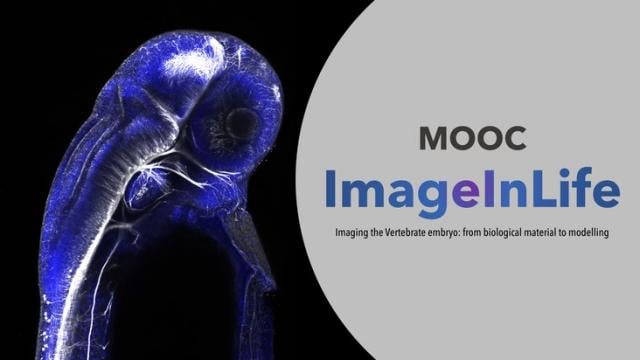
ImageInLife - Imaging the Vertebrate embryo: from biological material to modelling (FUN)

ImageInLife - Imaging the Vertebrate embryo: from biological material to modelling (FUN)

Microscopy technologies have progressed to such a point that it is now possible to image a developing vertebrate at the single cell resolution. Two main model species are being used for such studies, the zebrafish and the mouse. The present MOOC introduces the trainees to these two animal models, to the most modern microscopy technologies, to the use of high volume of data (images) and to the modelling of the studied processes. Trainees will also be introduced to the intravital study of viral infections.

The MOOC gives both a general introduction and introduces to more specialized tools and concepts.

At the end of the MOOC, you will know:

  • How to get vertebrate embryos to be imaged
  • How to label embryos and larvae for imaging
  • How to choose the right microscope for your purpose
  • How to deal with both the type of data generated and with the large amount of images/data generated by your microscope
  • How to choose the right modeling tools and what modelling could bring to the experimental plans and to the understanding of the underlying biological processes.

Course format
The MOOC is made of 5 weeks of electronic lessons, and you will be offered quizzes to evaluate your performances

Prerequisites
The target audience are :
Students in their first years at the University, before graduating a Bachelor, in order for them to be introduced to the challenges of intravital imaging in vertebrates before their first laboratory internship.
Master students interested in these disciplines or graduated students and researchers that want to implement research projects in these disciplines.
Prerequisite : Basic knowledge in biology

Course outline

Week 1 : Preparing embryos for imaging
Week 2 : What to image; Labelling techniques
Week 3 : How to image, Microscopes
Week 4 : From images to data
Week 5 : Modelling
Go to Class
MOOC List is learner-supported. When you buy through links on our site, we may earn an affiliate commission.

Related Courses

Evolution: A Course for Educators (Coursera) Coursera
American Museum of Natural History

Evolution: A Course for Educators (Coursera)

How are all of the species living on Earth today related? How does understanding evolutionary science contribute to our well-being? In this course, participants will learn about evolutionary relationships, population genetics, and natural and artificial selection. Participants will explore evolutionary science and learn how to integrate it into their classrooms.

Jul 27th 2026
4 Weeks
Bioinformatique : algorithmes et génomes (FUN) FUN
INRIA

Bioinformatique : algorithmes et génomes (FUN)

Dans ce cours, nous verrons **comment l’informatique permet d’interpréter le texte des génomes**. Doté d’algorithmes adaptés, mis en œuvre sous forme de programmes efficaces, l’ordinateur produit des prédictions quant à la localisation des milliers de gènes d’un organisme vivant et les fonctions que remplissent les protéines qu’ils codent.

No sessions available
5-12 Weeks
Nanotechnology: A Maker’s Course (Coursera) Coursera
Duke University,University of North Carolina,North Carolina State University

Nanotechnology: A Maker’s Course (Coursera)

How can we create nano-structures that are 10,000 times smaller than the diameter of a human hair? How can we “see” at the nano-scale? Through instruction and lab demonstrations, in this course you will obtain a rich understanding of the capabilities of nanotechnology tools, and how to use this equipment for nano-scale fabrication and characterization.

Aug 10th 2026
5-12 Weeks
Conversion Thermodynamique de la Chaleur : Cycles classiques et innovants (FUN) FUN
Institut Mines-Telecom

Conversion Thermodynamique de la Chaleur : Cycles classiques et innovants (FUN)

La Conversion Thermodynamique de la Chaleur joue un rôle essentiel dans nos sociétés car elle permet de répondre à des besoins fondamentaux comme le chauffage, la production de froid, l’éclairage, la mobilité, la fourniture d’énergie mécanique, etc. Les systèmes énergétiques qui seront étudiés dans ce MOOC ont donc un impact direct sur notre vie quotidienne à tous. Vous souhaitez comprendre comment ces systèmes énergétiques permettent d’effectuer des conversions entre chaleur et travail, mais vous ne supportez plus les développements théoriques fastidieux et inutiles. Ce MOOC propose pour cela une méthode originale qui permet de dépasser les limites que rencontre l'enseignement de la discipline par les approches classiques.

No sessions available
5-12 Weeks
Soul Beliefs: Causes and Consequences - Unit 2: Belief Systems (Coursera) Coursera
Rutgers University

Soul Beliefs: Causes and Consequences - Unit 2: Belief Systems (Coursera)

Throughout history, the vast majority of people around the globe have believed they have, however defined, a “soul.” While the question of whether the soul exists cannot be answered by science, what we can study are the causes and consequences of various beliefs about the soul and its prospects of surviving the death of the body. Why are soul and afterlife beliefs so common in human history? Are there adaptive advantages to assuming souls exist?

Aug 3rd 2026
5-12 Weeks
Understanding Plants - Part I: What a Plant Knows (Coursera) Coursera
Tel Aviv University

Understanding Plants - Part I: What a Plant Knows (Coursera)

For centuries we have collectively marveled at plant diversity and form—from Charles Darwin’s early fascination with stems and flowers to Seymour Krelborn’s distorted doting in Little Shop of Horrors. This course intends to present an intriguing and scientifically valid look at how plants themselves experience the world—from the colors they see to the sensations they feel. Highlighting the latest research in genetics and more, we will delve into the inner lives of plants and draw parallels with the human senses to reveal that we have much more in common with sunflowers and oak trees than we may realize.

Aug 3rd 2026
5-12 Weeks
Técnicas Microscópicas de Caracterización (Coursera) Coursera
University of Barcelona

Técnicas Microscópicas de Caracterización (Coursera)

El recorrido por el apasionante mundo de la microscopía nos permite ver a una escala muy alejada de mundo macroscópico al que estamos acostumbrados. Las diferentes técnicas microscópicas nos ayudan a entender el reino atómico y la estructura de los organismos vivos, así como también de los diversos materiales. Es una herramienta imprescindible para desarrollar nuevas funcionalidades en el campo de la nanociencia y la nanotecnología con aplicaciones biomédicas, en computación y telecomunicaciones, y en energías renovables, entre otras muchas.

Aug 10th 2026
5-12 Weeks
Evolution Today (Coursera) Coursera
Leiden University,Naturalis Biodiversity Center

Evolution Today (Coursera)

In this course you will learn how evolution works. You will develop an understanding of evolutionary processes and their formative power. You will see how evolution has shaped biodiversity, and continuously influences our daily life. Evolution impacts human endeavors as varied as medicine, agriculture, psychology, economy, and culture. It is the major unifying principle for biology and a fundamental natural law.

Aug 10th 2026
5-12 Weeks
Introduction to Systems Biology (Coursera) Coursera
Icahn School of Medicine at Mount Sinai

Introduction to Systems Biology (Coursera)

This course will introduce the student to contemporary Systems Biology focused on mammalian cells, their constituents and their functions. Biology is moving from molecular to modular. As our knowledge of our genome and gene expression deepens and we develop lists of molecules (proteins, lipids, ions) involved in cellular processes, we need to understand how these molecules interact with each other to form modules that act as discrete functional systems.

Aug 10th 2026
5-12 Weeks
Conversion Thermodynamique de la Chaleur : Modéliser et Simuler (FUN) FUN
Institut Mines-Telecom

Conversion Thermodynamique de la Chaleur : Modéliser et Simuler (FUN)

La Conversion Thermodynamique de la Chaleur joue un rôle essentiel dans nos sociétés car elle permet de répondre à des besoins fondamentaux comme le chauffage, la production de froid, l’éclairage, la mobilité, la fourniture d’énergie mécanique, etc. Les systèmes énergétiques qui seront étudiés dans ce MOOC ont donc un impact direct sur notre vie quotidienne à tous. Ce MOOC propose une méthode originale qui permet de dépasser les limites que rencontre l'enseignement de la discipline par les approches classiques.

No sessions available
5-12 Weeks
Genetics and Society: A Course for Educators (Coursera) Coursera
American Museum of Natural History

Genetics and Society: A Course for Educators (Coursera)

How have advances in genetics affected society? What do we need to know to make ethical decisions about genetic technologies? This course includes the study of cloning, genetic enhancement, and ownership of genetic information. Course participants will acquire the tools to explore the ethics of modern genetics and learn how to integrate these issues into their classrooms.

Jul 27th 2026
4 Weeks
Synapses, Neurons and Brains (Coursera) Coursera
Hebrew University of Jerusalem

Synapses, Neurons and Brains (Coursera)

These are very unique times for brain research. The aperitif for the course will thus highlight the present “brain-excitements” worldwide. You will then become intimately acquainted with the operational principles of neuronal “life-ware” (synapses, neurons and the networks that they form) and consequently, on how neurons behave as computational microchips and how they plastically and constantly change - a process that underlies learning and memory.

Jul 27th 2026
5-12 Weeks