Finding Hidden Messages in DNA (Bioinformatics I) (Coursera)

Finding Hidden Messages in DNA (Bioinformatics I) (Coursera)

This course begins a series of classes illustrating the power of computing in modern biology. Please join us on the frontier of bioinformatics to look for hidden messages in DNA without ever needing to put on a lab coat. In the first half of the course, we investigate DNA replication, and ask the question, where in the genome does DNA replication begin? We will see that we can answer this question for many bacteria using only some straightforward algorithms to look for hidden messages in the genome.

Class Deals by MOOC List - Click here and see Coursera's Active Discounts, Deals, and Promo Codes.

In the second half of the course, we examine a different biological question, when we ask which DNA patterns play the role of molecular clocks. The cells in your body manage to maintain a circadian rhythm, but how is this achieved on the level of DNA? Once again, we will see that by knowing which hidden messages to look for, we can start to understand the amazingly complex language of DNA. Perhaps surprisingly, we will apply randomized algorithms, which roll dice and flip coins in order to solve problems.
Finally, you will get your hands dirty and apply existing software tools to find recurring biological motifs within genes that are responsible for helping Mycobacterium tuberculosis go "dormant" within a host for many years before causing an active infection.

Course 1 of 7 in the Bioinformatics Specialization.

Syllabus

WEEK 1
This course will focus on two questions at the forefront of modern computational biology, along with the algorithmic approaches we will use to solve them in parentheses: Weeks 1-2: Where in the Genome Does DNA Replication Begin? (Algorithmic Warmup) Weeks 3-4: Which DNA Patterns Play the Role of Molecular Clocks? (Randomized Algorithms) Week 5 will consist of a Bioinformatics Application Challenge in which you will get to apply software for finding DNA motifs to a real biological dataset.

WEEK 2
Finding Replication Origins
This week, we will examine the biological details of how DNA replication is carried out in the cell. We will then see how to use these details to help us design an intelligent algorithmic approach looking for the replication origin in a bacterial genome.

WEEK 3
Hunting for Regulatory Motifs
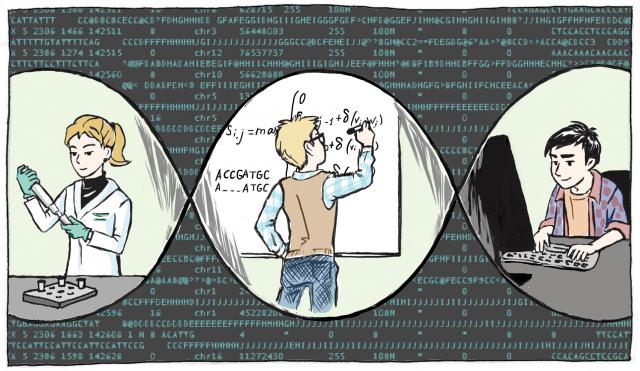
This week, we begin a new chapter, titled "Which DNA Patterns Play the Role of Molecular Clocks?" At the bottom of this message is this week's Bioinformatics Cartoon. What does a late night casino trip with two 18th Century French mathematicians have in common with finding molecular clocks? Start learning to find out...

WEEK 4
How Rolling Dice Helps Us Find Regulatory Motifs
Last week, we encountered a few introductory motif-finding algorithms. This week, we will see how to improve upon these motif-finding approaches by designing randomized algorithms that can "roll dice" to find motifs.

WEEK 5
Bioinformatics Application Challenge
Welcome to week 5 of the class! This week, we will apply popular motif-finding software in order to hunt for motifs in a real biological dataset.


Go to Class
MOOC List is learner-supported. When you buy through links on our site, we may earn an affiliate commission.

Related Courses

Cloud Computing Concepts: Part 2 (Coursera) Coursera
University of Illinois at Urbana-Champaign

Cloud Computing Concepts: Part 2 (Coursera)

Cloud computing systems today, whether open-source or used inside companies, are built using a common set of core techniques, algorithms, and design philosophies—all centered around distributed systems. Learn about such fundamental distributed computing "concepts" for cloud computing. Some of these concepts include: Clouds, MapReduce, key-value stores, Classical precursors, Widely-used algorithms, Classical algorithms, Scalability, Trending areas, And more!

Jun 1st 2026
5-12 Weeks
Antimicrobial resistance - theory and methods (Coursera) Coursera
Technical University of Denmark - DTU

Antimicrobial resistance - theory and methods (Coursera)

The course will cover the topics related to antimicrobial resistance with basic definitions and overview on antimicrobials their use and the emergence and spread of resistance. The course will guide you through the concepts and the importance of resistance spread and dissemination and how that happens. It will show you how bacteria become resistant and which mechanisms they might use for this. And as part of the course you will also receive some training in methods for antimicrobial susceptibility testing (AST) and detection of specific resistance in the microbiological laboratories with the basic methods available and with focus on the obtention of good quality results which can be interpreted and used for different purposes.

Jun 1st 2026
5-12 Weeks
Cluster Analysis in Data Mining (Coursera) Coursera
University of Illinois at Urbana-Champaign

Cluster Analysis in Data Mining (Coursera)

Discover the basic concepts of cluster analysis, and then study a set of typical clustering methodologies, algorithms, and applications. This includes partitioning methods such as k-means, hierarchical methods such as BIRCH, and density-based methods such as DBSCAN/OPTICS. Moreover, learn methods for clustering validation and evaluation of clustering quality. Finally, see examples of cluster analysis in applications.

Jun 1st 2026
4 Weeks
Mastering the Software Engineering Interview (Coursera) Coursera
University of California, San Diego

Mastering the Software Engineering Interview (Coursera)

You’ve hit a major milestone as a computer scientist and are becoming a capable programmer. You now know how to solve problems, write algorithms, and analyze solutions; and you have a wealth of tools (like data structures) at your disposal. You may now be ready for an internship or (possibly) an entry-level software engineering job. But can you land the internship/job? It depends in part on how well you can solve new technical problems and communicate during interviews. How can you get better at this? Practice!

Jun 1st 2026
4 Weeks
Java Programming: Solving Problems with Software (Coursera) Coursera
Duke University

Java Programming: Solving Problems with Software (Coursera)

Learn to code in Java and improve your programming and problem-solving skills. You will learn to design algorithms as well as develop and debug programs. Using custom open-source classes, you will write programs that access and transform images, websites, and other types of data. At the end of the course you will build a program that determines the popularity of different baby names in the US over time by analyzing comma separated value (CSV) files.

Jun 1st 2026
4 Weeks
Experimental Methods in Systems Biology (Coursera) Coursera
Icahn School of Medicine at Mount Sinai

Experimental Methods in Systems Biology (Coursera)

Learn about the technologies underlying experimentation used in systems biology, with particular focus on RNA sequencing, mass spec-based proteomics, flow/mass cytometry and live-cell imaging. A key driver of the systems biology field is the technology allowing us to delve deeper and wider into how cells respond to experimental perturbations. This in turns allows us to build more detailed quantitative models of cellular function, which can give important insight into applications ranging from biotechnology to human disease. This course gives a broad overview of a variety of current experimental techniques used in modern systems biology, with focus on obtaining the quantitative data needed for computational modeling purposes in downstream analyses.

Jun 1st 2026
5-12 Weeks
Machine Learning: Regression (Coursera) Coursera
University of Washington

Machine Learning: Regression (Coursera)

Case Study - Predicting Housing Prices. In our first case study, predicting house prices, you will create models that predict a continuous value (price) from input features (square footage, number of bedrooms and bathrooms,...). This is just one of the many places where regression can be applied. Other applications range from predicting health outcomes in medicine, stock prices in finance, and power usage in high-performance computing, to analyzing which regulators are important for gene expression.

Jun 1st 2026
5-12 Weeks
Algorithmic Toolbox (Coursera) Coursera
University of California, San Diego,Higher School of Economics - HSE University

Algorithmic Toolbox (Coursera)

The course covers basic algorithmic techniques and ideas for computational problems arising frequently in practical applications: sorting and searching, divide and conquer, greedy algorithms, dynamic programming. We will learn a lot of theory: how to sort data and how it helps for searching; how to break a large problem into pieces and solve them recursively; when it makes sense to proceed greedily; how dynamic programming is used in genomic studies. You will practice solving computational problems, designing new algorithms, and implementing solutions efficiently (so that they run in less than a second).

Jun 1st 2026
5-12 Weeks
Advanced Algorithms and Complexity (Coursera) Coursera
University of California, San Diego,Higher School of Economics - HSE University

Advanced Algorithms and Complexity (Coursera)

You've learned the basic algorithms now and are ready to step into the area of more complex problems and algorithms to solve them. Advanced algorithms build upon basic ones and use new ideas. We will start with networks flows which are used in more typical applications such as optimal matchings, finding disjoint paths and flight scheduling as well as more surprising ones like image segmentation in computer vision.

Jun 1st 2026
5-12 Weeks
Bioinformatic Methods I (Coursera) Coursera
University of Toronto

Bioinformatic Methods I (Coursera)

Large-scale biology projects such as the sequencing of the human genome and gene expression surveys using RNA-seq, microarrays and other technologies have created a wealth of data for biologists. However, the challenge facing scientists is analyzing and even accessing these data to extract useful information pertaining to the system being studied. This course focuses on employing existing bioinformatic resources – mainly web-based programs and databases – to access the wealth of data to answer questions relevant to the average biologist, and is highly hands-on.

Jun 1st 2026
5-12 Weeks
Classical papers in molecular genetics (Coursera) Coursera
University of Geneva

Classical papers in molecular genetics (Coursera)

You have all heard about the DNA double helix and genes. Many of you know that mutations occur randomly, that the DNA sequence is read by successive groups of three bases (the codons), that many genes encode enzymes, and that gene expression can be regulated. These concepts were proposed on the basis of astute genetic experiments, as well as often on biochemical results. The original articles were these concepts appeared are however not frequently part of the normal curriculum of biologists, biochemists and medical students.

Jun 1st 2026
5-12 Weeks