Exploring Beethoven's Piano Sonatas Part 4 (Coursera)

Exploring Beethoven's Piano Sonatas Part 4 (Coursera)

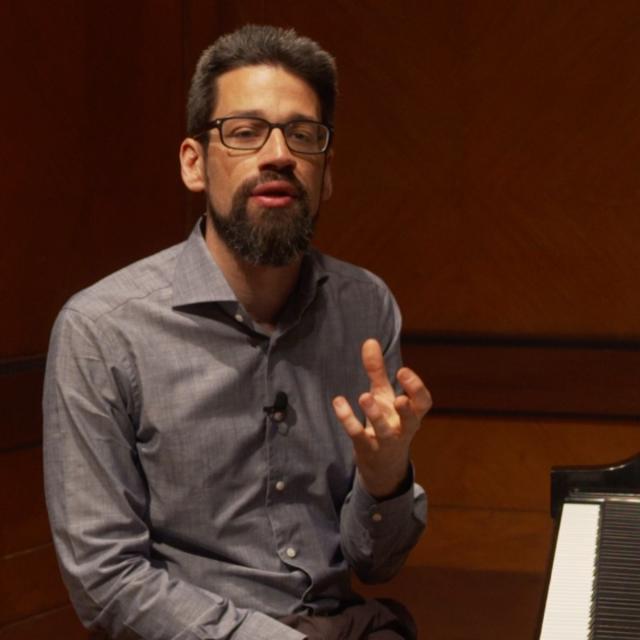
Please join us for Part 4 of Exploring Beethoven's Piano Sonatas course, taught by Curtis faculty member and extraordinary concert artist, Jonathan Biss. This course is new and contains separate sets of lectures and sonatas that we not previously discussed. Specifically, in Part 4, we will cover Beethoven's Piano Sonatas Op. 2, No. 2, Op. 10, No. 3, Op. 28 and Op. 110.

Class Deals by MOOC List - Click here and see Coursera's Active Discounts, Deals, and Promo Codes.

As with the other three Beethoven courses, it is not necessary to have taken the previous Exploring Beethoven's Piano Sonatas courses. We think you will be perfectly comfortable to start learning with Part 4, if you wish and go from here. There is always the option to go back to earlier parts at any time. Between these courses, there exists a large amount of additional resources and learning that might be helpful as you embark on Part 4. We certainly encourage you to take Parts 1, 2 and 3, if you have not yet. In the meantime, enjoy the class and Part 4 of Exploring Beethoven’s Piano Sonatas.

Syllabus

Week 1
We are glad that you have joined us for Part 4 of Exploring Beethoven's Piano Sonatas course, taught by Curtis faculty member and extraordinary concert artist, Jonathan Biss! This course is considered Part 4, with new and separate sets of lectures. Specifically, in Part 4, we will cover Beethoven's Piano Sonatas Op. 2, No. 2, Op. 10, No. 3, Op. 28 and Op. 110. As with the other three Beethoven courses, it is not necessary to have taken the previous Exploring Beethoven's Piano Sonatas courses. We think you will be perfectly comfortable to start learning with Part 4, if you wish and go from here. There is always the option to go back to earlier parts at any time. Between these courses, there exists a large amount of additional resources and learning that might be helpful as you embark on Part 4. We certainly encourage you to take Parts 1, 2 and 3, if you have not yet. In the meantime, enjoy the class and Part 4 of Exploring Beethoven’s Piano Sonatas.

Week 2
Op. 2, No. 2

Week 3
Op. 10, No. 3

Week 4
Op. 28

Week 5
Op. 110

Week 6
Your Thoughts Welcome

Go to Class
MOOC List is learner-supported. When you buy through links on our site, we may earn an affiliate commission.

Related Courses

Today’s Music Industry (Coursera) Coursera
West Virginia University

Today’s Music Industry (Coursera)

This course provides an engaging and methodical insight into the past and present cultural and commercial music industry developments, directions, and trends. It will equip the students with the knowledge and skills necessary to appreciate, understand and more productively participate in today’s music industry field.

Sep 28th 2026
5-12 Weeks
Music and Social Action (Coursera) Coursera
Yale University

Music and Social Action (Coursera)

What is a musician’s response to the condition of the world? Do musicians have an obligation and an opportunity to serve the needs of the world with their musicianship? At a time of crisis for the classical music profession, with a changing commercial landscape, a shrinking audience base, and a contraction in the number of professional orchestras, how does a young musician construct a career today? Are we looking at a dying art form or a moment of reinvigoration?

Oct 5th 2026
5-12 Weeks
Songwriting: Writing the Lyrics (Coursera) Coursera
Berklee College of Music

Songwriting: Writing the Lyrics (Coursera)

There’s a songwriter lurking somewhere inside you, peeking around corners, wondering if it’s safe to come out. Now it is. This course is an invitation to let your inner songwriter step into the sunlight. All it takes is a simple “yes” and you’ll be climbing that windy hill, marveling at the view. If you haven’t written any or many songs, this course will show you an efficient, effective process for tailoring songs to express your ideas and emotions. If you have, you’ll look at your process differently, taking control of aspects of the process you may have not noticed.

Oct 5th 2026
5-12 Weeks
So You Think You Know Tango? (Coursera) Coursera
Emory University

So You Think You Know Tango? (Coursera)

How well do you think you know tango? This two-week mini-course is designed for music lovers, musicians, and dancers who are interested in learning more about the Argentine Tango. It will explore the many dimensions of the Argentine Tango music, including its origins, popularization during the Golden Age, dissemination abroad, evolution into an artistic music-dance form, and adoption by Argentine and international art-music composers to date.

Sep 28th 2026
2 Weeks
Fundamentals of Audio and Music Engineering: Part 1 Musical Sound & Electronics (Coursera) Coursera
University of Rochester

Fundamentals of Audio and Music Engineering: Part 1 Musical Sound & Electronics (Coursera)

In this course students learn the basic concepts of acoustics and electronics and how they can applied to understand musical sound and make music with electronic instruments. Topics include: sound waves, musical sound, basic electronics, and applications of these basic principles in amplifiers and speaker design.

Sep 28th 2026
5-12 Weeks
Exploring Beethoven’s Piano Sonatas Part 2 (Coursera) Coursera
Curtis Institute of Music

Exploring Beethoven’s Piano Sonatas Part 2 (Coursera)

Welcome to Part 2 of Exploring Beethoven's Piano Sonatas! I'm delighted to launch another set of new lectures of this course as Part 2. As before, this class is meant for people of all levels of experience with Beethoven's music (including no experience at all!). Remember that you are able to watch the lectures as many times as you like, at whatever pace is comfortable for you.

Oct 5th 2026
5-12 Weeks
Jazz Improvisation (Coursera) Coursera
Berklee College of Music

Jazz Improvisation (Coursera)

Learn the basic concepts of improvisation from Gary Burton, one of the most renowned improvisers in the jazz world, including the mental, melodic, and harmonic processes that contribute to the instinctive skills that an improviser puts to use when taking a solo. While many people are fans of jazz and understand that musicians are often “making up” the notes they are playing during a performance, most people—often including musicians, themselves, who are beginning to learn improvising—aren’t clear about what exact processes take place to enable this to happen. The purpose of this course is to introduce the basic concepts of modern improvisation and how to go about mastering the different musical and mental skills involved.

Oct 5th 2026
5-12 Weeks
In the Studio: Postwar Abstract Painting (Coursera) Coursera
The Museum of Modern Art

In the Studio: Postwar Abstract Painting (Coursera)

Want to know how some of the 20th century’s most celebrated artists made abstract paintings? This course offers an in-depth, hands-on look at the materials, techniques, and thinking of seven New York School artists, including Willem de Kooning, Yayoi Kusama, Agnes Martin, Barnett Newman, Jackson Pollock, Ad Reinhardt, and Mark Rothko. Through studio demonstrations and gallery walkthroughs, you’ll form a deeper understanding of what a studio practice means and how ideas develop from close looking, and you’ll gain a sensitivity to the physical qualities of paint.

Sep 28th 2026
5-12 Weeks
Creating Sounds for Electronic Music (Coursera) Coursera
Berklee College of Music

Creating Sounds for Electronic Music (Coursera)

What you’ll achieve: In this project-centered course*, you will create sounds and use them in your own musical compositions. Whether you're an aspiring producer, composer, or hobbyist, this course will help you gain skills in music production and confidence using software synthesizers. Along with your classmates, you will create a massive database of designed sounds, or patches, to use in your compositions. As part of the course, you will work with a free version of FXpansion Strobe 2.

Sep 28th 2026
4 Weeks
Teoria Musical (Coursera) Coursera
Berklee College of Music

Teoria Musical (Coursera)

Explore os elementos básicos que compoem a música, desenvolva sua percepção, tire músicas de ouvido, e aprenda a ler e escrever usando notação musical. Procuramos criar um curso que unisse a cultura e música brasileira com técnicas de aprendizado de solfejo e leitura rítmica. Você fará parte de uma aula de Percepção Musical ("Ear Training") na Berklee College of Music, cantando e praticando com outros alunos e interagindo com os vídeos. Além disso, você terá acesso a material para praticar, como faixas de acompanhamento e partituras.

Oct 5th 2026
5-12 Weeks