EdX

Design of mound breakwaters for feasibility studies. Cubipod® Manual 2016 (edX)

Design of mound breakwaters for feasibility studies. Cubipod® Manual 2016 (edX)

The goal of this course is to provide the tools to create feasible designs of mound breakwaters protected with Cubipod® armors fulfiling the prescribed economic, functional and safety requirements. This course is intended for professionals of coastal and port engineering who work in the preliminary design and feasibility studies of breakwaters.

Class Deals by MOOC List - Click here and see EdX's Active Discounts, Deals, and Promo Codes.

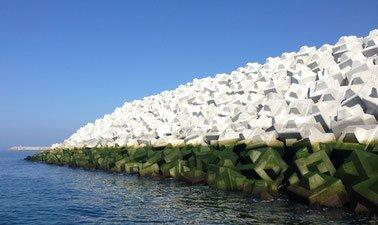
The course is planned for civil engineers and other professionals familiar with common coastal and port engineering concepts and terminology. The goal of this course is to provide the tools to create feasible designs of mound breakwaters protected with Cubipod® armors fulfiling the prescribed economic, functional and safety requirements. Cubipod® is a massive concrete armor unit, the only one which can be safely and easily used in single- and double-layer armoring. This course will be beneficial if you are a civil engineer analyzing variants for breakwaters and feasibility studies.
This course is focused on Cubipod® armored breakwaters, considering the logistic constraints and minimizing the economic cost as well as the carbon and energy footprints. During the feasibility studies, different workable preliminary designs are compared; later, several alternatives are analyzed in detail. This course facilitates the preliminary design of single- and double-layer Cubipod® armored breakwaters. This course is organized in seven modules corresponding to the seven chapters of the Cubipod® Manual 2016, which will be used as the basic reference book.

What you'll learn
In this course you will learn:

  1. the main characteristics of mound breakwaters and armor layers,
  2. the fundamental concepts to be taken into consideration to study alternatives and to estimate costs, with special attention on the use of Cubipods to protect mound breakwaters,
  3. the estimation of the hydraulic stability of single- and double-layer Cubipod® armors, run-up, overtopping and forces on crown walls,
  4. the assessment of the structural integrity of Cubipods, the manufacturing process, handling, stacking and placement on the armor layer and
  5. the rules to make a preliminary design of a Cubipod® armored mound breakwater. The objective is to learn how to find feasible designs of single- or double-layer Cubipod® armored breakwaters fulfiling the prescribed economic, functional and safety requirements.

Syllabus

  1. Introduction
  2. Hydraulic stability of the armor layer
  3. Overtopping and forces on crown wall
  4. Structural integrity of cubipod® armor units
  5. Manufacture, handling and stacking of cubipods
  6. Cubipod® placement in the armor
  7. Example. Preliminary design of a mound breakwater
  8. Final exam

Prerequisites
General knowledge of Civil Engineering and particular knowledge of Coastal and Port Engineering. Previous knowledge of basic concepts and terminology commonly used in Coastal and Port Engineering is also required, such as “significant wave height”, “peak period”, “crown wall”, “return period”, “stability number”, etc.

Go to Class
MOOC List is learner-supported. When you buy through links on our site, we may earn an affiliate commission.

Related Courses

Signals and Systems, Part 2 (edX) EdX
IIT Bombay,IITBombayX

Signals and Systems, Part 2 (edX)

This course provides the basic toolkit for any signal processing application - the abstraction of signals and systems, from the point of view of analysis and characterisation. We encounter signals and systems extensively in our day-to-day lives, from making a phone call, listening to a song, editing photos, manipulating audio files, using speech recognition softwares like Siri and Google now, to taking EEGs, ECGs and X-Ray images. Each of these involves gathering, storing, transmitting and processing information from the physical world. This course will equip you to deal with these tasks efficiently by learning the basic mathematical framework of signals and systems.

No sessions available
5-12 Weeks
Fundamentos de Mecánica para Ingeniería (edX) EdX
Universitat Politècnica de València,UPValenciaX

Fundamentos de Mecánica para Ingeniería (edX)

Estudiaremos la cinemática y la dinámica del punto, los conceptos de trabajo y potencia y la energía mecánica. Se aborda el estudio del universo físico analizando objetos en movimiento. Se definen y analizan todas las magnitudes y leyes físicas que permiten describir geométrica y causalmente el movimiento de cuerpos representados por un punto.

Self Paced
Self-Paced
Introducción a la Ingeniería del Helicóptero (edX) EdX
OECx,Open Education Consortium - OEC

Introducción a la Ingeniería del Helicóptero (edX)

El curso proporciona una introducción del conocimiento aplicado de la aerodinámica, aeromecánica, mecánica del vuelo, estructura e ingeniería de los sistemas del helicóptero, que permita identificar y resolver problemas aplicando, con creatividad, los conocimientos adquiridos para finalizar con la aplicación de los conocimientos al análisis de un diseño preliminar de un helicóptero. The course provides an overview of applied knowledge of aerodynamics, aeromechanics, flight mechanics, structures and engineering of helicopter systems. The objective of this brief description is to acquire the skills and capabilities to identify and solve elementary problems of preliminary design of a helicopter.

No sessions available
4 Weeks
Graphene Science and Technology (edX) EdX
Chalmers University of Technology,ChalmersX

Graphene Science and Technology (edX)

Graphene: its practical applications and how it offers new insights into quantum physics. Graphene is the world’s first 2-dimensional material and is the thinnest, strongest, and most flexible material known to exist. Graphene, a special form of carbon,,can conduct electricity and heat better than anything else.

No sessions available
5-12 Weeks
Urban Sewage Treatment (edX) EdX
Delft University of Technology,DelftX

Urban Sewage Treatment (edX)

Learn about urban water services, focusing on basic sewage treatment technologies. This course will focus on basic technologies for the treatment of urban sewage. Unit processes involved in the treatment chain will be described as well as the physical, chemical and biological processes involved. There will be an emphasis on water quality and the functionality of each unit process within the treatment chain. After the course one should be able to recognise the process units, describe their function and make simple design calculations on urban sewage treatment plants.

Self Paced
Self-Paced
Dynamics and Control (edX) EdX
Universitat Politècnica de València,UPValenciaX

Dynamics and Control (edX)

This is an interactive course about the basic concepts of Systems, Control and their impact in all the human activities. First, the basic concepts of systems, dynamics, structure and control are introduced. Then, looking at many examples in Nature and human made devices, we will realize that the dynamic behavior of most systems can be modified by adding a control system. Later we will see how knowing how to evaluate the dynamic behavior of a system and measure its performance will provide the tools to design new controlled systems fulfilling some requirements.

Self Paced
Self-Paced
Symmetry, Structure and Tensor Properties of Materials (edX) EdX
MIT,MITx

Symmetry, Structure and Tensor Properties of Materials (edX)

An upper-level undergraduate engineering course that explores the structure and symmetry of materials and the profound effect that structure has on physical properties of materials. In Symmetry, Structure, and Tensor Properties of Materials, you will study the underlying structures of materials and you will deepen your understanding of the relationship between the properties of materials and their structures.

No sessions available
4 Weeks
Robot Mechanics and Control, Part II (edX) EdX
Seoul National University,SNUx

Robot Mechanics and Control, Part II (edX)

A mathematical introduction to the mechanics and control of robots. This course is Part II of a two-part mathematical introduction to the mechanics and control of robots that can be modeled as kinematic chains. Topics covered include the concept of a robot’s configuration space and degrees of freedom, static grasp analysis, the description of rigid body motions, kinematics of open and closed chains, and the basics of robot control.

No sessions available
4 Weeks
Caer o No caer. El secreto de las estructuras (edX) EdX
Universidad Carlos III de Madrid - UC3M,UC3Mx

Caer o No caer. El secreto de las estructuras (edX)

Las estructuras están presentes en todos los sistemas que nos rodean. Descubrirlas y comprender cómo funcionan es sencillo y fascinante. Las estructuras están implicadas en nuestras vidas: las plantas, los animales, casi todo lo que fabrica el ser humano, incluso nuestro propio cuerpo, deben soportar una serie de fuerzas sin romperse, y por lo tanto prácticamente cualquier elemento de nuestro entorno es una estructura de una clase u otra.

Self Paced
Self-Paced