EdX

Introduction to Quantum Transport (edX)

Offered by Purdue University, PurdueX,
Introduction to Quantum Transport (edX)

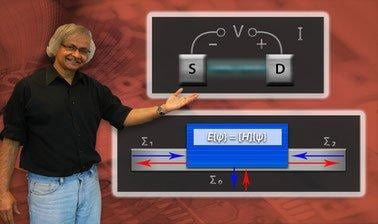
This course introduces the non-equilibrium Green’s function (NEGF) method widely used to describe quantum effects in nanoscale devices, along with its applications to spintronic devices. This course introduces the Schrödinger equation, using the tight-binding method to discuss the concept of bandstructure and E(k) relations, followed by an introduction to the NEGF method with simple illustrative examples. Concept of spinors is introduced along with the application of the NEGF method to spintronic devices.

Class Deals by MOOC List - Click here and see EdX's Active Discounts, Deals, and Promo Codes.

No prior background in quantum mechanics or statistical mechanics is assumed.
This course is part of the Nanoscience and Technology MicroMasters.

What you'll learn

  • The Schrödinger equation
  • How the tight-binding model works
  • The concept of bandstructure and E(k) relations
  • Self-energy
  • Broadening
  • NEGF equations
  • Dephasing

Syllabus

Week 1: Schrödinger Equation
1.1 Introduction
1.2 Wave Equation
1.3 Differential to Matrix Equation
1.4 Dispersion Relation
1.5 Counting States

Week 2: Schrödinger Equation (continued)
1.6 Beyond 1D
1.7 Lattice with a Basis
1.8 Graphene
1.9 Reciprocal Lattice/Valleys
1.10 Summing Up

Week 3: Contact-ing Schrödinger & Examples
2.1 Introduction
2.2 Semiclassical Model
2.3 Quantum Model
2.4 NEGF Equations
2.5 Bonus Lecture, NOT covered on exams
2.6 Scattering Theory

Week 4: Contact-ing Schrödinger & Examples (continued)
2.7 Transmission
2.8 Resonant Tunneling
2.9 Dephasing
2.10 Summing Up
3.1 Bonus Lecture, NOT covered on exams
3.2 Quantum Point Contact
3.3 - 3.10 Bonus Lectures, NOT covered on exams

Week 5: Spin Transport
4.1 Introduction
4.2 Magnetic Contacts
4.3 Rotating Contacts
4.4 Vectors and Spinors
4.5 - 4.6 Bonus Lectures NOT covered on exams
4.7 Spin Density/Current
4.8-4.10 Bonus Lectures NOT covered on exams

Text: S. Datta, “Lessons from Nanoelectronics”, Part B: Quantum Transport, World Scientific, Second Edition 2017.
The manuscript will be available for download in the course.


Go to Class
MOOC List is learner-supported. When you buy through links on our site, we may earn an affiliate commission.

Related Courses

Solid State Devices 1 (edX) EdX
Purdue University,PurdueX

Solid State Devices 1 (edX)

Semiconductor are everywhere in human activities, from your credit card to space exploration. This graduate-level introduction brings aspects of physics, chemistry, and engineering together to understand, analyze, and design transistors and solar cells. This course provides the graduate-level introduction to understand, analyze, characterize and design the operation of semiconductor devices such as transistors, diodes, solar cells, light-emitting devices, and more.

Jan 9th 2023
13-24 Weeks
Semiconductor Fundamentals (edX) EdX
Purdue University,PurdueX

Semiconductor Fundamentals (edX)

From smartphones to satellites, semiconductors are everywhere. Tying together physics, chemistry, and electrical engineering, this easy-to-follow introduction provides the background needed to understand devices such as transistors and solar cells. This course provides the essential foundations required to understand the operation of semiconductor devices such as transistors, diodes, solar cells, light-emitting devices, and more.

Jan 9th 2023
5-12 Weeks
Engineering the Space Shuttle (edX) EdX
MIT,MITx

Engineering the Space Shuttle (edX)

Learn all about the world’s first reusable spacecraft - the Space Shuttle - from the very people who designed, built, and operated it for 30 years. This course examines how the Space Shuttle was designed and how its design was influenced by economics and politics. The course goes into detail on many of the Shuttle’s subsystems (e.g. rocket engines, thermal protection, aerodynamics, environmental control and life support, communications, etc.) and explains how the Shuttle was operated (launch, mission control, payloads, etc.). The course also uses the Space Shuttle to present the fundamentals of Systems Engineering.

Feb 16th 2022
5-12 Weeks
Fundamentals of Current Flow (edX) EdX
Purdue University,PurdueX

Fundamentals of Current Flow (edX)

Gain a new perspective on electron flow in solids with this insightful introduction. Very different from what is taught in standard courses, "Fundamentals of Current Flow" provides a unified conceptual framework for ballistic and diffusive transport of both electrons and phonons - essential information for understanding nanoelectronic devices.

Jan 8th 2024
5-12 Weeks
Introduction to Quantum Science & Technology (edX) EdX
Purdue University,PurdueX

Introduction to Quantum Science & Technology (edX)

Learn about fundamental concepts and engineering challenges of quantum technologies. Emerging quantum systems are disruptive technologies redefining computing and communication. Teaching quantum physics to engineers and educating scientists on engineering solutions are critical to address fundamental and engineering challenges of the quantum technologies.

Aug 21st 2023
13-24 Weeks
Decision Making in Engineering Design (edX) EdX
Purdue University,PurdueX

Decision Making in Engineering Design (edX)

In this course, you will learn the foundations of decision-making in the design of engineering products, processes, and systems. Decision making is an essential activity in all organizations and teams involved in engineering design and product development. Successful design requires the ability to make good decisions in the presence of risk and uncertainty, and an understanding of how customers and other stakeholders make decisions.

Jan 10th 2022
13-24 Weeks
Fundamentals of Non-Destructive Testing (edX) EdX
Purdue University,PurdueX

Fundamentals of Non-Destructive Testing (edX)

Learn the fundamentals of non-destructive testing (NDT), a technique used to evaluate material and structure properties and defects without causing damage. Non-destructive testing (NDT) is used across industries to ensure product integrity and reliability; it is used in the aerospace, defense, oil and gas, and automotive sectors. In civil engineering, NDT is commonly used to detect flaws and defects in concrete elements and structures.

Jan 10th 2022
5-12 Weeks
RF Design: Passive and Active Components (edX) EdX
Purdue University,PurdueX

RF Design: Passive and Active Components (edX)

Learn the necessary techniques and tools for designing high-performance passive and active RF components. Following the ‘Primer on RF Design’ course, this class focuses on passive and active components. We use the techniques learnt in the previous course, to design advanced RF devices including couplers, filters and amplifiers. Current research topics are discussed as appropriate.

Nov 1st 2021
5-12 Weeks