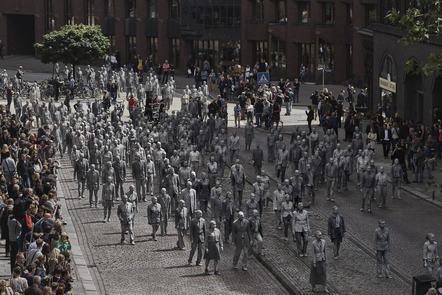
Contemporary Art (saylor.org)

Offered by Saylor.org,
Contemporary Art (saylor.org)

This course will survey contemporary art, starting with the 1960s and concluding in 2010. While the focus is on Western art and culture, we will also explore a selection of contemporary art and artistic practices around the globe, which have become increasingly influential in the definition of contemporary art today.

In common conversation, we often use the phrase “contemporary art” to refer to current artistic production—the art being produced today. However, in the art history field, the phrase denotes a specific period of art and artistic practice starting in the 1960s and continuing today. It is characterized by a break from the modernist artistic canon and a desire to move away from the dominant Western cultural model, looking for inspiration in everyday and popular culture. More specifically, many contemporary artworks reject traditional modernistic artistic media (such as painting or sculpture) in favor of a more collaborative, ephemeral, and multimedia approach that further blurs the boundaries between high and mass culture. In its subject matter, this art also tends to reflect a shift away from purely aesthetic issues to more socially oriented concerns. Finally, it is important to note that contemporary art should not be seen as a progression of different artistic styles but as series of different cultural, social, and political inquiries that occupied contemporary art practice over the course of the past 50 years or so. We will examine these important aesthetic and cultural changes within their historical and social context as we progress through this course.
Each of the units will examine a set of specific aesthetic and social issues and look at the different strategies contemporary artists proposed and used in their work. By the end of this course, you should be able to recognize and interpret most important aspects of contemporary art and contemporary visual culture while better understanding some of the cultural and social aspects of our daily life in today’s global world.
Upon successful completion of this course, the student will be able to:

  • Identify significant works of contemporary art and visual culture.
  • Describe the difference between modernist and contemporary works of art.
  • Explain the geographical shift of artistic centers from Europe (Paris) to the United States (New York), and then in the 21st century to a global spreading (Asia and Africa).
  • Define and discuss the development of contemporary art as a series of different cultural, social, and political inquiries over the past 50 years.
  • Identify and discuss multiple and vital relationships between contemporary art and such broader social and cultural issues as ideology, gender, race, or ethnicity.
  • Describe and explain a relationship between different contemporary art strategies, such as performance or installation, and their immediate social and cultural context.
  • Discuss how important contemporary artworks relate to their social and historical contexts.
  • Define contemporary art as a continuing, international artistic project.
  • Identify and define the importance of contemporary art and contemporary visual culture in today’s increasingly globalized world.

Requirements:
Have completed all courses listed in the Core Program of the art history discipline: Art Appreciation and Techniques, Introduction to Western Art History: Prehistoric to High Gothic, Introduction to Western Art History: Proto-Renaissance to Contemporary Art and Art Historical Methodologies.
Go to Class
MOOC List is learner-supported. When you buy through links on our site, we may earn an affiliate commission.

Related Courses

Making Architecture (Coursera) Coursera
IE Business School,IE School of Architecture & Design

Making Architecture (Coursera)

Making architecture offers a unique insight into the mind and work of an Architect, starting with the basics of the profession and culminating with the production of a scaled site model. The course should act as ideal preparation for those interested in undertaking an undergraduate degree in Architecture, although its flexible, intriguing and enjoyable content makes it accessible for all those looking to increase their knowledge in the field.

Sep 14th 2026
4 Weeks
What Is Contemporary Art? (Coursera) Coursera
The Museum of Modern Art

What Is Contemporary Art? (Coursera)

What is contemporary art? In this course, you’ll consider this question through more than 70 works of art made between 1980 and the present, with a focus on art from the past decade. You’ll hear directly from artists, architects, and designers from around the globe about their creative processes, materials, and inspiration.

Sep 14th 2026
5-12 Weeks
Women in Arts: From 1900 until today (FutureLearn) FutureLearn
Centre Pompidou

Women in Arts: From 1900 until today (FutureLearn)

Discover the women creators who shaped modern and contemporary art and those who continue to make huge impacts today. Delve into art history through the extraordinary works of women artists. On this seven-week course, you’ll journey through an alternative history of modern and contemporary art – one that is centred on the brilliant women creators in the movement.

Nov 15th 2021
5-12 Weeks
Art of Ancient Greece and Rome (saylor.org) Saylor Academy
Saylor.org

Art of Ancient Greece and Rome (saylor.org)

In this course, we will study the art of Classical Antiquity. The different units of the course reflect the main chronological stages in art development in Ancient Greece and Rome, from the coming together of the Greek city-state and the emergence of “geometric art” (around 900 B.C.) to the fourth century A.D. shift that took place within Roman culture and art due to the growing influence of Christianity.

Legacy Course
Self-Paced
The Italian Proto-Renaissance To Mannerism (saylor.org) Saylor Academy
Saylor.org

The Italian Proto-Renaissance To Mannerism (saylor.org)

In this course, we will focus on becoming “literate” in the art of the Italian Renaissance, on identifying the effects that the Renaissance had on the arts of Italy, and discovering the ways in which specific historical developments impacted those arts from the end of the thirteenth century to the end of the sixteenth century.

Legacy Course
Self-Paced
La percepción del paisaje (edX) EdX
Universidad Autonoma de Madrid,UAMx

La percepción del paisaje (edX)

En este MOOC nos proponemos dos objetivos: recrear la historia del paisaje y percibirlo no sólo por la vista, sino por los cinco sentidos. De forma que veremos cómo se ha ido pasando de una percepción frontal del paisaje (la del caminante y el navegante), a una lateral (la de las ventanillas del ferrocarril) y a otra vertical (la de los submarinos y los satélites espaciales). Y desde la aparición de internet ha surgido otra dimensión: el paisaje virtual.

Self Paced
Self-Paced
ART of the MOOC: Activismo y Movimientos Sociales (Coursera) Coursera
Duke University,Creative Time

ART of the MOOC: Activismo y Movimientos Sociales (Coursera)

Este curso es para activistas, artistas y pensadores que deseen entender mejor el cambio social y participar en él. El contenido del curso enfoca en la coincidencia prolífica y emocionante entre el arte socialmente comprometido y prácticas culturales generadas por recientes movimientos sociales en todo el mundo. Más que evaluar la eficacia política de actividades como el luto, la escucha, la organización, el baile, o la fiesta, las conferencias examinan tales actividades culturales al lado y dentro de la práctica artística contemporánea.

Sep 14th 2026
5-12 Weeks
Videojuegos: ¿de qué hablamos? (Coursera) Coursera
Universitat Autònoma de Barcelona

Videojuegos: ¿de qué hablamos? (Coursera)

Probablemente, todos hemos jugado a algún videojuego, pero ¿qué hay detrás de él? Podemos decir que - con independencia del videojuego - hay un árduo trabajo multidisciplinar que incluye desde aspectos de diseño hasta la programación como tal del videojuego. Este curso pretende ser un curso introductorio que muestre qué aspectos hay que considerar en el videojuego, y que permita con posterioridad abordar individualmente los temas que se consideran nucleares: diseño, arte, motor del videojuego y 'game play'.

Sep 21st 2026
5-12 Weeks
Principles of fMRI 1 (Coursera) Coursera
Johns Hopkins University

Principles of fMRI 1 (Coursera)

Functional Magnetic Resonance Imaging (fMRI) is the most widely used technique for investigating the living, functioning human brain as people perform tasks and experience mental states. It is a convergence point for multidisciplinary work from many disciplines. Psychologists, statisticians, physicists, computer scientists, neuroscientists, medical researchers, behavioral scientists, engineers, public health researchers, biologists, and others are coming together to advance our understanding of the human mind and brain. This course covers the design, acquisition, and analysis of Functional Magnetic Resonance Imaging (fMRI) data, including psychological inference, MR Physics, K Space, experimental design, pre-processing of fMRI data, as well as Generalized Linear Models (GLM’s).

Sep 14th 2026
4 Weeks