Computer Networking (Coursera)

Offered by Illinois Tech,
Computer Networking (Coursera)

In this course, you will study the fundamental concepts involved in interconnecting devices for communications. You will also explore protocols, network hardware, and network services. The career skills acquired in this course will begin your journey into the world of networking.

Class Deals by MOOC List - Click here and see Coursera's Active Discounts, Deals, and Promo Codes.

At the end of the course, you will be able to:

  • Compare and contrast Transmission Control Protocol (TCP) and User Datagram Protocol (UDP) ports, protocols, and their purposes.
  • Analyze and compare common networking hardware.
  • Compare and contrast protocols for wireless networking.
  • Summarize services provided by networked hosts.
  • Summarize common network configuration concepts.
  • Compare and contrast Internet connection types, network types, and their features.

Software requirements: A Linux/Unix terminal or Windows command prompt. Cisco Packet tracer, Wireshark

What you'll learn

  • Compare and contrast Transmission Control Protocol (TCP) and User Datagram Protocol (UDP) ports, protocols, and their purposes.
  • Analyze and compare common networking hardware.
  • Compare and contrast protocols for wireless networking.

Syllabus

Module 1: Network Hardware
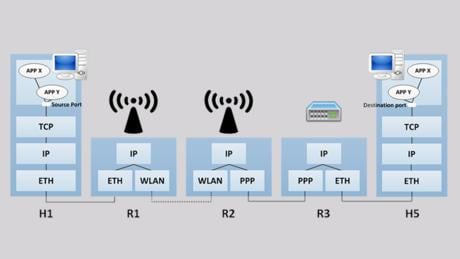
Welcome to Computer Networking! In this course, we will cover the topics of: Network Hardware, Protocols, and Wireless Technology. This module explores communication networks. It examines basic network hardware and communication protocols. The module provides methods for creating networks and discusses network topologies, specifically local area networks (LAN) and wide area networks (WAN).

Module 2: Protocols
This module compares how data is sent over the internet using Transmission Control Protocol (TCP) and User Datagram Protocol (UDP). It explores how each uses an Internet Protocol (IP) address for transferring data but through different processes. The module identifies services available through network hosts.

Module 3: Wireless Technology
This module investigates basics of wireless technology. It explores wireless security and the standard for information technology, specifically IEEE 802.11.

Summative Course Assessment
Module 4
This module contains the summative course assessment that has been designed to evaluate your understanding of the course material and assess your ability to apply the knowledge you have acquired throughout the course. Be sure to review the course material thoroughly before taking the assessment.


Go to Class
MOOC List is learner-supported. When you buy through links on our site, we may earn an affiliate commission.

Related Courses

Wiretaps to Big Data: Privacy and Surveillance in the Age of Interconnection (edX) EdX
Cornell University

Wiretaps to Big Data: Privacy and Surveillance in the Age of Interconnection (edX)

Explore the privacy issues of an interconnected world. How does cellular technology enable massive surveillance? Do users have rights against surveillance? How does surveillance affect how we use cellular and other technologies? How does it affect our democratic institutions? Do you know that the metadata collected by a cellular network speaks volumes about its users? In this course you will explore all of these questions while investigating related issues in WiFi and Internet surveillance.

No sessions available
5-12 Weeks
Information Systems Auditing, Controls and Assurance (Coursera) Coursera
The Hong Kong University of Science and Technology - HKUST

Information Systems Auditing, Controls and Assurance (Coursera)

Information systems (IS) are important assets to business organizations and are ubiquitous in our daily lives. With the latest IS technologies emerging, such as Big Data, FinTech, Virtual Banks, there are more concerns from the public on how organizations maintain systems’ integrity, such as data privacy, information security, the compliance to the government regulations. Management in organizations also need to be assured that systems work the way they expected. IS auditors play a crucial role in handling these issues.

Oct 5th 2026
4 Weeks
Internet Emerging Technologies (Coursera) Coursera
Yonsei University

Internet Emerging Technologies (Coursera)

Every information service is connected through the Internet. If your work is any bit related to information, there is no excuse, you have to know what the Internet is and how it works! The relation of information and the Internet is equivalent to the blood and blood vessels of our body, which we have been using and will be using every day of our lives.

Feb 18th 2019
3 Weeks
Principes des Réseaux de données (FUN) FUN
Institut Mines-Telecom

Principes des Réseaux de données (FUN)

Pour suivre ce cours, vous avez le choix entre deux formules : formule DECOUVERTE qui vous permettra de vous familiariser avec le sujet grace aux vidéos, quiz et accès aux forums et formule QUALIFIANTE dans laquelle vous pourrez acquérir des compétences pratiques à travers des études de cas et l'utilisation d'un simulateur.

No session available
5-12 Weeks
An Introduction to Computer Networking for Teachers (FutureLearn) FutureLearn
Raspberry Pi Foundation,National Centre for Computing Education

An Introduction to Computer Networking for Teachers (FutureLearn)

Build your knowledge and understanding of computer networks as a computer science teacher. Learn how you can create connections with computers. Explore the fundamentals of computer networking with this online course for GCSE teachers. You will improve your understanding of key concepts and gain the confidence to teach the subject in the classroom.

Nov 1st 2021
3 Weeks
Administering School ICT infrastructure: developing your knowledge and skills (European Schoolnet) European Schoolnet Academy
European Schoolnet

Administering School ICT infrastructure: developing your knowledge and skills (European Schoolnet)

This course brings ICT together administrators to hear about current practices and new developments, to learn from each other and to reflect on their work through a mix of over 20 specially commissioned video case studies produced by practitioners, live webinars with expert input, and stimulating, enjoyable and relevant activities and discussions. The course aims to build your knowledge, skills and confidence in six key topic areas: Optimising the school network, Wireless networking and Bring Your Own Device, Cloud models and services, Securing networks and digital safety, New tools and services (including technology for special needs), and Professional skills and tips, including producing a school ICT development plan.

Legacy Course
Self-Paced