Build your own viral Lens! AR with Snapchat's Lens Studio (OpenLearning)

Offered by Snapchat,
Build your own viral Lens! AR with Snapchat's Lens Studio (OpenLearning)

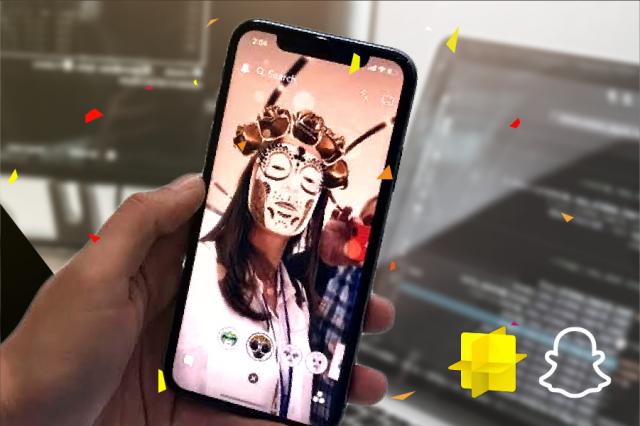
Discover how to create and publish your own AR lens using Snapchat's Lens Studio. Have you ever wondered what it takes to create your very own AR (Augmented Reality) content? Become a Lens Creator and join the Official Lens Creators (OLC) Community to inspire others with your imagination and talent.

Discover Lens Studio and its pre-built templates to get started with creating your own Snapchat lenses. Follow the steps and you'll be creating your first lens in no time at all.

What You Will Learn
Course Outcomes

  • familiarize with Lens Studio
  • Identify different types of templates
  • Create augmented reality lens using Lens Studio

What topics will you cover?

Module 0: Let’s Get Started
This module is for getting you set up and ready to dive into the course, including downloading and setting up the required tools to complete the course.

Module 1: Introduction to Lens Studio
Go through the basics such as the Lens Studio dashboard, lens vs. filter, and an overview of built-in templates in this module.

Module 2: Creating Your First Lens - Face Lens Basic Templates
In this module, you will create your first 'face lens'! We’re going to start with the basics and explore different face lenses that can be created using Lens Studio. Face lens is an AR experience that uses your smartphone selfie camera.

Module 3: World Lens Basic Templates
Make your first 'world lens' in this module! World lens is an AR experience from the world around you, hence we would use our smartphone’s rear camera for this.

What software or tools do you need?
To take part in the course you’ll need:

  1. A Snapchat account
  2. A Smartphone with the Snapchat app (iOS or Android) installed
  3. Lens Studio software (Windows 10 (64 bit); macOS 10.11+)
  4. Hardware (Minimum of Intel Core i3 2.5Ghz or AMD Phenom II 2.6Ghz with 4 GB RAM; Intel HD Graphics 4000 / Nvidia GeForce 710 / AMD Radeon HD 6450 or better; screen resolution of 1280x768 or higher)

Who is the course for?
This course is designed for anyone vying for a customised and personalised AR experience. Zero coding skills are required in order to successfully create your own AR lens.

Go to Class
MOOC List is learner-supported. When you buy through links on our site, we may earn an affiliate commission.

Related Courses

Handheld AR App Development with Unity (Coursera) Coursera
Unity

Handheld AR App Development with Unity (Coursera)

Augmented Reality, or AR, will transform how we see and interact with the world. And the hardware that makes AR possible is the smartphone that you may already have in your pocket. In this course, you'll learn how to develop your own mobile AR applications in Unity for iOS and Android devices. You'll learn about the features offered by Unity's AR Foundation, and about additional features in ARKit and ARCore.

Mar 13th 2023
4 Weeks
Leading Digital and Data Decision Making (edX) EdX
Arizona State University,ASUx

Leading Digital and Data Decision Making (edX)

In this course, you will learn how leaders make managerial and relevant decisions based on data across multiple global industries. You will also explore how companies benefit from a digital ecosystem including sensors (IoT), Blockchain, artificial intelligence (AI), and augmented reality (AR) that move data-driven insights from the data scientist to the boardroom.

This course is archived
5-12 Weeks
Digital Design (edX) EdX
HKUSTx,HKU School of Professional and Continuing Education

Digital Design (edX)

The course is an introduction to digital design technology. It allows you to understand the basics of digital design and helps you develop skills from computer aided design to animation covering topics such as rigging, key framing, rendering and more. Digital Design is about designing in digital space so that the created contents can be displayed and seen on a digital device. With the availability of high computing power, designers are able to quickly create designs in digital space prior to actual deployment.

Self Paced
Self-Paced
MOOC on Visual Literacies: Exploring educational practice and technologies (ViliProject) Other Providers
Lancaster University

MOOC on Visual Literacies: Exploring educational practice and technologies (ViliProject)

Welcome to this MOOC on visual literacies where we will be exploring the educational practices and technologies associated with visual communication and visual thinking. In this course you will find out about the transformative power of photos, mind maps, comics, infographics and data visualization; how educators use video and animation and why it works; game-based learning, augmented reality, virtual and mixed reality; and synchronous video communication and holography.

No sessions available
5-12 Weeks
AR VR The Promise of Sci-Fi (OpenLearning) OpenLearning
Sunway University

AR VR The Promise of Sci-Fi (OpenLearning)

This course explores how the emerging forms of media and the development in the digital field opens possibilities for exploration of virtual reality and augmented reality that carries potential benefits applicable to various industries portrayed through user experience cases that you will discover throughout this course.

Self Paced
Self-Paced
Designing, Running, and Analyzing Experiments (Coursera) Coursera
University of California, San Diego

Designing, Running, and Analyzing Experiments (Coursera)

You may never be sure whether you have an effective user experience until you have tested it with users. In this course, you’ll learn how to design user-centered experiments, how to run such experiments, and how to analyze data from these experiments in order to evaluate and validate user experiences. You will work through real-world examples of experiments from the fields of UX, IxD, and HCI, understanding issues in experiment design and analysis.

Jun 29th 2026
5-12 Weeks
What is the Metaverse? (Coursera) Coursera
Meta

What is the Metaverse? (Coursera)

The metaverse isn’t just for gamers or developers, it will be for everyone. In this free course from the experts at Meta, you’ll learn what the metaverse is, what it means for our world today and into the future, and the opportunities it presents for both professionals and businesses. Understand the metaverse fundamentals. Experts will guide you through a broad range of topics spanning the metaverse ecosystem, from communication and collaboration to NFTs and cryptocurrency, from avatars and devices to platforms and game engines. You’ll learn about augmented reality (AR), virtual reality (VR), extended reality, NFTs, blockchain, web3, cryptocurrency, and more.

Jun 8th 2026
5-12 Weeks
Input and Interaction (Coursera) Coursera
University of California, San Diego

Input and Interaction (Coursera)

In this course, you will learn relevant fundamentals of human motor performance, perception, and cognition that inform effective interaction design. You will use these models of how people work to design more effective input and interaction techniques. You’ll apply these to both traditional graphic and gestural interfaces.

Jun 29th 2026
3 Weeks
Foundations of AR (Coursera) Coursera
Meta

Foundations of AR (Coursera)

In this course, you will learn the basics of augmented reality (AR). You will focus on where AR fits in the XR spectrum, how AR is used, what AR can do today—and in the future—and the various technologies used for building such experiences. You will also learn about computer vision in AR, the software development lifecycle, and careers in AR development.

Nov 25th 2024
4 Weeks