EdX

Autonomous Navigation for Flying Robots (edX)

Autonomous Navigation for Flying Robots (edX)

You will learn how to infer the position of the quadrotor from its sensor readings and how to navigate it along a trajectory.

Class Deals by MOOC List - Click here and see EdX's Active Discounts, Deals, and Promo Codes.

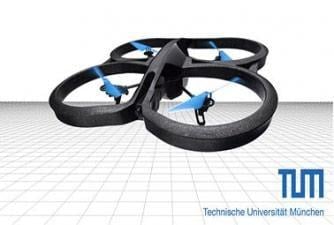
In recent years, flying robots such as miniature helicopters or quadrotors have received a large gain in popularity. Potential applications range from aerial filming over remote visual inspection of industrial sites to automatic 3D reconstruction of buildings. Navigating a quadrotor manually requires a skilled pilot and constant concentration. Therefore, there is a strong scientific interest to develop solutions that enable quadrotors to fly autonomously and without constant human supervision. This is a challenging research problem because the payload of a quadrotor is uttermost constrained and so both the quality of the onboard sensors and the available computing power is strongly limited.
In this course, we will introduce the basic concepts for autonomous navigation for quadrotors.

The following topics will be covered:

  • 3D geometry,
  • probabilistic state estimation,
  • visual odometry, SLAM, 3D mapping,
  • linear control.

In particular, you will learn how to infer the position of the quadrotor from its sensor readings and how to navigate it along a trajectory.
The course consists of a series of weekly lecture videos that we be interleaved by interactive quizzes and hands-on programming tasks. For the flight experiments, we provide a browser-based quadrotor simulator which requires the students to write small code snippets in Python.

What you'll learn
After successful participation of this module, students will be able to

  • Understand the flight principles of quadrotors and their application potential
  • Specify the pose of objects in 3D space and to perform calculations between them (e.g., compute the relative motion)
  • Explain the principles of Bayesian state estimation
  • Implement and apply an extended Kalman filter (EKF), and to select appropriate parameters for it
  • Implement and apply a PID controller for state control, and to fine tune its parameters
  • Understand and explain the principles of visual motion estimation and 3D mapping

Go to Class
MOOC List is learner-supported. When you buy through links on our site, we may earn an affiliate commission.

Related Courses

Collaborative Robot Safety: Design & Deployment (Coursera) Coursera
University at Buffalo,The State University of New York

Collaborative Robot Safety: Design & Deployment (Coursera)

As robots evolve and increasingly interact with humans, enhancing the safety of personnel working with these “collaborative robots” (cobots) is vital. This course equips you to assess the safety of a collaborative robot workcell and prevent the chances of injury or harm. It imparts industry-endorsed safety standards, technical report recommendations and best practices from the International Organization for Standardization (ISO), Robotic Industries Association (RIA) and Occupational Safety and Health Administration (OSHA).

Aug 31st 2026
4 Weeks
Robot Mechanics and Control, Part II (edX) EdX
Seoul National University,SNUx

Robot Mechanics and Control, Part II (edX)

A mathematical introduction to the mechanics and control of robots. This course is Part II of a two-part mathematical introduction to the mechanics and control of robots that can be modeled as kinematic chains. Topics covered include the concept of a robot’s configuration space and degrees of freedom, static grasp analysis, the description of rigid body motions, kinematics of open and closed chains, and the basics of robot control.

No sessions available
4 Weeks
Manufacturing Process Control I (edX) EdX
MIT,MITx

Manufacturing Process Control I (edX)

Learn how to model variations in manufacturing processes and develop methods to reduce and control deterministic variations to achieve consistent process quality. Randomness is inherent in all processes including manufacturing. The fundamental concepts taught in this course will help learners develop powerful statistical process control methods that are the foundation of world-class manufacturing quality.

Aug 18th 2026
5-12 Weeks
Motion Planning for Self-Driving Cars (Coursera) Coursera
University of Toronto

Motion Planning for Self-Driving Cars (Coursera)

Welcome to Motion Planning for Self-Driving Cars, the fourth course in University of Toronto’s Self-Driving Cars Specialization. This course will introduce you to the main planning tasks in autonomous driving, including mission planning, behavior planning and local planning. By the end of this course, you will be able to find the shortest path over a graph or road network using Dijkstra's and the A* algorithm, use finite state machines to select safe behaviors to execute, and design optimal, smooth paths and velocity profiles to navigate safely around obstacles while obeying traffic laws.

Aug 24th 2026
5-12 Weeks
Introducing Robotics: Robotics and Society (FutureLearn) FutureLearn
Queensland University of Technology

Introducing Robotics: Robotics and Society (FutureLearn)

How do you feel about robots? Learn how robotics is used today and explore how it might help solve the big issues of our time. Once only found in fiction, robots are being applied in an increasing array of ways in society, from mechanisation of industrial tasks to exploring places humans can’t go. This course starts with your perceptions of robotics, describes different types of robots, and leads into a discussion of the future: knowing we can use robots, should we?

No sessions available
3 Weeks
Introducing Robotics: Build a Robot Arm (FutureLearn) FutureLearn
Queensland University of Technology

Introducing Robotics: Build a Robot Arm (FutureLearn)

Design, build and program a simple robot and share it with other learners. Here’s your chance to build a simple robot. Robotics is all about integrating hardware and software. In this course, you’ll design, build and program a simple robot, with at least two joints, that can carry a pen or pencil and draw a coordinated line on a sheet of a paper.

No sessions available
5-12 Weeks
Product Design: The Delft Design Approach (edX) EdX
Delft University of Technology,DelftX

Product Design: The Delft Design Approach (edX)

Learn to design meaningful products and services in this challenging design course. Do you want to learn how to design? Using the Delft Design Approach, you will learn how to use a number of key design methods to create meaningful products and services. This course is an introduction to the Delft Design Approach offering a set of signature methods from Delft to teach you how to get from understanding the user in context to defining a meaningful design challenge and – in the end – deliver a great design!

Self Paced
Self-Paced
Industrial Biotechnology (edX) EdX
Delft University of Technology,DelftX

Industrial Biotechnology (edX)

Learn the basics of sustainable processing for biobased products to further understand their impact on global sustainability. As fossil-based fuels and raw materials contribute to climate change, the use of renewable materials and energy as an alternative is increasingly important and common. This transition is not a luxury, but rather a necessity.

Self Paced
Self-Paced
Quantum Detectors and Sensors (edX) EdX
Purdue University,PurdueX

Quantum Detectors and Sensors (edX)

Learn how to analyze and design quantum sensors and devices that extract maximal information from the world around us. Classical detectors and sensors are ubiquitous around us from heat sensors in cars to light detectors in a camera cell phone. Leveraging advances in the theory of noise and measurement, an important paradigm of quantum metrology has emerged. Here, ultra-precision measurement devices collect maximal information from the world around us at the quantum limit.

Aug 24th 2026
13-24 Weeks