EdX

Sparse Representations in Signal and Image Processing: Fundamentals (edX)

Offered by IsraelX,
Sparse Representations in Signal and Image Processing: Fundamentals (edX)

Learn about the field of sparse representations by understanding its fundamental theoretical and algorithmic foundations. This course introduces the fundamentals of the field of sparse representations, starting with its theoretical concepts, and systematically presenting its key achievements. We will touch on theory and numerical algorithms.

Class Deals by MOOC List - Click here and see EdX's Active Discounts, Deals, and Promo Codes.

Modeling data is the way we – scientists – believe that information should be explained and handled. Indeed, models play a central role in practically every task in signal and image processing. Sparse representation theory puts forward an emerging, highly effective, and universal such model. Its core idea is the description of the data as a linear combination of few building blocks – atoms – taken from a pre-defined dictionary of such fundamental elements.

A series of theoretical problems arise in deploying this seemingly simple model to data sources, leading to fascinating new results in linear algebra, approximation theory, optimization, and machine learning. In this course you will learn of these achievements, which serve as the foundations for a revolution that took place in signal and image processing in recent years.
This course is part of the Sparse Representations in Signal and Image Processing Professional Certificate Program.

What you'll learn

  • About the fundamental ideas of sparse representation theory – exploring properties such as uniqueness, equivalence, and stability.
  • About sparse coding algorithms and their proven ability to perform well.

Syllabus

This program is composed from two separate parts:
1.Part 1: Sparse Representations in Signal and Image Processing: Fundamentals.
2.Part 2: Sparse Representations in Image Processing: From Theory to Practice.
While we recommend taking both courses, each of them can be taken independently of the other. The duration of each course is five weeks, and each part includes: (i) knowledge-check questions and discussions, (ii) series of quizzes, and (iii) Matlab programming projects. Each course will be graded separately, using the average grades of the questions/discussions [K] quizzes [Q], and projects [P], by Final-Grade = 0.1K + 0.5Q + 0.4P.
The following includes more details of the topics we will cover in the first course:

  • Overview of Sparseland, including mathematical warm-up and intro to L1-minimization.
  • Seeking sparse solutions: the L0 norm and P0 problem.
  • Theoretical analysis of the Two-Ortho case of P0, including definitions of Spark and Mutual-Coherence.
  • Theoretical analysis of the general case of the P0 problem.
  • Greedy pursuit algorithms including: Thresholding (THR), Orthogonal Matching Pursuit (OMP) and its variants.
  • Relaxation pursuit algorithms including Basis Pursuit (BP).
  • Theoretical guarantees of pursuit algorithms: THR, OMP and BP.
  • Practical tools to solve approximate problems, including exact solution of unitary case, Iterative Re-weighted Least Squares algorithm (IRLS) and Alternating Direction Method of Multipliers (ADMM).
  • Theoretical guarantees to approximate solutions including definition of Restricted Isometry Property (RIP) and pursuit algorithms' stability.

Go to Class
MOOC List is learner-supported. When you buy through links on our site, we may earn an affiliate commission.

Related Courses

Discrete Time Signals and Systems, Part 2: Frequency Domain (edX) EdX
Rice University,RiceX

Discrete Time Signals and Systems, Part 2: Frequency Domain (edX)

Enter the world of signal processing: analyze and extract meaning from the signals around us! Technological innovations have revolutionized the way we view and interact with the world around us. Editing a photo, re-mixing a song, automatically measuring and adjusting chemical concentrations in a tank: each of these tasks requires real-world data to be captured by a computer and then manipulated digitally to extract the salient information.

No sessions available
4 Weeks
Aplicaciones de la Teoría de Grafos a la vida real II (edX) EdX
Universitat Politècnica de València,UPValenciaX

Aplicaciones de la Teoría de Grafos a la vida real II (edX)

Aprenderemos a modelizar problemas del mundo real mediante su representación con grafos y a resolverlos mediante sus algoritmos asociados. Este curso trata la Teoría de Grafos desde el punto de vista de la modelización, lo que nos permitirá con posterioridad resolver muchos problemas de diversa índole. Presentaremos ejemplos de los distintos problemas en un contexto real, analizaremos la representación de éstos mediante grafos y veremos los algoritmos necesarios para resolverlos.

Self Paced
Self-Paced
Advanced Algorithmics and Graph Theory with Python (edX) EdX
Institut Mines-Telecom,IMTx

Advanced Algorithmics and Graph Theory with Python (edX)

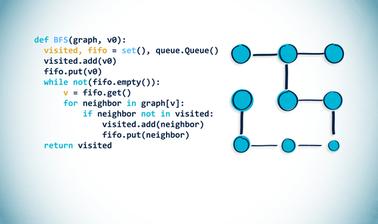
Strengthen your skills in algorithmics and graph theory, and gain experience in programming in Python along the way. Algorithmics and programming are fundamental skills for engineering students, data scientists and analysts, computer hobbyists or developers. Learning how to program algorithms can be tedious if you aren’t given an opportunity to immediately practice what you learn. In this course, you won't just focus on theory or study a simple catalog of methods, procedures, and concepts. Instead, you’ll be given a challenge wherein you'll be asked to beat an algorithm we’ve written for you by coming up with your own clever solution.

Sep 4th 2023
5-12 Weeks
Data Structures & Algorithms IV: Pattern Matching, Dijkstra’s, MST, and Dynamic Programming Algorithms (edX) EdX
Georgia Institute of Technology,GTx

Data Structures & Algorithms IV: Pattern Matching, Dijkstra’s, MST, and Dynamic Programming Algorithms (edX)

Delve into Pattern Matching algorithms from KMP to Rabin-Karp. Tackle essential algorithms that traverse the graph data structure like Dijkstra’s Shortest Path. Study algorithms that construct a Minimum Spanning Tree (MST) from a graph. Explore Dynamic Programming algorithms. Use the course visualization tool to understand the algorithms and their performance.

Self Paced
Self-Paced
Signals and Systems, Part 2 (edX) EdX
IIT Bombay,IITBombayX

Signals and Systems, Part 2 (edX)

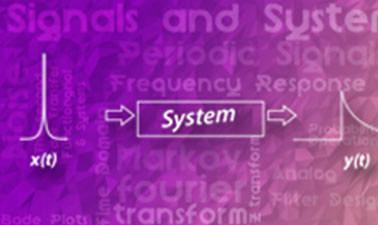
This course provides the basic toolkit for any signal processing application - the abstraction of signals and systems, from the point of view of analysis and characterisation. We encounter signals and systems extensively in our day-to-day lives, from making a phone call, listening to a song, editing photos, manipulating audio files, using speech recognition softwares like Siri and Google now, to taking EEGs, ECGs and X-Ray images. Each of these involves gathering, storing, transmitting and processing information from the physical world. This course will equip you to deal with these tasks efficiently by learning the basic mathematical framework of signals and systems.

No sessions available
5-12 Weeks
Signals and Systems, Part 1 (edX) EdX
IIT Bombay,IITBombayX

Signals and Systems, Part 1 (edX)

This course provides the basic toolkit for any signal processing application - the abstraction of signals and systems, from the point of view of analysis and characterization. We encounter signals and systems extensively in our day-to-day lives, from making a phone call, listening to a song, editing photos, manipulating audio files, using speech recognition softwares like Siri and Google now, to taking EEGs, ECGs and X-Ray images.

No sessions available
5-12 Weeks
GIS Image Analysis in ArcGIS Pro (edX) EdX
University of Alaska Fairbanks,AlaskaX

GIS Image Analysis in ArcGIS Pro (edX)

Learn fundamentals of remote sensing, image analysis, image processing and its application on real-world problems such as vegetation health, wildfire severity, and flooding. Image analysis is extraction of meaningful information from an image to accomplish a simple task like understanding the landscape or to solve a complex problem like face recognition.

Self Paced
Self-Paced
CS50's Introduction to Computer Science (edX) EdX
HarvardX,Harvard University

CS50's Introduction to Computer Science (edX)

An introduction to the intellectual enterprises of computer science and the art of programming. This is CS50, Harvard University's introduction to the intellectual enterprises of computer science and the art of programming for majors and non-majors alike, with or without prior programming experience. An entry-level course taught by David J. Malan, CS50 teaches students how to think algorithmically and solve problems efficiently.

Self Paced
Self-Paced