Skepticism (Coursera)

Skepticism (Coursera)

Skepticism is about doubt, and doubt is everywhere in the world around us today. There are doubts about whether man-made climate change is real, whether vaccinations are harmful, whether we can trust our politicians or our media, and so on. When is such skepticism warranted, and when does it stray into unreasonable territory? How widespread can such skepticism get while still being coherent? How might a radical skepticism have pernicious social consequences, such as by leading to relativism (and just what is relativism, and what is problematic about it)?

Class Deals by MOOC List - Click here and see Coursera's Active Discounts, Deals, and Promo Codes.

These are all questions that we will be engaging with in this course Along the way we will consider some important philosophical issues, such as what the nature of knowledge is, whether there are any good arguments that show that knowledge is impossible, and how a moderate skepticism might accord with an ancient conception of the good life of human flourishing, one that essentially involves the intellectual virtues.
This course is aimed at anyone who is interested in learning more about philosophy, along with those who are looking for strategies to combat extremism in their communities. Using these approaches, no matter what your skill levels in topics you would like to master, you can change your thinking and change your life.
What You Will Learn

  • Explore the concept of Skepticism
  • Discuss the role of Skepticism in contemporary society
  • Identify common responses to Skepticism
  • Compare/Contrast various forms of Skepticism
  • Apply knowledge of Skepticism to form a personal stance
  • Recognize why knowledge is more than just true belief

Syllabus

WEEK 1
What is Skepticism?
We will begin this course by exploring the nature of Skepticism through an investigation of foundational concepts of truth and knowledge. We'll also discuss how current issues in public debate (climate change denial, fake news etc) trade on Skepticism; but how a moderate skepticism can also be a force for good.

WEEK 2
Is Knowledge Impossible?
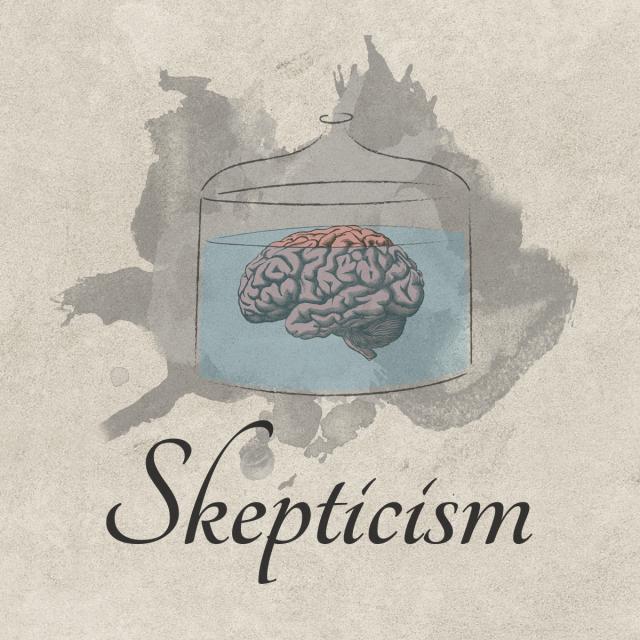
How does one know that we are not a Brain-in-a-Vat? And how can we know that we are or are not? In this module will explore what kinds of things can, and cannot, motivate skeptical doubt. We will also review the radical skeptical hypotheses, and why we can’t rule it out. We'll conclude by discussing the radical skeptical paradox.

WEEK 3
Defending Knowledge
So how does one respond to radical skepticism? In this module we will discuss strategies for responding to the idea that knowledge is impossible. We will also examine the contributions of the Austrian philosopher Ludwig Wittgenstein on the possibility of global rational evaluation.

WEEK 4
Skepticism as a Way of Life
What does Skepticism have to do with "the good life"? In this module we will learn from Aristotle, an Ancient philosopher that believed that the good life is a life of virtue. We will explore how intellectual vices and virtues go hand-in-hand with moderate Skepticism.

Go to Class
MOOC List is learner-supported. When you buy through links on our site, we may earn an affiliate commission.

Related Courses

Philosophy and the Sciences: Introduction to the Philosophy of Physical Sciences (Coursera) Coursera
University of Edinburgh

Philosophy and the Sciences: Introduction to the Philosophy of Physical Sciences (Coursera)

What is the origin of our universe? What are dark matter and dark energy? This is the first part of the course 'Philosophy and the Sciences', dedicated to Philosophy of the Physical Sciences. Scientific research across the physical sciences has raised pressing questions for philosophers. The goal of this course is to introduce you to some of the main areas and topics at the key juncture between philosophy and the physical sciences.

Jun 1st 2026
4 Weeks
On Strategy : What Managers Can Learn from Philosophy - PART 1 (Coursera) Coursera
CentraleSupélec

On Strategy : What Managers Can Learn from Philosophy - PART 1 (Coursera)

In the expression “creative thinking”, the keyword is not creativity; the keyword is thinking. With the help of great philosophers, you will rediscover the art of thinking. To help leaders to be rigorous even without figures, great philosophers have lots of ideas. Managers are invited to rediscover the art of thinking. They should understand the role of mental models, realize the importance of cognitive bias, agree on clear definitions and efficient criteria etc. Creativity demands the ability to unshackle ourselves from conventional ways of thinking, to "think outside the box".

Jun 1st 2026
5-12 Weeks
Re-imaging God in Korean Context (Coursera) Coursera
Yonsei University

Re-imaging God in Korean Context (Coursera)

This course will be an overview of a development of the theological methods in relation to Korea’s cultural context. Completing the course, the learners can understand cultural influences on the dynamic development of Korean churches and indigenous theology; they can also gain an insight into their own image of God and theological imagination in their own cultural context.

May 25th 2026
5-12 Weeks
The Modern and the Postmodern (Part 2) (Coursera) Coursera
Wesleyan University

The Modern and the Postmodern (Part 2) (Coursera)

This course examines how the idea of "the modern" develops at the end of the 18th century in European philosophy and literature, and how being modern (or progressive, or hip) became one of the crucial criteria for understanding and evaluating cultural change. Are we still in modernity, or have we moved beyond the modern to the postmodern?

May 18th 2026
5-12 Weeks
Evaluating Problems (Coursera) Coursera
Macquarie University

Evaluating Problems (Coursera)

The second course of the specialization EVALUATING PROBLEMS will show you how humans think and how to utilize different disciplinary approaches to tackle problems more effectively. It advances your knowledge of your own field by teaching you to look at it in new ways. EVALUATING PROBLEMS is constructed in the following way: Week I. “Thinking about Thinking” – How problem solving evolved in nature, how the mechanics of our brains work, and the psychological biases that can emerge when we think. Week II. “Philosophy, Science, and Problem Solving” – How humans have historically approached problem solving, from ancient times to the present. Week III. “Approaching Problems in the Natural Sciences” – How people in the natural sciences deconstruct problems. Week IV. “Statistics and Problem Solving” – How statistics can be used to evaluate problems and think critically. Week V. “Approaching Problems in the Humanities” – How people in the social sciences and humanities deconstruct problems. Week VI. “Evaluating the Anthropocene” – How to evaluate the problems of the Anthropocene.

Jan 13th 2025
5-12 Weeks
Philosophy, Science and Religion: Science and Philosophy (Coursera) Coursera
University of Edinburgh

Philosophy, Science and Religion: Science and Philosophy (Coursera)

Philosophy, Science and Religion mark three of the most fundamental modes of thinking about the world and our place in it. Are these modes incompatible? Put another way: is the intellectually responsible thing to do to ‘pick sides’ and identify with one of these approaches at the exclusion of others? Or, are they complementary or mutually supportive? As is typical of questions of such magnitude, the devil is in the details. For example, it is important to work out what is really distinctive about each of these ways of inquiring about the world. In order to gain some clarity here, we’ll be investigating what some of the current leading thinkers in philosophy, science and religion are actually doing.

Jun 1st 2026
5-12 Weeks
Intellectual Humility: Practice (Coursera) Coursera
University of Edinburgh

Intellectual Humility: Practice (Coursera)

We live in a polarised world where all too often people talk past each other. But do you know when to believe what others say? For example, how quick should we be to accept something that someone else tells us is true, and what should we be looking out for when assessing a person's trustworthiness? Meanwhile, what should we do when we encounter disagreements with people who seem to be our equals? How and when should we adjust our beliefs, and how does the appropriate response vary depending on the evidence? These challenges may be especially important in the arena of religious disagreements. How should we weigh the evidence for and against various theistic and atheistic stances?

Jun 1st 2026
4 Weeks
Foundations of Teaching for Learning: Being a Professional (Coursera) Coursera
Commonwealth Education Trust

Foundations of Teaching for Learning: Being a Professional (Coursera)

The Foundations of Teaching for Learning programme is for anyone who is teaching, or who would like to teach, in any subject and any context - be it at school, at home or in the workplace. With dynamic lessons taught by established and respected professionals from across the Commonwealth, this eight course programme will see you develop and strengthen your skills in teaching, professionalism, assessment, and more. As you carry on through the programme, you will find yourself strengthening not only your skills, but your connection with colleagues across the globe. A professional development opportunity not to be missed.

Jun 1st 2026
5-12 Weeks
Reason and Persuasion: Thinking Through Three Dialogues By Plato (Coursera) Coursera
National University of Singapore

Reason and Persuasion: Thinking Through Three Dialogues By Plato (Coursera)

In this course we will study Plato's ancient art of blowing up your beliefs as you go, to make sure they're built to last. We spend six weeks studying three Platonic dialogues, then two more weeks pondering a pair of footnotes to Plato; that is, we will consider some contemporary manifestations of issues Plato discusses. Our focus will be: moral theory and moral psychology.

Jan 6th 2025
5-12 Weeks
Setting Expectations & Assessing Performance Issues (Coursera) Coursera
University of California, Davis

Setting Expectations & Assessing Performance Issues (Coursera)

If you don’t know where you are going, any road will take you there. One of the most important roles of a manager is to ensure everyone knows the destination. The most effective managers set expectations and assess their employees’ performance against those expectations, and take a coaching approach to helping them get to the destination. That’s exactly what you’ll learn to do in this course! You will explore how to collaboratively develop expectations with those you lead. When you encounter expectations that are not being met, you’ll learn how to use "Coaching Algebra" to determine the underlying issues that are impeding performance, and how to respond as a manger-coach.

Jun 1st 2026
4 Weeks
Principles of Secure Coding (Coursera) Coursera
University of California, Davis

Principles of Secure Coding (Coursera)

This course introduces you to the principles of secure programming. It begins by discussing the philosophy and principles of secure programming, and then presenting robust programming and the relationship between it and secure programming. We'll go through a detailed example of writing robust code and we'll see many common programming problems and show their connection to writing robust, secure programs in general.

Jun 1st 2026
4 Weeks