Silicon Thin Film Solar Cells (Coursera)

Offered by École Polytechnique,
Silicon Thin Film Solar Cells (Coursera)

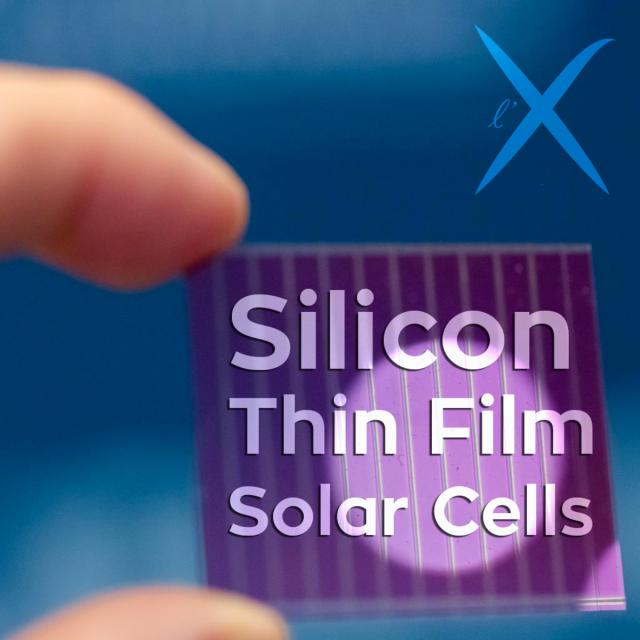
This course consists of a general presentation of solar cells based on silicon thin films. It is the third MOOC of the photovoltaic series of Ecole polytechnique on Coursera. The general aspects of the photovoltaic field are treated in "Photovoltaic Solar Energy". And the detailed description of the crystalline silicon solar cells can be found in "Physics of Silicon Solar Cells".

Class Deals by MOOC List - Click here and see Coursera's Active Discounts, Deals, and Promo Codes.

After a brief presentation of solar cells operation, thin film semiconductors are described here. The general properties of disordered and crystalline semiconductors are found very different, in particular in terms of band structure and doping mechanisms. Silicon thin films, generally less than 1 µm thick, are deposited from silane plasma leading to hydrogen incorporation. The growth mechanisms are discussed, in particular the capability to prepare partially crystallized thin films which appear as a mixture of nanocrystallites embedded in an amorphous tissue.
The consequences of the semiconductor properties on solar cells behavior are reviewed. The optical properties of amorphous and nanocrystalline silicon are complementary. Thus the plasma process is particularly well adapted to the preparation of multijunctions, with conversion efficiencies around 13-15 %. Furthermore plasma processes allow to prepare solar cells in large area on glass or flexible substrates.
Finally, it is shown that crystalline and amorphous silicon materials can be combine into heterojunctions solar cells with high efficiency conversion (about 25 %).
What You Will Learn

  • Solar Energy
  • Nanotechnology
  • Semiconductor Materials
  • Thin Films

Syllabus

WEEK 1
Solar Cell Operation
A description of the energetic source, the solar Spectrum, followed by the general principle of operation of solar cells based on semiconductor materials

WEEK 2
Thin Film Semiconductors
A general description of the properties of disordered semiconductors followed by a presentation of the most extensively used materials : hydrogenated amorphous silicon.

WEEK 3
Silicon Thin Film Solar Cells
A general review of silicon thin film solar cells and multijunctions followed by heterojunctions combining crystalline and amorphous silicon


Go to Class
MOOC List is learner-supported. When you buy through links on our site, we may earn an affiliate commission.

Related Courses

The ABC of sustainability (Coursera) Coursera
Campus BBVA

The ABC of sustainability (Coursera)

The sustainability agenda is currently key to companies, governments and citizens. It’s vital for people to have first-hand knowledge of the basic concepts in order to understand all issues related to sustainability as a vector of systemic change in the economy, society, companies and our lives. The course is an introduction to sustainability, regarded as a cross-cutting discipline in our society (in the public and private international spheres) that’s based on the most updated public information on economic, social and environmental issues.

Aug 17th 2026
4 Weeks
Sustainable Food Production Through Livestock Health Management (Coursera) Coursera
University of Illinois at Urbana-Champaign

Sustainable Food Production Through Livestock Health Management (Coursera)

Learn about the impact of infectious disease on sustainable animal-based food production by understanding the science of growth, immunity, and infection and by learning the problem-solving skills needed to advance animal health and food production through optimal management practices. In this course we will explore the effect of infectious disease on sustainable animal-based food production. The content and learning outcomes of this new course will be designed to be relevant across different food production sectors (i.e., beef, dairy, poultry, and pigs).

Aug 10th 2026
5-12 Weeks
Our Earth's Future (Coursera) Coursera
American Museum of Natural History

Our Earth's Future (Coursera)

Our Earth’s Future is about the science of climate change and how to talk about it. You will learn from scientists in the fields of climatology, oceanography, Earth science, and anthropology who study how climate change is affecting people, populations, and ways of life. Explore the multiple lines of evidence for the human-induced climate change that is happening today, and consider what that means for the future of our planet. At the end of this course you will be able to understand key scientific principles, identify and address misconceptions, and contribute confidently to conversations about climate change.

Aug 10th 2026
5-12 Weeks
Nanotechnology and Nanosensors, Part 1 (Coursera) Coursera
Technion - Israel Institute of Technology

Nanotechnology and Nanosensors, Part 1 (Coursera)

Nanotechnology and nanosensors are broad, interdisciplinary areas that encompass (bio)chemistry, physics, biology, materials science, electrical engineering and more. The present course will provide a survey on some of the fundamental principles behind nanotechnology and nanomaterials and their vital role in novel sensing properties and applications. The course will discuss interesting interdisciplinary scientific and engineering knowledge at the nanoscale to understand fundamental physical differences at the nanosensors.

Aug 10th 2026
5-12 Weeks
Ecosystem Services: a Method for Sustainable Development (Coursera) Coursera
University of Geneva

Ecosystem Services: a Method for Sustainable Development (Coursera)

Ecosystem services are a way of thinking about – and evaluating – the goods and services provided by nature that contribute to the well-being of humans. This MOOC will cover scientific (technical), economic, and socio-political dimensions of the concept through a mix of theory, case-studies, interviews with specialists and a serious-game.

Aug 10th 2026
5-12 Weeks
Management of Urban Infrastructures – part 1 (Coursera) Coursera
École Polytechnique Fédérale de Lausanne

Management of Urban Infrastructures – part 1 (Coursera)

Sustainability, Resilience and Efficiency are fundamental considerations for city managers in managing urban infrastructures. Today, more than 3.9 billion people, making up more than 54% of the global population, live in cities. Urbanization is expected to continue in the coming years, raising the urban population to 6.0 billion by 2045. This dramatic increase in urban populations will inevitably increase the demand for energy, mobility (transportation), water, and other urban services in every city around the world. Without functional governance and management structures that ensure efficient, resilient and sustainable performance in cities, the current urbanization growth might become a catastrophic risk threatening the quality of life of the humanity.

Aug 17th 2026
5-12 Weeks
Perspectives in Digital Transformation: Agribusiness (Coursera) Coursera
Inter-American Development Bank - IDB

Perspectives in Digital Transformation: Agribusiness (Coursera)

In this course, you will be learn how to apply the best practices that have been tested by global companies to make the most of the potentialities of digital transformation and its application to your business. Discover what the level of digital maturity is for your organization by identifying current trends in digital transformation, the use of technologies, and the impact on sustainability in the agribusiness sector in Latin America.

Aug 17th 2026
3 Weeks
Nanotechnology: A Maker’s Course (Coursera) Coursera
Duke University,University of North Carolina,North Carolina State University

Nanotechnology: A Maker’s Course (Coursera)

How can we create nano-structures that are 10,000 times smaller than the diameter of a human hair? How can we “see” at the nano-scale? Through instruction and lab demonstrations, in this course you will obtain a rich understanding of the capabilities of nanotechnology tools, and how to use this equipment for nano-scale fabrication and characterization.

Aug 10th 2026
5-12 Weeks
Wood Science: Beyond Building (Coursera) Coursera
West Virginia University

Wood Science: Beyond Building (Coursera)

The central question of this course: “why study wood?” If “why study wood” is the question, one answer would be that it is the only raw material available to us that is truly renewable in human life span terms. Wood is as important to society today as it ever was, despite the development of many man-made substitute materials, changing resource availability, and the changing needs of society.

Aug 10th 2026
4 Weeks
Climate Change Mitigation in Developing Countries (Coursera) Coursera
University of Cape Town

Climate Change Mitigation in Developing Countries (Coursera)

This course challenges you to consider how one might lift societies out of poverty while also mitigating greenhouse gas emissions. We explore the inherent complexity of developing country governments wanting to grow their economies in a climate friendly way. You will be introduced to an approach with which to address this challenge. The approach consists of a facilitated process whereby academic researchers and high-level influential actors within society co-produce knowledge. You will track this process in four Latin American countries - Brazil, Chile, Colombia, Peru, and South Africa. You will hear from various professionals about their contexts and the different challenges and opportunities the process includes.

Aug 24th 2026
5-12 Weeks
Act on Climate: Steps to Individual, Community, and Political Action (Coursera) Coursera
University of Michigan

Act on Climate: Steps to Individual, Community, and Political Action (Coursera)

Are you concerned about climate change? Would you like to learn how to address and respond to this challenge? If so, this course is for you. Act on Climate: Steps to Individual, Community, and Political Action is intended to help learners understand, address and respond to climate change as individuals and in partnership with their communities and political leaders.

Aug 10th 2026
5-12 Weeks