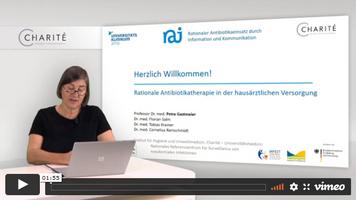
Rationale Antibiotikatherapie in der hausärztlichen Versorgung (mooc house)

Rationale Antibiotikatherapie in der hausärztlichen Versorgung (mooc house)

Dieser Kurs ist im Rahmen eines One-Health-Projektes zum rationalen Antibiotikaeinsatz entstanden. Der 4-wöchige Kurs richtet sich primär an Ärztinnen und Ärzte in der hausärztlichen Versorgung. Nach einer kurzen Einführung erwartet Sie in der ersten Woche unter anderem die Epidemiologie ausgewählter multiresistenter Erreger, sowie Videobeiträge zum ambulanten Antibiotikaverbrauch. In der zweiten Woche werden Grundlagen der Präanalytik und der rationalen Antibiotikatherapie erläutert. Außerdem werden wir einen Blick auf das menschliche Mikrobiom werfen, sowie auf unkomplizierte Harnwegsinfektionen. In der dritten Woche liegt der Schwerpunkt auf den akuten Atemwegsinfektionen (Rhinosinusitis, Tonsillopharyngitis, akute Bronchitis, akute Exazerbation einer COPD & ambulant erworbenen Pneumonie). In der vierten und letzten Woche wird die akute Gastroenteritis und die Reiseassoziierte Diarrhoe vorgestellt werden. Des Weiteren finden sich allgemeine Vorträge zur rationalen Antibiotikaanwendung.

Der Kurs wurde im März 2017 aufgenommen. Er repräsentiert entsprechend den damaligen Wissensstand, wurde aber auf Aktualität überprüft. Aufgrund der sehr positiven Resonanz wird er nun erneut angeboten.

Lernziele des Kurses:

  • Relevanz einer rationalen Antibiotikatherapie im ambulanten Setting sowie One-Health-Aspekte - Kritische Indikationsstellung für den Start einer antibiotischen Therapie
  • Kritische Substanzwahl: "so schmal wie möglich und nur so breit wie nötig"
  • Kritische Wahl der Dauer der Therapie: "so kurz wie möglich und nur so lange wie nötig"

Um den Kurs erfolgreich abzuschließen, sollte man einen Zeitaufwand von 2 Stunden pro Woche einplanen. Eine CME-Zertifizierung wurde bei der Ärztekammer Berlin beantragt.
Für eine CME-zertifizierte Teilnahmebescheinigung (auf der Plattform mooc.house Zeugnis genannt) müssen Sie auf über 90% der Kursunterlagen zugegriffen haben, sowie die Lernerfolgskontrolle mit mind. 70% richtigen Antworten bestanden haben. Darüber hinaus erhält man ein Zertifikat (auf der Plattform mooc.house Teilnahmebestätigung genannt), wenn man auf mind. 90% der Kursinhalte zugegriffen hat.
Bei technischen Schwierigkeiten steht Ihnen der Helpdesk zur Verfügung.
Bei inhaltlichen Fragen können Sie sich gerne an Frau Dr. Sandra Schneider wenden.
Sie können Ihre Fragen auch gerne direkt ins Diskussionsforum stellen.
Der Kurs bietet verschiedene Möglichkeiten zur Interaktion. Sie können mit anderen Kursteilnehmen Kleingruppen gründen oder diesen beitreten um in diesen Gruppen z.B. in eine vertiefende Diskussion einzusteigen.
Finanzierung:
Dieser Fortbildung ist im Rahmen des Konsortiums InfectControl2020 finanziert durch das Förderprogramm Zwanzig20 - Partnerschaft für Innovation des Bundesministeriums für Bildung und Forschung entstanden.
Interessenkonflikte: Es bestehen keine Interessenskonflikte.

Woche 1:

  1. Einführung, Vorstellung des MOOC-Ablaufs (PG)
  2. Technische Einführung (FS)
  3. One Health (PG)
  4. RAI Vorstellung (PG)
  5. Selektion und Transmission (FS)
  6. Epidemiologie ausgewählter Erreger (PG)
  7. Antibiotikaverbrauch 1 (PG)
  8. Antibiotikaverbrauch 2 (PG)

Woche 2:

  1. Das Mikrobiom (PG)
  2. Resistenztestung – wie geht das? (TK)
  3. Was beeinflusst einen bakteriologischen Befund (TK)
  4. Interpretation eines bakteriologischen Befundes (TK)
  5. Rationale Antibiotikatherapie (TK)
  6. Film RAI stationär (TK)
  7. Harnwegsinfektion 1 (TK)
  8. Harnwegsinfektion 2 (TK)

Woche 3:

  1. Rhinosinusitis (CR)
  2. Tonsillopharyngitis (CR)
  3. Akute Bronchitis (CR, FS)
  4. Akut exazerbierte COPD (CR)
  5. CAP (TK)
  6. Prävention CAP (CR)

Woche 4:

  1. Diarrhoe & akute Gastroenteritis (TK)
  2. Das Wissen und die Rationalität des Handelns (FS)
  3. Wege zu einer rationalen AB- Therapie (FS)
  4. Das RAI-Projekt 1 (FS)
  5. Abschluss (PG)
Go to Class
MOOC List is learner-supported. When you buy through links on our site, we may earn an affiliate commission.

Related Courses

In the footsteps of Zika… approaching the unknown (Coursera) Coursera
University of Geneva

In the footsteps of Zika… approaching the unknown (Coursera)

Welcome to this on-demand MOOC “In the footsteps of Zika… approaching the unknown”. This MOOC has been produced by Université de Genève Institut Pasteur, Université Paris Descartes and Centre Virchow-Villermé. With the help of the intervention of faculty members and international experts, we will explore together the recent Zika phenomenon, a previously rare benign virus that recently turned unexpectedly into the limelight when on the 1st of February 2016 it was declared by the WHO as a Public Health Emergency of International Concern.

Jun 1st 2026
5-12 Weeks
Planning a Patient Safety or Quality Improvement Project (Patient Safety III) (Coursera) Coursera
Johns Hopkins University

Planning a Patient Safety or Quality Improvement Project (Patient Safety III) (Coursera)

This course provides students with a set of tools and methodologies to plan and initiate a Problem Solving or Quality Improvement project. The first module presents methods for selecting, scoping and structuring a project before it is even initiated. It also introduces the project classifications of implementation and discovery. The second module describes the A3 problem solving methodology and the tool itself. Further in that same module, the student is shown tools to identify problems in flow, defects, and waste and to discover causes, brainstorm, and prioritize interventions. Module 3 shows a methodology within the implementation class. These methods are designed to overcome emotional and organizational barriers to translating evidence-based interventions into practice. The fourth and last module looks at one more way to approach improvement projects in the discovery class. These tools are specifically for new, out-of-the-box design thinking.

Jun 1st 2026
4 Weeks
Herbal Medicine (Coursera) Coursera
University of Minnesota

Herbal Medicine (Coursera)

There is strong demand for alternatives to pharmaceuticals for a variety of common illnesses due to concerns of safety, efficacy, and a desire for more “natural” products. Despite this growing interest, “conventional” healthcare providers may have little to no knowledge about herbal medicines, which is further compounded by the sometimes misleading information in the media and on the internet. This course provides the necessary background for providers to begin to incorporate herbal medicines into their practice, particularly in regards to their therapeutic properties, efficacy (or lack thereof), and safety concerns, including quality control and potential adverse effects.

Jun 3rd 2026
5-12 Weeks
Ebola: Essential knowledge for health professionals (Coursera) Coursera
University of Amsterdam,Universiteit Utrecht

Ebola: Essential knowledge for health professionals (Coursera)

March 2014 marked the starting point of the largest outbreak of Ebola virus disease in history. Although the disease seems to be on a decrease, we are not there yet and new outbreaks will surely emerge. New efforts to combat the outbreak are necessary. This is why we developed this online course about Ebola, targeted at health professionals across the world. In this course you will cover the fundamental knowledge any health professional should have with expected or confirmed cases or a general interest in the Ebola disease.

Jun 1st 2026
5-12 Weeks
Writing in the Sciences (Coursera) Coursera
Stanford University

Writing in the Sciences (Coursera)

This course teaches scientists to become more effective writers, using practical examples and exercises. Topics include: principles of good writing, tricks for writing faster and with less anxiety, the format of a scientific manuscript, peer review, grant writing, ethical issues in scientific publication, and writing for general audiences.

Jun 1st 2026
5-12 Weeks
Ebola : Vaincre ensemble ! (Coursera) Coursera
University of Geneva

Ebola : Vaincre ensemble ! (Coursera)

Il s’agit d’un MOOC sur la crise internationale sur Ebola partie d’Afrique de l’Ouest en 2014 ; d’une durée de 5 semaines, où interviendront plus de 30 professeurs des universités, chercheurs, responsables politiques, autorités sanitaires nationales et internationales, membres d’ONGs, et autres acteurs d’Europe et d’Afrique sur plus de 60 séquences vidéos. Les thèmes abordés se dérouleront selon une séquence hebdomadaire décrite ci-dessous (section « plan du cours »).

Jun 1st 2026
5-12 Weeks
International Women's Health and Human Rights (Coursera) Coursera
Stanford University

International Women's Health and Human Rights (Coursera)

This course focuses on women’s health and human rights issues from infancy through old age, including information about positive interventions relating to those issues. Learners are encouraged to interact with each other through interactive discussions. It is important to us that this course be available to all learners. We encourage you to apply for Coursera's financial aid (see link to left) if the cost of the course certificate is difficult for you to afford. Please note that you may view all materials in this course, and participate in it, without purchasing a certificate.

Jun 1st 2026
5-12 Weeks
Global Health at the Human-Animal-Ecosystem Interface (Coursera) Coursera
University of Geneva

Global Health at the Human-Animal-Ecosystem Interface (Coursera)

The University of Geneva, Institute Pasteur, University of Montreal and Centre Virchow-Villermé/University Paris Descartes welcome you to this new MOOC on "Global Health at the Human-Animal-Ecosystem Interface"! Over the next 5 weeks, you will explore and learn about some of the major and current Global Health Challenges at the Human-Animal-Ecosystem Interface: zoonotic emerging infections (e.g. Ebola, Nipah, MERS, Avian Influenza), antimicrobial resistance, neglected tropical diseases (e.g. rabies, leishmaniasis, zoonotic TB), snakebite and other human-animal conflicts etc.

Jun 1st 2026
5-12 Weeks
Nutrition and Lifestyle in Pregnancy (Coursera) Coursera
Ludwig-Maximilians-Universität München

Nutrition and Lifestyle in Pregnancy (Coursera)

Nutrition and Lifestyle in Pregnancy offers an overview of the latest research findings and international recommendations on a variety of nutrition-related aspects and outcomes of pregnancy. Ensuring a healthy nutritional status and lifestyle prior to and during pregnancy is one of the best ways to help support the healthy growth and development of the unborn child. We will look at how a healthy diet and lifestyle should ideally be achieved prior to conception and provide recommendations for pre-conception counselling of women.

Jun 1st 2026
4 Weeks