Qualitative and Quantitative Analysis of Disaster Risk (Coursera)

Qualitative and Quantitative Analysis of Disaster Risk (Coursera)

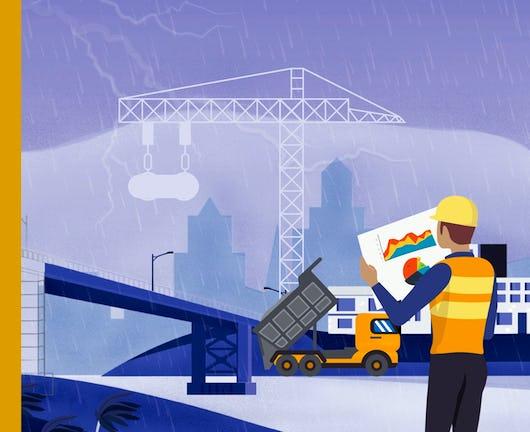
This course will teach you how to identify and analyze the risks of natural disasters in infrastructure projects. You will learn about different types of qualitative and quantitative analysis, as well as the methodologies and tools used to conduct these analyses in order to apply the knowledge. You will review risk models and comprehensive risk management.

Class Deals by MOOC List - Click here and see Coursera's Active Discounts, Deals, and Promo Codes.

Interesting practical exercises will be presented that require the installation of specific software from the Inter-American Development Bank to conduct analyses related to the presented contents.
This course is ideal for individuals interested in risk management, project planning, and climate change. It will also be useful for those working in government, non-governmental organizations, or the private industry.
This course is part of a Specialization. Before starting, we recommend you take Course 1: "Natural Disaster Risk in Infrastructure Projects".

This course is part of the Natural Disaster and Climate Change Risk Assessment Specialization.

What you'll learn

  • Identify key aspects of qualitative and quantitative analysis of natural disaster risks in infrastructure projects.
  • Recognize methodologies and tools that enable qualitative and quantitative analysis of natural disaster risks.
  • Identify cases where qualitative and quantitative analysis of disaster risks is required in infrastructure projects.

Syllabus

Week 1
This course addresses the qualitative and quantitative methodology for disaster risk management in infrastructure projects, using best practices, examples, and case studies. We will explore the importance of both types of analysis and the benefits of complementing one with the other depending on the needs of each situation. Additionally, we will delve into each methodology with recommended tools such as the failure mode identification process, fault trees, and event trees to capture the complexity of system responses.

Week 2

Go to Class
MOOC List is learner-supported. When you buy through links on our site, we may earn an affiliate commission.

Related Courses

Project Execution: Running the Project (Coursera) Coursera
Google

Project Execution: Running the Project (Coursera)

This is the fourth course in the Google Project Management Certificate program. This course will delve into the execution and closing phases of the project life cycle. You will learn what aspects of a project to track and how to track them. You will also learn how to effectively manage and communicate changes, dependencies, and risks. As you explore quality management, you will learn how to measure customer satisfaction and implement continuous improvement and process improvement techniques. Next, you will examine how to prioritize data, how to use data to inform your decision-making, and how to effectively present that data.

Jun 10th 2026
5-12 Weeks
Disaster Risk Management and Korean Policies (Coursera) Coursera
Yonsei University

Disaster Risk Management and Korean Policies (Coursera)

In the past, developing countries such as Korea lacked guidelines for exploring effective policies for disaster-resilient growth, resulting in unnecessary sacrifices in terms of time, resources, and human capital. Through the lessons learned by Korea, currently developing countries facing socio-economic development can build disaster resilience without sacrifices.

Jun 8th 2026
5-12 Weeks
Positive Psychology: Resilience Skills (Coursera) Coursera
University of Pennsylvania

Positive Psychology: Resilience Skills (Coursera)

Learn how to incorporate resilience interventions into your personal and professional life with Dr. Karen Reivich. In this course, you are exposed to the foundational research in resilience, including protective factors such as mental agility and optimism. Several types of resilience interventions are explored including cognitive strategies; strategies to manage anxiety and increase positive emotions such as gratitude; and a critical relationship enhancement skill.

Jun 8th 2026
4 Weeks
Introduction to Cyber Attacks (Coursera) Coursera
New York University

Introduction to Cyber Attacks (Coursera)

This course provides learners with a baseline understanding of common cyber security threats, vulnerabilities, and risks. An overview of how basic cyber attacks are constructed and applied to real systems is also included. Examples include simple Unix kernel hacks, Internet worms, and Trojan horses in software utilities. Network attacks such as distributed denial of service (DDOS) and botnet- attacks are also described and illustrated using real examples from the past couple of decades.

Jun 8th 2026
4 Weeks
Resilience & Leadership: Tools, Methods, & Applications (Coursera) Coursera
University of Colorado Boulder

Resilience & Leadership: Tools, Methods, & Applications (Coursera)

Resilience & Leadership: Tools, Methods, & Applications is the second course of the ‘Resilience Engineering and Leadership in Crisis’ specialization. This course offers tools and methods for applying the concepts from the Course 1 (Resilience & Leadership: Concepts, Definitions, & Frameworks) to various applications and disaster scenarios. Systems thinking, crisis management lifecycle, and organizational strategy are presented to help cultivate and strengthen crisis leadership and communication skills. Learners will assess the resilience of a complex system and create a crisis management plan.

Jun 9th 2026
5-12 Weeks
Life After COVID-19: Get Ready for our Post-Pandemic Future (Coursera) Coursera
Institute for the Future

Life After COVID-19: Get Ready for our Post-Pandemic Future (Coursera)

The pandemic will create long-lasting and surprising ripple effects, even after vaccines are widely available. Are you ready for what's next? This course will give you a clear forecast of the challenges and opportunities you’re most likely to encounter over the next 3-5 years, as a direct result of the ongoing COVID-19 pandemic. Find out what risks still lie ahead; Make a plan for resilience; Play future forecasting games to stretch your imagination about what's possible; Build your post-pandemic confidence; Envision the world you want to live in when we’re all finally on the other side of COVID-19. How can you take advantage of this unprecedented moment of disruption to make positive change in your community, company or other organization?

Jun 8th 2026
4 Weeks
Renewable Energy Futures (Coursera) Coursera
University of Colorado Boulder

Renewable Energy Futures (Coursera)

Renewable energy's future is bright, yet uncertain. Will it continue to grow rapidly? Is current growth sufficient to achieve climate stabilization? How do related technologies, like electric vehicles and heat pumps, fit in? This course will shed light on the many confusing and at-times inconsistent claims and predictions for renewable energy.

Jun 8th 2026
5-12 Weeks
Climate Change, Sustainability, and Global Public Health (Coursera) Coursera
University of Michigan

Climate Change, Sustainability, and Global Public Health (Coursera)

The third course of the Impacts of the Environment on Global Public Health specialization will introduce you to two major environmental health challenges facing the world today. The first is climate change –the preeminent threat to public health today, and a threat that will impact every human and ecosystem on the planet.

Jun 8th 2026
4 Weeks
Introduction to Risk Management (Coursera) Coursera
New York Institute of Finance

Introduction to Risk Management (Coursera)

What is risk? Why do firms manage risk? In this course, you will be introduced to the different types of business and financial risks, their sources, and best practice methods for measuring risk. This course will help you gauge different risk types and set risk limits, describe the key factors that drive each type of risk, and identify the steps needed to choose probability distributions to estimate risk.

Jun 8th 2026
5-12 Weeks
Credit Risk Management: Frameworks and Strategies (Coursera) Coursera
New York Institute of Finance

Credit Risk Management: Frameworks and Strategies (Coursera)

In this course, you will use business and industry analysis to understand companies, projects, business models, and financing proposals. You will then prepare qualitative risk analysis for specific companies to use as the basis for financial analysis, project analysis, and risk decisions. Lastly, you will understand how to use financial ratios and financial metrics to evaluate a company or project’s profitability, balance sheet, capital structure, and cash flow to assess overall financial performance and risk profile.

Jun 8th 2026
5-12 Weeks
Adaptability and Resiliency (Coursera) Coursera
University of California, Davis

Adaptability and Resiliency (Coursera)

To survive in today’s constantly changing business landscape requires being comfortable in uncertainty. Adaptability is what allows people and businesses to solve problems, overcome challenges and move back from the edge of attrition to the more stable ground of relevance. Adaptability is everything. — Jeff Boss, Forbes. Adaptability refers to your ability change your actions, course, or approach in order to suit different conditions or environments. Adaptability implies a sense of personal choice, of purposefully navigating—rather than being driven by—changing circumstances. Resilience is the capacity to recover quickly from difficulties. Resilience gives you the ability to bounce forward with new insights and learning you can carry into the future.

Jun 8th 2026
4 Weeks