FUN

Peser l'Univers (FUN)

Offered by Observatoire de Paris,
Peser l'Univers (FUN)

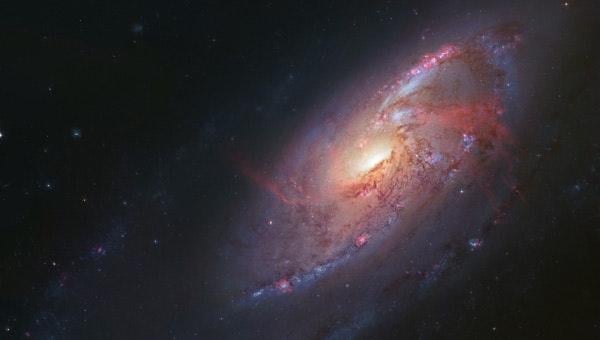
Comment peser l'Univers ? Plus exactement, comment mesurer cette grandeur fondamentale qu'est la masse pour tout objet céleste ? Ce cours a pour objectif de vous initier aux différentes méthodes utilisées par les astrophysiciens pour mesurer la masse. Ces méthodes seront illustrées pour le Système solaire et jusqu'aux galaxies très lointaines. Ce MOOC sera aussi l'occasion d'aborder quelques recherches actuelles en astrophysique en lien avec cette problématique de mesure des masses dans l'Univers. En particulier, nous verrons comment les récentes observations d'ondes gravitationnelles permettent de peser les trous noirs.

Changement du mode du cours : le cours est devenu ouvert en permanence
Caractéristique du cours ouvert en permanence

  • Il n'y aura pas de visio-conférence en hangout
  • Il n'y aura plus d'attestations de réussite avec succès de délivrée
  • Les forums de discussions sont fermés

Format
Le cours dure 7 semaines, chaque semaine est divisée en chapitres. Chaque chapitre est composé de différentes parties, plusieurs parties de cours sous forme de texte ou de vidéo, ensuite une partie nommée Évaluation constituée d’exercices notés comptant pour l’obtention de l’attestation de suivi avec succès, puis éventuellement une partie comportant des exercices optionnels et enfin une partie Discussion où vous pouvez poser vos questions et commentaires et voir ceux des autres pour le chapitre en question.

Plan du cours

Semaine 1 : Introduction et zoologie de l'Univers
Semaine 2 : Les lois de Kepler, histoire et rappels mathématiques
Semaine 3 : Les lois de Kepler, énoncés et démonstrations
Semaine 4 : Peser l'Univers avec la 3ème loi de Kepler
Semaine 5 : Peser les étoiles et le milieu interstellaire
Semaine 6 : Peser l'Univers à grande échelle
Semaine 7 : Peser l'Univers avec les ondes gravitationnelles
Go to Class
MOOC List is learner-supported. When you buy through links on our site, we may earn an affiliate commission.

Related Courses

Introduction to Thermodynamics: Transferring Energy from Here to There (Coursera) Coursera
University of Michigan

Introduction to Thermodynamics: Transferring Energy from Here to There (Coursera)

This course provides an introduction to the most powerful engineering principles you will ever learn - Thermodynamics: the science of transferring energy from one place or form to another place or form. We will introduce the tools you need to analyze energy systems from solar panels, to engines, to insulated coffee mugs. More specifically, we will cover the topics of mass and energy conservation principles; first law analysis of control mass and control volume systems; properties and behavior of pure substances; and applications to thermodynamic systems operating at steady state conditions.

Sep 21st 2026
5-12 Weeks
Basics of Nuclear Magnetic Resonance (FUN) FUN
Université Lille

Basics of Nuclear Magnetic Resonance (FUN)

Nuclear Magnetic Resonance (NMR) phenomenon is currently exploited for many purposes, including medical imaging using the MRI technique as well as the characterization of the structure and the dynamics of matter at atomic scale by NMR spectroscopy, which is a key tool in chemistry, structural biology, pharmacology and material sciences. NMR is also employed for oil exploration or the inspection of artworks. "Basics of Nuclear Magnetic Resonance" is the first course of a comprehensive three-part online learning programme on NMR.

Oct 5th 2021
5-12 Weeks
Physique des objets du quotidien (FUN) FUN
Université de Bordeaux

Physique des objets du quotidien (FUN)

Nous sommes entourés au quotidien d’objets dont la physique est très riche. Une fois cette physique dévoilée, il devient possible d’effectuer des expériences spectaculaires : mesurer la vitesse de la lumière avec un four à micro-ondes, transformer son Smartphone en microscope pour observer des cellules, maîtriser la polarisation de la lumière avec des lunettes 3D ou encore faire des bulles de savon géantes...

No sessions available
5-12 Weeks
Science & Religion 101 (Coursera) Coursera
University of Alberta

Science & Religion 101 (Coursera)

This course examines the nature of both science and religion and attempts to explore the possible relationships between them. The primary purpose is to dispel the popular myth that science and religion are entrenched in a never-ending conflict. As a result, this course argues that if the limits of both science and religion are respected, then their relationship can be complementary.

Sep 28th 2026
5-12 Weeks
Global Warming I: The Science and Modeling of Climate Change (Coursera) Coursera
University of Chicago

Global Warming I: The Science and Modeling of Climate Change (Coursera)

This class describes the science of global warming and the forecast for humans’ impact on Earth’s climate. Intended for an audience without much scientific background but a healthy sense of curiosity, the class brings together insights and perspectives from physics, chemistry, biology, earth and atmospheric sciences, and even some economics—all based on a foundation of simple mathematics (algebra).

Sep 21st 2026
5-12 Weeks
Big History - From the Big Bang until Today (Coursera) Coursera
University of Amsterdam

Big History - From the Big Bang until Today (Coursera)

Welcome to this Big History course! In this course, renowned scientists and scholars from the University of Amsterdam and beyond will take you on a journey from the Big Bang until today while addressing key questions in their fields. After completing this journey you will have developed a better understanding of how you and everything around you became the way they are today.

Sep 28th 2026
4 Weeks
The Discovery of the Higgs Boson (Coursera) Coursera
University of Edinburgh

The Discovery of the Higgs Boson (Coursera)

The discovery of a new fundamental particle at the Large Hadron Collider (LHC), CERN is the latest step in a long quest seeking to answer one of physics’ most enduring questions: why do particles have mass? The experiments’ much anticipated success confirms predictions made decades earlier by Peter Higgs and others, and offers a glimpse into a universe of physics beyond the Standard Model.

Sep 28th 2026
5-12 Weeks
Tesoros de la Física y sus Descubridores I (Coursera) Coursera
Universidad de los Andes

Tesoros de la Física y sus Descubridores I (Coursera)

¿Sabes cómo vuelan los aviones, tan pesados y no se caen mientras vuelan? ¿Sabes que viajamos por el espacio sobre el planeta Tierra que se traslada y gira muy rápido y no lo percibimos? ¿O acaso, notas efectos de su movimiento? ¿Cuál es nuestro lugar en el universo? ¿Podemos viajar en el tiempo? ¡Preguntas, muchas preguntas! Con espíritu de descubridores nuestra curiosidad nos motiva a buscar respuestas, a explorar nuestro entorno, a entrar a lo desconocido y hallar nuevo conocimiento.

Sep 28th 2026
5-12 Weeks
Electrodynamics: An Introduction (Coursera) Coursera
Korea Advanced Institute of Science and Technology - KAIST

Electrodynamics: An Introduction (Coursera)

The depth and breadth of electromagnetism, the foundation for many fields including materials science, electrical engineering, and physical chemistry, requires a long, steep, and steady learning curve. This course aims to bridge the gap between the fundamental principles taught in electromagnetism and its practical application to specific fields such as materials, physics, and chemistry related to energy storage and harvesting.

Sep 28th 2026
5-12 Weeks