FUN

À la recherche d'autres planètes habitables (FUN)

À la recherche d'autres planètes habitables (FUN)

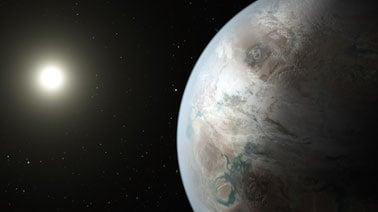
La question de la vie sur d’autres planètes que la Terre est une question fascinante. Nous savons depuis les années 1990 que le système solaire n’est pas unique : il y a des planètes autour de nombreuses autres étoiles. Mais nous n’avons pas encore trouvé d’exo-planète véritablement similaire à la Terre. Au cours de ce MOOC, nous partirons à la recherche d’autres mondes habitables. Le premier chapitre vous plongera dans l’histoire des premières découvertes d’exo-planètes. Vous découvrirez les méthodes pour les détecter, et leur extraordinaire diversité.

Dans un deuxième chapitre, nous étudierons la manière dont les planètes se forment au sein de grands disques de gaz et de poussière autour des étoiles naissantes. Dans le troisième chapitre, nous retracerons les grandes étapes de l’apparition de la vie sur Terre, et vous découvrirez quels diagnostics les astronomes pensent utiliser pour identifier des formes de vie sur une autre planète.

Plan de cours

Semaines 1 & 2 : Détecter d'autres planètes
Semaines 3 & 4 : Former les planètes
Semaines 5 & 6 : Identifier la présence de la vie
Go to Class
MOOC List is learner-supported. When you buy through links on our site, we may earn an affiliate commission.

Related Courses

Space Mission Design and Operations (edX) EdX
École Polytechnique Fédérale de Lausanne,EPFLx

Space Mission Design and Operations (edX)

Learn the concepts used in the design of space missions, manned or unmanned and operations, based on the professional experience of the lecturer. This course builds on university level physics and mechanics to introduce and illustrate orbital dynamics as is applied in the design of space missions. Simple tools will be provided to allow planning of missions on orbit around Earth or in the Solar System. You will learn from the experience of Claude Nicollier, one of the first ESA astronauts, specifically through his involvement in the Shuttle project and his role in the maintenance of the Hubble Space Telescope on two occasions.

Self Paced
Self-Paced
Big History - From the Big Bang until Today (Coursera) Coursera
University of Amsterdam

Big History - From the Big Bang until Today (Coursera)

Welcome to this Big History course! In this course, renowned scientists and scholars from the University of Amsterdam and beyond will take you on a journey from the Big Bang until today while addressing key questions in their fields. After completing this journey you will have developed a better understanding of how you and everything around you became the way they are today.

Aug 3rd 2026
4 Weeks
Origens da Vida no Contexto Cósmico (Coursera) Coursera
Universidade de São Paulo, Brasil

Origens da Vida no Contexto Cósmico (Coursera)

Origens da vida no contexto cósmico é um curso desenvolvido no Instituto de Astronomia, Geofísica e Ciências Atmosféricas da Universidade de São Paulo, com o objetivo de apresentar os mais recentes avanços científicos na compreensão deste intrigante assunto. É um curso com formato multidisciplinar que o levará a compreender melhor os aspectos envolvidos no surgimento de vida na Terra e no possível surgimento de vida em outros planetas.

Aug 3rd 2026
4 Weeks
Atmospheric Chemistry: Planets and Life Beyond Earth (FutureLearn) FutureLearn
University of Leeds

Atmospheric Chemistry: Planets and Life Beyond Earth (FutureLearn)

Learn about the atmospheric chemistry of planets and celestial bodies and explore the possibility of finding life beyond Earth. Discover the extraordinary world of atmospheric chemistry. On this course you will learn about planetary atmospheres across our solar system and beyond. You will discover what an atmosphere is, how it’s formed, and how data collected from space missions is used to determine a planet’s atmosphere.

Self Paced
2 Weeks
Moons (FutureLearn) FutureLearn
The Open University

Moons (FutureLearn)

Explore the many moons of our Solar System. Find out what makes them special and ask whether we send humans to our Moon again. Discover the amazing diversity of moons in our Solar System. There are lots of moons in our Solar System. The Earth is the only planet with just a single moon. Some are bigger than ours. Many are much smaller. Some moons have ongoing volcanic eruptions. Others have rivers of liquid methane. A small handful may even be home to primitive life. This online course will allow you to explore the rich diversity of moons in our Solar System.

Self Paced
5-12 Weeks
Peser l'Univers (FUN) FUN
Observatoire de Paris

Peser l'Univers (FUN)

Comment peser l'Univers ? Plus exactement, comment mesurer cette grandeur fondamentale qu'est la masse pour tout objet céleste ? Ce cours a pour objectif de vous initier aux différentes méthodes utilisées par les astrophysiciens pour mesurer la masse. Ces méthodes seront illustrées pour le Système solaire et jusqu'aux galaxies très lointaines. Ce MOOC sera aussi l'occasion d'aborder quelques recherches actuelles en astrophysique en lien avec cette problématique de mesure des masses dans l'Univers. En particulier, nous verrons comment les récentes observations d'ondes gravitationnelles permettent de peser les trous noirs.

No sessions available
5-12 Weeks
Sustainable Development in the 21st Century with Ban Ki-moon (Coursera) Coursera
Yonsei University

Sustainable Development in the 21st Century with Ban Ki-moon (Coursera)

The course is designed for people that want to learn about the latest development agenda the international community agreed to achieve by 2030. Structured around the five pillars of Agenda 2030 – people, prosperity, planet, peace and justice, and partnership, students will learn that these pillars are interconnected and need to be integrated in practical policy-making and operational activities for development, in both developed and developing country settings.

Aug 3rd 2026
5-12 Weeks