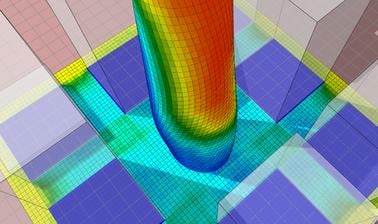
This course focuses on evaluating alternative spatial configurations to support evidence-based decision making. You will learn methods for calculating various spatial performance metrics related to the built environment that can be used for comparative analysis of design options.
Class Deals by MOOC List - Click here and see EdX's Active Discounts, Deals, and Promo Codes.
This course is the last in our “Spatial Computational Thinking” program. This “Performative Modelling” course focuses on evaluating alternative spatial configurations to support evidence-based decision making. You will learn methods for calculating various spatial performance metrics related to the built environment that can be used for comparative analysis of design process.
This course will build on the previous three courses that covered procedural, semantic, and generative modelling. In this course, you will switch modes from generating to evaluating spatial performance. Thus, you will be creating procedures for evaluating alternative spatial configurations with respect to a set of performance indicators. This will once again require an increase in coding complexity, together with a new set of strategies for managing that complexity.
In this course, you will learn how to create your own reusable and customised function libraries. You will use this powerful technique to create a set of generative and performative functions. The generative functions will be used to generate alternative spatial configurations for building designs. The performative functions will be used to evaluate various performance metrics. You will then combine these functions, evaluating each spatial configuration against each performance metric. Finally, you will develop procedures for visualizing and exporting the performance results in order to support decision making.
In the process, you will learn a powerful technique, the ability to import one flowchart into another flowchart and to use it as a function. This allows you to execute larger computational processes with many more procedures hidden inside it.
The modelling exercises and assignments during this course will mainly focus on evaluating alternative spatial configurations for buildings within the urban environment. A site will be selected, and procedures will be developed for calculating performance metrics using morphological and raytracing analysis methods. The morphological analysis includes plot ratio, compacity ratio, passive zone proportion, etc, while the raytracing analysis includes sky view factor, sun exposure factor, viewsheds, etc. The various metrics will then be weighted and aggregated, in order to allow alternative options to be easily compared.
Completing the four courses that make up the “Spatial Computational Thinking” program will provide you with the fundamental knowledge and skills required to tackle a wide variety computational design challenges using digital technologies.
This course is part of the Spatial Computational Thinking Professional Certificate.
What you'll learn
Learning algorithmic thinking:
- How to evaluate alternative spatial configurations using morphological attributes and performance indicators
- Use abstraction as a way of selectively exposing the parameters that are most relevant to the problem being investigated
- Use encapsulation as a way of managing problem complexity
Learning performative modelling:
- Analysing performance indicators using morphological analysis and raytracing analysis
- Understanding morphological analysis: plot ratio, compacity ratio, passive zone proportion, etc
- Understanding raytracing analysis: sky view factor, sun exposure factor, viewsheds, etc
- Evaluating alternative spatial configurations based on multiple performance metrics
- Strategies for supporting decision making using weighted performance metrics
- Integrating non-spatial data formats into spatial information modeling workflows
- Strategies for data visualization
Learning coding:
- Understanding how to break down large procedures into a set of smaller functions
- Understanding how to document functions to support reuse
- Understanding how to create and share libraries of functions that can be reused
Learning Möbius Modeller:
- Difference between local and global functions
- Creating flowcharts that can be imported as global functions
- Strategies for implementing with global functions
- Working with the geospatial viewer