EdX

Modeling Climate Change (edX)

Modeling Climate Change (edX)

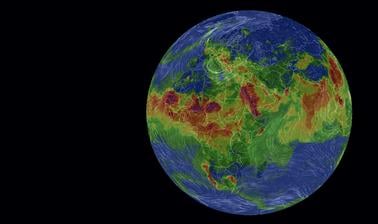
Intended for non-specialists, this course starts with basic principles and builds to more complicated, realistic models of the Earth's climate.
Class Deals by MOOC List - Click here and see EdX's Active Discounts, Deals, and Promo Codes.

Bringing together insights from physics, chemistry, biology, earth and atmospheric sciences -- and even some economics -- this course is geared to curious enthusiasts, allowing them to work with real climate data and simulations of the earth’s changing climate.
This eight-week class takes a quantitative approach to the science of global warming and will enable students to understand the greenhouse effect, the planet's carbon cycle, and how burning fossil fuel affects that cycle; and to evaluate the potential severity of humans’ impact on Earth’s climate.

What you'll learn
Intended for non-specialists, this course starts with basic principles and builds to more complicated, realistic models of the Earth's climate.

Go to Class
MOOC List is learner-supported. When you buy through links on our site, we may earn an affiliate commission.

Related Courses

Sensing Planet Earth - Water and Ice (edX) EdX
Chalmers University of Technology,ChalmersX

Sensing Planet Earth - Water and Ice (edX)

Learn how to measure and monitor the Earth’s water and ice masses to deepen your understanding of global change. Global warming. Rising sea levels. Droughts. Flooding. The melting of the polar ice caps. In this energy and earth science course, you will learn how continental water and ice masses are measured and monitored through remote sensing.

Self Paced
5-12 Weeks
Modeling and Simulation of Multibody Systems - Part I (edX) EdX
LouvainX,Université Catholique de Louvain - UCL

Modeling and Simulation of Multibody Systems - Part I (edX)

Vehicles, bicycles, cranes, human body and robots are multibody systems. Learn how to model them and compute their kinematic and dynamic characteristics, such as velocities, accelerations and forces. This course aims at acquainting you with the modeling and simulation of complex articulated mechanical systems, denoted as multibody systems, such as vehicles, merry-go-rounds, motorbikes, cranes, human bodies, suspensions, robot manipulators, mechanical transmissions, etc.

Self Paced
Self-Paced
Sustainable Aviation: The Route to Climate-Neutral Aviation (edX) EdX
Delft University of Technology,DelftX

Sustainable Aviation: The Route to Climate-Neutral Aviation (edX)

To reduce the environmental footprint of the aviation sector we need to start a clean sky revolution. Discover the latest developments in this field – from airplane design, energy carriers, operations – and learn how you can play a role. Sustainable aviation is a key area for climate action. In this course, we will introduce you to various aircraft technologies, and recent innovations and promising future developments in the field of aviation. All necessary mathematical and engineering concepts will explained.

Self Paced
Self-Paced
Data Science: Inference and Modeling (edX) EdX
HarvardX,Harvard University

Data Science: Inference and Modeling (edX)

Learn inference and modeling, two of the most widely used statistical tools in data analysis. Statistical inference and modeling are indispensable for analyzing data affected by chance, and thus essential for data scientists. In this course, you will learn these key concepts through a motivating case study on election forecasting.

Self Paced
Self-Paced
Why Move Towards Cleaner Power (edX) EdX
Imperial College London,ImperialX

Why Move Towards Cleaner Power (edX)

Learn why we need to clean up our power supply, and why is it urgent that we take action now. Gain the tools you need to present arguments in favour of a cleaner power sector in your part of the world. This course looks at how increasing greenhouse gases are warming the climate and what it means to decarbonise - reduce the greenhouse gas intensity of - the power sector. It will also provide a range of arguments in favour of decarbonisation, including consideration of ease of access to a secure and affordable energy supply and improvements to health and the environment.

Self Paced
Self-Paced
Constraint Programming (edX) EdX
LouvainX,Université Catholique de Louvain - UCL

Constraint Programming (edX)

Learn the basics of constraint programming from the implementation of solvers to modeling techniques for solving concrete combinatorial problems such as routing and scheduling. In this course, we will learn the basics of constraint programming: a paradigm that aims to reduce the cost of developing and solving combinatorial problems through extensive reuse of code, whose design is open-ended, but also through pruning techniques of the search space by reasoning at the level of constraints.

Self Paced
Self-Paced
Statistical Inference and Modeling for High-throughput Experiments (edX) EdX
HarvardX,Harvard University

Statistical Inference and Modeling for High-throughput Experiments (edX)

A focus on the techniques commonly used to perform statistical inference on high throughput data. In this course you’ll learn various statistics topics including multiple testing problem, error rates, error rate controlling procedures, false discovery rates, q-values and exploratory data analysis. We then introduce statistical modeling and how it is applied to high-throughput data. In particular, we will discuss parametric distributions, including binomial, exponential, and gamma, and describe maximum likelihood estimation.

Self Paced
Self-Paced
Introduction to Energy Management Powered by RETScreen (edX) EdX
HECMontrealX,HEC Montréal

Introduction to Energy Management Powered by RETScreen (edX)

The objective of this MOOC is to help organizations combat climate change through effective energy management. It explains proven strategies to reduce greenhouse gases and encourage the transition to a low carbon economy. It also provides an introduction to RETScreen Expert – the world’s leading software to empower cleaner energy decisions.

Self Paced
Self-Paced