"Making" Progress Teach-Out (Coursera)

Offered by Emory University,
"Making" Progress Teach-Out (Coursera)

What is “progress”? How do we decide when we’re moving forward and not taking steps backward? And how do we explore the idea of progress around public sites of memory? This Teach-Out is an invitation to think about what progress means, and how you can look for it wherever you are—in your city, community, or neighborhood—and reflect upon your own ideas about the place you live in.

Class Deals by MOOC List - Click here and see Coursera's Active Discounts, Deals, and Promo Codes.

Changes in the built environment of our communities are themselves the result of human actions and intentions, such as municipal planning, commercial enterprises, or communities transforming their own space. In other words, in our cities we can see the results of our plans—our attempts to create and shape the future. Neighbors, political groups, corporations, governments, schools, and other organizations, they all shape the community, leaving traces that allow us to see in what directions they transformed our lives.
This Teach-Out will ask the following questions:
• What are the forces that shape and change the places we inhabit?
• How do people connect with places in our modern cities?
• Do places progress?
• How can we measure in them whether there is any “progress”?
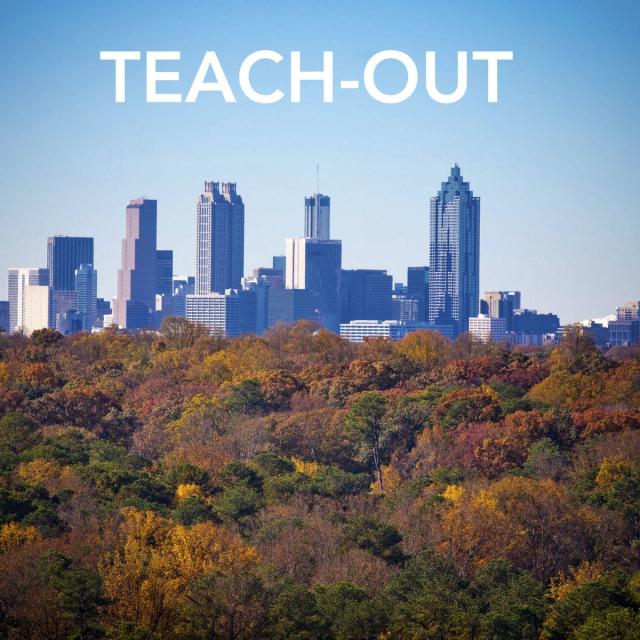
We will interview a number of people who work in Atlanta, Georgia, but the questions and places we will see here are comparable to many of other places in the world on what it means to progress. In this Teach-Out you will learn how to find the history of public spaces in any community and how to reflect upon the idea of progress. Finally, you can join a conversation to discuss what has been explored, uncovered, and possibly transformed both within ourselves and our communities.
A Teach-Out is:
– an event – it takes place over a fixed, short period of time
– an opportunity – it is open for free participation to everyone around the world
– a community – it will be joined by a large number of diverse individuals
– a conversation – an opportunity to give and take ideas and information from people
This community learning event invites participants from around the world to come together in conversation with the Emory campus community, including faculty experts. This Teach-Out is part of Emory’s commitment to engage the local and global community in exploring and understanding problems, events, and phenomena most important to our society.

Go to Class
MOOC List is learner-supported. When you buy through links on our site, we may earn an affiliate commission.

Related Courses

Network Dynamics of Social Behavior (Coursera) Coursera
University of Pennsylvania

Network Dynamics of Social Behavior (Coursera)

How do revolutions emerge without anyone expecting them? How did social norms about same sex marriage change more rapidly than anyone anticipated? Why do some social innovations take off with relative ease, while others struggle for years without spreading? More generally, what are the forces that control the process of social evolution –from the fashions that we wear, to our beliefs about religious tolerance, to our ideas about the process of scientific discovery and the best ways to manage complex research organizations?

Aug 3rd 2026
5-12 Weeks
Anti-Racism I (Coursera) Coursera
University of Colorado Boulder

Anti-Racism I (Coursera)

Anti-Racism I is an introduction to the topic of race and racism in the United States. The primary audience for this course is anyone who is interested in learning about race/racism in the US who has never taken a course in critical race or ethnic studies or affiliated fields (indeed, who may not know what the fields of critical race studies or ethnic studies are), who has never read a book about race/racism, or attended any race equity or diversity trainings on the topic of race/racism.

Aug 3rd 2026
3 Weeks
Climate change and Indigenous People and local communities (Coursera) Coursera
Universitat Autònoma de Barcelona

Climate change and Indigenous People and local communities (Coursera)

Climate change is a global phenomenon, but its impacts vary among different social groups, who perceive and adapt to climate change impacts in different ways. In this course, you will: a) understand the different debates around climate change impacts on Indigenous Peoples and local communities (IPLC); b) familiarize yourself with different impacts of climate change on IPLC, with the IPLC understanding of climate change impacts and with their strategies to adapt to climate change; and c) learn about different strategies to incorporate Indigenous peoples and local communities in climate change research and policy.

Aug 3rd 2026
5-12 Weeks
Civic Engagement in American Democracy (Coursera) Coursera
Duke University

Civic Engagement in American Democracy (Coursera)

So how does the American political system work? Who are some of the key actors? What are key concepts for a student trying to understand what’s going on? How can I as a citizen influence politics? Civic Engagement in American Democracy takes on these and other key questions. We’re Dr. Nicholas Carnes and Dr. Bruce Jentleson, the principal course instructors. Along with our Duke faculty colleagues who also contributed modules, we’ve designed the course to provide a strong foundational introduction to US politics.

Aug 10th 2026
4 Weeks
ADHD: Everyday Strategies for Elementary Students (Coursera) Coursera
University at Buffalo,The State University of New York

ADHD: Everyday Strategies for Elementary Students (Coursera)

This course will provide an overview of ADHD diagnosis and treatment. Course participants can expect to learn about ADHD as a developmental disorder that begins early in childhood, and participants will also learn about evidence-based approaches for diagnosing ADHD. Following that, two evidence-based treatment approaches (the Daily Report Card and Parenting Strategies) will be introduced. (Note these course activities are informational and are not intended to replace working with a licensed/trained professional).

Aug 3rd 2026
4 Weeks
社会调查与研究方法 (上)Methodologies in Social Research (Part I) (Coursera) Coursera
Peking University

社会调查与研究方法 (上)Methodologies in Social Research (Part I) (Coursera)

社会调查与研究方法,首先,是一套观察社会现象、测量社会现象的工具;其次,是一套分析和运用社会现象数据的科学方法;最高境界,则是一套针对社会、经济、教育、政治、法律、管理、公共卫生、新闻报道等人类的生产与生活现象,进行科学沟通的思维逻辑与表达方式。

Aug 10th 2026
5-12 Weeks
Assessing and Improving Community Health (Coursera) Coursera
University of Michigan

Assessing and Improving Community Health (Coursera)

This course is intended to serve as an introduction to population health from both the vantage point of both public health and healthcare. We will examine the key components of community health needs assessments, how they are used, and how to compare population health assessments across subpopulations and time. We will also explore the epidemiological sources and criteria by which to select high quality data sources to estimate population health indicators and to select evidence-based interventions to improve population health. Finally, we will design multi sector collaborations that support the phases of population health improvement.

Aug 3rd 2026
4 Weeks
Quantitative Methods (Coursera) Coursera
University of Amsterdam

Quantitative Methods (Coursera)

Discover the principles of solid scientific methods in the behavioral and social sciences. Join us and learn to separate sloppy science from solid research! This course will cover the fundamental principles of science, some history and philosophy of science, research designs, measurement, sampling and ethics. The course is comparable to a university level introductory course on quantitative research methods in the social sciences, but has a strong focus on research integrity. We will use examples from sociology, political sciences, educational sciences, communication sciences and psychology.

Aug 17th 2026
5-12 Weeks
William Shakespeare's Twelfth Night: Comedy, Conflict, and Community (Coursera) Coursera
University of Colorado Boulder

William Shakespeare's Twelfth Night: Comedy, Conflict, and Community (Coursera)

This course introduces and explores William Shakespeare’s classic comedy, Twelfth Night. Interviews with actors who appeared in the Colorado Shakespeare Festival’s 2019 production of Twelfth Night, as well as lectures by scholars and theater professionals who work and teach at the University of Colorado Boulder, offer students insight into Shakespeare’s artistic vision and its applications.

Aug 17th 2026
5-12 Weeks
Risk in Modern Society (Coursera) Coursera
Leiden University,LDE Centre for Safety and Security

Risk in Modern Society (Coursera)

Risk has become one of the defining features of modern society. Almost daily, we are preoccupied with assessing, discussing, or preventing a wide variety of risks. It is a cornerstone notion for businesses and organizations, but also for nation states and their many levels of government. And even for individuals, risk and the avoidance or embracing thereof, is a key theme. The course Risk in Modern Society sheds light on the broad concept of risk.

Aug 3rd 2026
5-12 Weeks
Arctic Economy (Coursera) Coursera
University of Alberta,UiT The Arctic University of Norway

Arctic Economy (Coursera)

Arctic communities have diverse histories and roles in local, regional and global economies. However, the scope and scale of globalization has increased so quickly that vulnerable Arctic communities are facing new kinds of challenges to their survival. In this 3-week MOOC, a unique collaboration between the University of Alberta and UiT The Arctic University of Norway, you will investigate the challenges faced by Indigenous, North American, Russian and Nordic Arctic communities in a modern world. So join us as we venture above the 60th parallel North, and explore how these fascinating communities adjust to change while maintaining their ways of life, socio-economic histories, and cultural traditions.

Aug 17th 2026
4 Weeks